A great indoor playground can print money on a rainy Saturday and sit half-empty the next Tuesday. The difference between the two is rarely the equipment — it’s the plan behind it. This guide walks you through every section of a fundable indoor playground business plan, with real 2026 startup costs, honest profit margins, the risks most guides skip, and a free template you can download and fill in today.
Why trust this guide? BMI Leisure has built booking, POS, and CRM software for family entertainment centers and indoor play venues for over 25 years across 25+ countries. The cost and profitability ranges below are drawn from public 2025–2026 industry data (sources cited at the end) — not guesses. Replace them with quotes from your own suppliers and local market before you submit your plan.
What Is an Indoor Playground Business Plan (and Why You Need One)
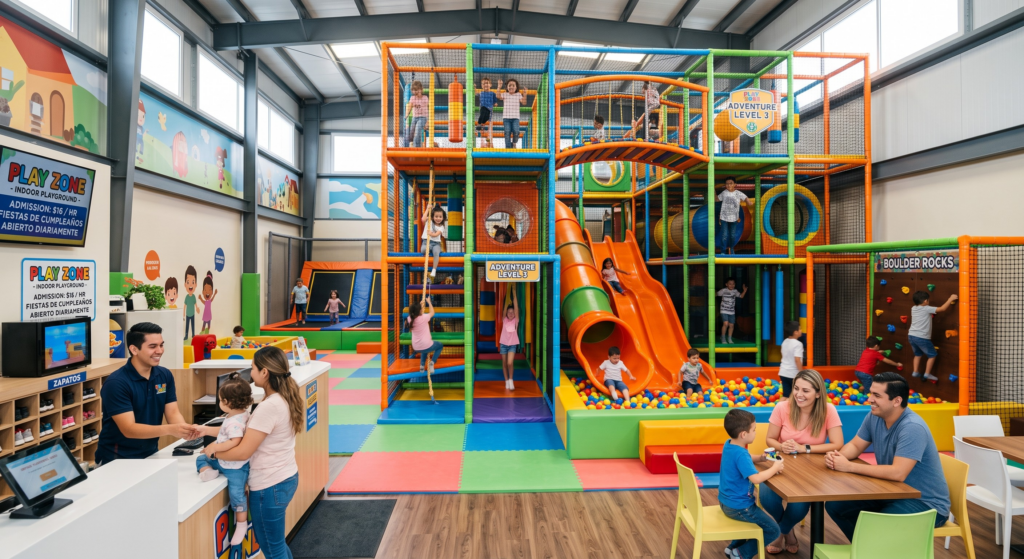
An indoor playground business plan is a written document that defines your concept, your market, your numbers, and your path to profit. It’s part strategy (what you’ll build and for whom) and part financial model (what it costs, what it earns, and when it breaks even). Think of it as the operating manual you write before you sign a lease — while mistakes are still cheap.
You’ll see this document called a few different things depending on where you are — a soft play business plan in the UK, or an indoor play area business plan elsewhere — but it’s the same core document, and the nine sections below apply to all of them.
Who this guide is for (first-time owners vs. investors)
If you’re a first-time owner, the plan is how you stress-test your dream against reality before risking your savings. If you’re pitching investors or a bank, it’s the document they’ll judge you on — they fund plans, not ideas. Either way, the sections are the same; only the emphasis changes. Owners lean on operations and marketing; investors zero in on the financials and the break-even timeline.
How a business plan helps you secure funding
Lenders and investors are pattern-matchers: they’ve seen good plans succeed and vague ones fail. A complete indoor playground business plan proves three things — that real local demand exists, that your numbers are realistic (not optimistic fantasy), and that you understand the risks. Weak or missing financial projections are one of the most common reasons funding applications get rejected. Your plan is quite literally the difference between a “yes” and a “come back when you’re ready.”
Indoor Playground Business Plan Template: The 9 Essential Sections
Every strong indoor playground business plan contains the same nine building blocks. Below is what goes in each — and you can download the free template to fill them in as you read.
1. Executive Summary
The executive summary is a one-page overview of the entire plan, and usually the first thing a lender reads in your indoor playground business plan. Counterintuitively, you write it last, because it distills everything else. Investors often read only this page before deciding whether to keep going, so make it count.
What to include: your concept in one sentence, location and size, target market, the funding you’re requesting, your projected revenue and break-even point, and the single strongest reason your venue will win.
2. Market Analysis & Opportunity Assessment
How to research local demand and demographics
Your market is families with children roughly 0–12 within a 15–20 minute drive. Pull free census data on the number of households with young kids, median household income, and population growth in that radius. A rule of thumb: you want a dense base of young families with disposable income and a shortage of rainy-day options.
Competitor SWOT analysis (and who your real competitors are)
Your competitors aren’t only other playgrounds. They’re trampoline parks, children’s museums, malls, movie theaters — anywhere a parent can burn two hours with a restless five-year-old. List each, then run a quick SWOT (strengths, weaknesses, opportunities, threats). Read their Google reviews: the 1-star complaints are a map of the gaps you can fill.
Identifying your market gap
The opportunity lives in what your area lacks: no clean toddler-only zone, no venue with a real café for parents, no membership option, no weekday morning program. Name the gap explicitly — it becomes the backbone of your USP.
3. Defining Your Target Audience & Ideal Customer
Why “every local parent” is a red flag
If your answer to “who is this for?” is “all local families,” you don’t yet have a plan — you have a wish. Broad targeting produces bland venues and wasted marketing. Investors read “everyone” as “the owner hasn’t done the work.”
Building your ideal customer avatar
Get specific: e.g., “Parents of children 1–6, household income $75k+, within 15 minutes, who value cleanliness and a comfortable place to work or relax while their kids play.” That single sentence decides your zone design, pricing, café quality, and ad targeting.
4. Your Unique Selling Proposition (USP)
Themed zones, services, and what makes you the “go-to”
Your USP is the reason a parent chooses you over the trampoline park down the road. It could be immersive themed zones, strict age-segmented areas so toddlers aren’t trampled, a genuinely good café, spotless sanitation, or a members-first model. Pick one or two things and be unmistakably the best at them — “a bit of everything” is not a USP.
If you’re still gathering indoor playground ideas for your business, this is the section to get creative: study what your local market lacks, then build your differentiator around that gap rather than copying the venue across town.
5. Services & Revenue Streams
Open play, memberships, birthday parties, and café
Diversified revenue is what keeps you alive through slow weeks. The core streams:
- Open play admissions — your volume driver (often 40–60% of revenue).
- Birthday parties & private events — your profit driver; parties can contribute 30–50% of profit at premium margins.
- Memberships & recurring passes — predictable cash flow that smooths seasonality.
- Café / food & beverage — 50–70% margins on drinks and snacks; captive, comfortable parents spend.
- Add-ons — grip socks, retail, camps, and classes.
High-ticket vs. recurring revenue (and the seasonality trap)
Parties are high-ticket but lumpy. Memberships are smaller but recurring. You want both, because indoor playgrounds are seasonal: packed on rainy days and school holidays, quiet on sunny summer afternoons. Build memberships and weekday programs specifically to defend against the slow months — the operators who ignore seasonality run out of cash in July.
6. Indoor Playground Startup Costs & Financial Projections
How much does it cost to start an indoor playground?
The financials are the section that gets your indoor playground business plan approved or rejected, so build them from real quotes. For a mid-sized U.S. venue (roughly 5,000 sq ft), expect total startup costs of $200,000 to $1 million. Compact concepts can start near $50,000, while large, premium facilities exceed $1 million. Play equipment alone typically eats 40–50% of the budget.
Startup cost breakdown
Use this as a framework, then replace every range with real quotes for your space and market:
| Line item | Typical range (USD) | Notes |
|---|---|---|
| Play equipment & installation | $80,000 – $300,000 | 40–50% of budget; certified used gear can cut this 30–50% |
| Buildout / leasehold improvements | $50,000 – $150,000 | Impact flooring, HVAC, restrooms, sound dampening |
| Lease deposit (3–6 months) | $30,000 – $60,000 | Landlords treat play venues as high-risk tenants |
| Licenses, permits & first-year insurance | $7,000 – $15,000 | Liability insurance is non-negotiable |
| Furniture, fixtures & café equipment | $10,000 – $30,000 | Seating, party rooms, kitchen |
| POS / booking / management software | $1,000 – $5,000 setup | Plus monthly fee; see operations section |
| Grand-opening marketing | $5,000 – $20,000 | Pre-launch list building + opening event |
| Working capital (3–6 months) | $50,000 – $150,000 | The buffer that keeps you alive during ramp-up |
| Typical total | $200,000 – $1,000,000+ | Varies by size, location, and finish level |
Payroll and operating expenses
After rent, payroll is your single largest ongoing expense, which is why labor efficiency largely dictates whether you’re profitable. Model realistic staffing ratios (floor supervision, party hosts, café, cleaning), plus rent, utilities, insurance, software, restocking, and maintenance. Impact flooring and equipment wear out — budget for upkeep from day one.
Revenue forecasts and break-even timeline
Indoor playgrounds generate anywhere from roughly $100,000 to over $1 million a year depending on size and execution. Build a conservative 3-year monthly forecast and identify your break-even point. Be honest: most venues take about 2–3 years to reach solid profitability. The number-one reason they fail in year one isn’t a lack of customers — it’s running out of cash during ramp-up. Plan the buffer accordingly.
7. Business Structure, Legal & Compliance
Choosing a legal structure (LLC, sole proprietorship, etc.)
Most indoor playgrounds form an LLC for liability protection — critical in a business where children play on your equipment. Sole proprietorships are simplest but expose your personal assets; corporations suit multi-investor or franchise plans. Confirm the right choice with an accountant and attorney; the tax and liability implications are worth the consult.
Licenses, permits, and insurance
Expect to need a business license, zoning and certificate-of-occupancy approvals, health and fire inspections, and general liability insurance (often $5,000–$15,000/year). Signed liability waivers for every visitor are standard. Build permit timelines into your launch schedule — delays here routinely push back opening dates.
Safety standards and risk management
Safety is both an ethical duty and your best insurance against a business-ending lawsuit. Equipment should meet ASTM safety standards, staff should be trained in first aid/CPR, and you need documented cleaning, sanitation, and incident-reporting procedures. In a post-pandemic market, visible cleanliness is also a marketing advantage.
8. Marketing & Launch Strategy
Pre-launch and grand opening
Start marketing before you open. Build an email/SMS waitlist, run “founding member” pre-sales, and partner with local schools, daycares, and mom groups. A strong grand-opening event with a soft-launch beforehand irons out operational kinks and generates the first wave of reviews.
Ongoing marketing channels
- Google Business Profile + local SEO — most parents find you by searching “indoor playground near me.”
- Reviews — your highest-ROI channel; ask every happy family at pickup.
- Meta (Facebook/Instagram) & local mom groups — where your audience already is.
- Memberships & referrals — turn first visits into recurring revenue.
- Birthday-party promotion — market your highest-margin product hardest.
For a deeper playbook on paid ads that convert clicks into bookings, see our guide on advertising a location-based entertainment venue — the platform tactics translate directly to indoor play.
9. Operations, Technology & Staffing
Management software and booking systems
Your technology stack is not an afterthought — it’s the difference between smooth Saturdays and chaotic ones. You need online booking (open play and parties), a POS for admissions and café, memberships, waiver capture, and a CRM that stores customer data for remarketing. Fragmented tools create double-bookings and lost revenue.
Real-World Results: Solving the Fragmented Software Problem
Theory is great, but execution is what keeps a venue open. The operational bottleneck for most high-volume venues isn’t a lack of customers; it’s a tech stack that doesn’t communicate.
Take Elev8 Fun, a massive, multi-attraction Family Entertainment Center. Their Operations Director, Brian Lopez, recognized early on that scaling a business requires a centralized system.
- The Challenge: In his past experience, venues often ran on disconnected software—one system for food, another for booking, and a separate one for point-of-sale. This lack of communication between systems resulted in bad accounting, operational friction, and increased costs.
- The Solution: Elev8 Fun built their entire operational infrastructure from the ground up using BMI Leisure’s all-in-one platform.
- The Impact: By consolidating their tech stack, they unified their disparate systems, getting them to “talk to each other” and drastically simplifying their daily operations.
“BMI Leisure offers one software solution for everything. It’s a one-stop-shop, which really made it easy… The system can handle everything from A to Z.” – Brian Lopez, Operations Director, Eleven8 Fun.
This is exactly what BMI Leisure is built for: an all-in-one platform combining online booking, POS, memberships, waivers, and CRM for family entertainment centers and indoor play venues. Connecting bookings, payments, and customer data in one system lets you fill quiet weekdays with targeted offers and turn one-time visitors into members. Book a demo to see how it fits your plan.
Don’t Lose Sales — Turn Visitors Into Loyal Customers
Our all-in-one software gives you everything you need to launch and run your indoor playground: online booking, POS, memberships, and CRM working together to convert every visit into revenue.
Get Started with BMI LeisureHiring and training your team
Your staff are the guest experience. Define roles (floor supervisors, party hosts, café, cleaning), realistic ratios for peak times, and a training program covering safety, sanitation, and hospitality. Staff turnover is a real cost in this industry — culture and scheduling matter as much as pay.
Indoor Playground Franchise vs. Independent Business
One of the biggest early decisions is whether to buy into a franchise or build your own brand. Franchises offer a proven system and brand recognition in exchange for fees and control; independents offer freedom and lower cost in exchange for figuring it out yourself.
| Factor | Franchise | Independent |
|---|---|---|
| Upfront cost | Higher — franchise fees $50,000 – $150,000+ on top of buildout | Lower — you control every dollar |
| Brand recognition | Established, instant trust | Built from scratch |
| Systems & support | Proven playbook, training, suppliers | You design your own |
| Creative freedom | Limited — follow the model | Full — your concept, your rules |
| Ongoing fees | Royalties & marketing fees | None |
| Best for | First-timers who want a safety net | Operators with a clear vision and local insight |
Is an Indoor Playground a Good Investment? (Honest Pros & Cons)
Let’s answer the question real prospective owners ask at 2 a.m. — the one all over parenting forums: “Talk me out of starting an indoor playground.” Here’s the honest version.
Profit margins and ROI expectations
The upside is real. The indoor amusement market was around $48.5 billion in 2023 and is projected to reach roughly $90.8 billion by 2030. Well-run venues report net margins of 15–30%, with the highest returns coming from parties and food & beverage. A profitable indoor playground is a genuinely good business — once it’s ramped.
The real risks nobody talks about
- Cash flow, not customers, kills you first. Memberships take months to build; expenses hit on day one. Undercapitalization is the top first-year failure cause.
- Landlords see you as high-risk. Specialized buildouts are hard to remove, so landlords often demand 3–6 months’ deposit — potentially $60,000 just for the keys.
- Payroll and cleaning never stop. Labor is your biggest cost, and sanitation is relentless — sick kids, spills, and constant supervision.
- Seasonality is brutal. Beautiful summer weekends can empty your venue. Without memberships and programs, revenue swings violently.
- It owns your time. This is a hands-on, weekends-and-holidays business. Owner burnout is common and rarely mentioned in the glossy guides.
None of this means don’t do it. It means go in with a buffer, a niche, and realistic numbers — which is exactly what a proper business plan forces you to do.
5 Red Flags That Sink an Indoor Playground Business Plan
- Targeting “everyone.” No defined customer avatar means no focus and wasted marketing.
- Fantasy financials. Optimistic revenue, no cash buffer, break-even in month three — instant credibility loss with lenders.
- Ignoring seasonality. A plan with flat monthly revenue tells investors you don’t understand the business.
- One revenue stream. Relying on open-play admissions alone leaves you fragile; diversify into parties, memberships, and café.
- No operations or tech plan. Great concept, no booking/POS/CRM system, no staffing model — where profits quietly leak away.
Download Your Free Indoor Playground Business Plan Template
All 9 sections, fill-in-the-blank, ready to print or save as PDF for your bank or investor.
Frequently Asked Questions
Everything you need to know about starting and running an indoor playground business.
How much does it cost to start an indoor playground?
Most U.S. indoor playgrounds cost $200,000–$1 million to launch, with compact setups starting near $50,000 and large venues exceeding $1 million. Play equipment (40–50% of the budget) and buildout are the largest line items. Always add 3–6 months of operating capital on top of startup costs.
Is an indoor playground business profitable?
Yes, when managed well. Industry estimates put net margins around 15–30%, with annual revenue from roughly $100,000 to over $1 million. Birthday parties and food & beverage are the highest-margin streams. Most venues reach solid profitability in about 2–3 years.
How do I get funding for an indoor playground?
Common routes are SBA loans, bank business loans, equipment financing, investors, and personal savings. Lenders want a complete business plan with realistic projections, a break-even timeline, and proof of local demand — the plan itself is the biggest factor in approval.
What are the legal requirements?
Typically a business license, a legal entity (often an LLC), zoning/occupancy permits, health and fire inspections, general liability insurance, and signed waivers. Equipment should meet ASTM safety standards, and staff often need background checks and first-aid/CPR training.
What equipment do I need?
Core equipment: a multi-level soft play structure, slides, ball pits, climbing features, a dedicated toddler zone, and impact-rated flooring. Revenue add-ons include ninja courses, trampolines, interactive games, party rooms, and a café. Certified used equipment can cut costs 30–50%.
How to start an indoor playground business with no money?
Start lean: a smaller 1,200–1,800 sq ft space, certified used equipment, a landlord tenant-improvement (TI) allowance, and equipment financing or SBA loans. Many owners begin with pop-up or mobile play events to prove demand before committing to a long lease.
How do indoor playgrounds make money?
Through open-play admissions (40–60% of income), birthday parties and private events (highest margin), memberships and recurring passes, and café/F&B (50–70% margins). Add-ons like grip socks, retail, and camps round out revenue.
Sources
- Financial Models Lab — Indoor Playground Operating Costs (link) & Startup Costs (link). Payroll as top expense, landlord deposits, cash-buffer requirements.
- Startup cost breakdowns & equipment share of budget — Hanlin, SanXiu, Business Plan Suite.
- Profitability & revenue mix (net margins, tickets/parties/F&B) — Hanlin, Financial Models Lab, Inqilaplay.
All figures are industry estimates as of 2026 and vary by size, location, and finish level. Verify with your own supplier quotes and local market data before submitting your plan. Last updated: July 2, 2026.