People will pay good money to put on a helmet and destroy a printer with a baseball bat — and investors have noticed. If you’re researching a rage room franchise, you’ve probably seen investment figures thrown around from $80,000 to $780,000 and profit claims near $200,000 a store. Here’s the full picture: what the leading franchises actually cost, whether rage rooms are truly profitable, how the franchise route compares to going independent, and the safety and operations side nobody covers.
What Is a Rage Room Franchise? (Quick Answer)
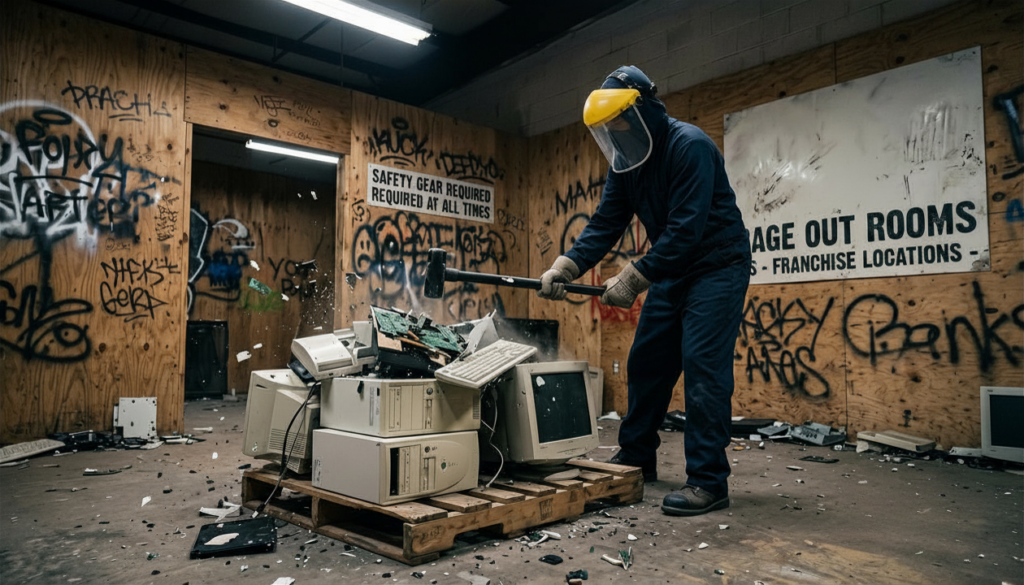
A rage room franchise is a licensed smash-room business — venues where guests pay to safely destroy items like electronics, glass, and furniture in a controlled space. Franchise investments reportedly range from roughly $83,000 to $780,000 depending on the brand, and most locations diversify with add-ons like splatter painting and axe throwing.
Also called smash rooms or anger rooms, these venues sell short, high-intensity sessions: 15–30 minutes, protective gear on, crate of breakables in, stress out. The business model is deceptively simple — the inventory people destroy costs almost nothing (donated electronics, thrift-store dishes), which is exactly why the model attracts entrepreneurs. The real question is whether you need a franchise to run one well.
Are Rage Rooms Profitable? (The Numbers)
Yes — when they’re run as event businesses, not novelty attractions. Industry pricing data puts private sessions at an average of about $48 per person, with group and corporate sessions running $280–$450 per booking. Set that against breakables that cost pennies and you get gross margins most entertainment concepts envy.
The honest caveat — echoed by successful operators in owner forums — is that walk-in traffic alone rarely pays the rent. The money is in corporate team events, parties, and group packages: one $400 corporate booking equals eight individual sessions, arrives on a weekday, and books in advance. Rage rooms also ride demand spikes around breakups, exam seasons, and “divorce parties” — quirky, but real, and smart operators market to them.
How much do rage rooms make a year?
It varies enormously with market size and event mix. Industry reporting on franchised locations cites average net profits approaching $200,000 per store for established operations, while small-market independents may clear far less. The market itself is growing fast: the global rage room venue market was valued around $1.24 billion in 2024 and analysts project roughly 10% annual growth as experiential entertainment and corporate wellness spending expand.
The revenue streams beyond smashing
- Splatter paint rooms — the calm sibling of the smash room; same space logic, family-friendly, birthday-party gold.
- Axe throwing lanes — shares the “controlled danger” audience and the same waiver infrastructure.
- Extra breakable crates — the upsell that prints money: guests mid-session almost always want “one more box.”
- Corporate packages — team building with catering partnerships and private-room hire.
- Merch and recordings — smash-session videos are self-made social ads guests pay you for.
Top Rage Room Franchises Compared (2026)
These are the reported figures for the best-known U.S. rage room franchises. Treat them as directional: franchise economics change yearly, listing sites disagree with each other, and the only numbers that matter are in the brand’s current Franchise Disclosure Document (FDD).
| Franchise | Reported total investment | Reported fees | Known for |
|---|---|---|---|
| iSmash | ~$278,000–$780,000 | Franchise fee ~$42,500–$59,950 (sources vary); 6% royalty; ~$100K liquid capital required | Largest U.S. rage room franchise; multi-activity model (axe throwing, blacklight splatter); national sourcing alliances |
| Smash Room | From ~$82,800 minimum | $35,000 franchise fee; 6% of gross sales royalty | Lowest reported entry point; fee includes initial staff training |
| Simply Smashing | Varies by site | Not publicly listed | On-site feasibility analysis, startup cost projections, weekly mentoring for first 4 months |
| Breakthrough Smash Room | Varies by site | Not publicly listed | Regional operator expanding via franchise; emphasis on therapy-adjacent positioning |
Figures compiled July 2026 from franchise listing sites and FDD analyses (sources below). Request the current FDD directly from each brand before making any decision.
What you get for the franchise fee (and what you don’t)
The fee buys a playbook: site selection help, buildout specs, safety protocols, supplier relationships for breakables and gear, training, and a brand. What it doesn’t buy is the thing franchises usually sell best — customer-pulling brand recognition. Rage rooms are a young industry; no smash brand has the gravitational pull of a McDonald’s or an Anytime Fitness. You’re paying for operational shortcuts, not for a name that fills the calendar by itself. Weigh the fee against that reality.
How Much Does It Cost to Open a Rage Room?
Here’s the franchise-vs-independent cost picture side by side:
| Cost item | Independent | Franchise |
|---|---|---|
| Entry fee | $0 | $35,000–$60,000 |
| Lease deposit & buildout | $15,000–$40,000 | Per brand specs — typically higher finishes |
| Safety gear | $2,000–$5,000 | Included in packages or via approved suppliers |
| Breakables inventory | $500–$2,000 (donations, thrift, recyclers) | Supplier alliances included |
| Insurance (year one) | $3,000–$10,000 | Similar; some brands negotiate group rates |
| Booking software & POS | $1,500–$5,000/year | Sometimes mandated by brand |
| Marketing launch | $3,000–$10,000 | Plus ongoing 0–2% brand fund |
| Typical total | ~$25,000–$80,000 | ~$83,000–$780,000 |
The structural insight: in this business, the product you sell costs almost nothing — people pay you to destroy what others throw away. Your real costs are the space, the safety infrastructure, and the systems that keep sessions flowing. That cost profile is what makes the independent route unusually viable here.
Rage Room Franchise vs. Independent: Which Should You Choose?
| Factor | Franchise | Independent |
|---|---|---|
| Upfront cost | High — fee plus brand-spec buildout | A fraction: ~$25K–$80K typical |
| Brand recognition | Limited — young industry, no household names yet | None, but the gap vs. franchises is small |
| Playbook & training | Proven safety protocols, suppliers, site help | You build it (this guide is a start) |
| Ongoing fees | ~6% royalty + 0–2% marketing fund, forever | None |
| Creative control | Limited — brand rules on pricing, add-ons, design | Total — your themes, your events, your prices |
| Best for | First-time owners who want rails and can fund them | Operators with hospitality/ops experience, tighter budgets, or unique local concepts |
How to Start a Rage Room Business in 7 Steps
- Validate your market. Rage rooms thrive near dense 20–45 populations, offices (corporate events!), and nightlife corridors. Check what’s within 30 minutes — this is still an industry where being first in a metro is possible.
- Choose your model. Franchise or independent (table above). Decide before signing anything — the lease requirements differ.
- Secure and reinforce the space. 1,500–3,000 sq ft works: 2–4 smash rooms, a briefing/gear area, and a lobby. Walls need impact protection, floors need debris-safe surfacing, and ventilation matters more than you think.
- Get insured and build your waiver process. General liability suited to the activity, plus a signed waiver for every single guest — no exceptions, no “they’re with me.” More on this below.
- Set up your breakables pipeline. Partner with e-waste recyclers, thrift stores, offices clearing old equipment, and your own guests (“bring your ex’s stuff” promotions are a marketing classic). Also plan disposal — you’ll generate serious debris.
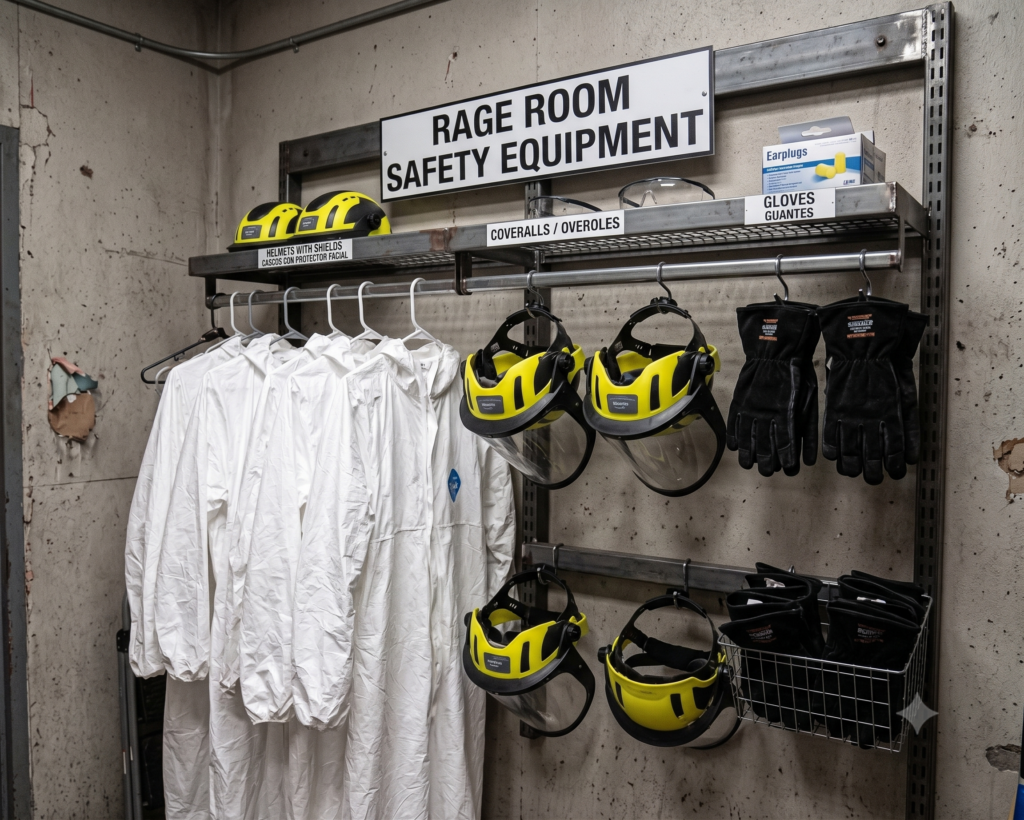
- Gear up. Helmets with face shields, coveralls, cut-resistant gloves, closed-toe shoe policy, and weapon racks (bats, crowbars, sledgehammers). Buy commercial grade; this equipment is your liability shield.
- Launch with online booking from day one. Sessions are time-slotted like karting heats — walk-in-only operations bleed capacity. Price sessions and crates, open your calendar, and let corporate groups book and pay online.
Safety, Insurance, and Waivers: The Part Nobody Talks About
Every rage room guide loves the fun parts — the sledgehammers, the playlists, the plate-smashing photos. Almost none of them tell you the operational truth: you are running a venue where untrained members of the public swing steel at glass. Your safety system isn’t paperwork; it’s the business.
The non-negotiables: full protective gear on every guest, a pre-session safety briefing (recorded or in person, documented), one-guest-per-room-per-weapon rules, staff monitoring via window or camera, a glass-and-debris protocol between sessions, and air circulation that handles dust from shattered electronics.
Why every guest needs a signed waiver before they swing
A liability waiver is your first legal line of defense, and in this industry it’s universal practice — no waiver, no entry, ever. It must be signed by every participant (adults for themselves, guardians for minors), stored retrievably, and matched to the actual person in the room. A binder of paper waivers at the front desk fails all three tests the day you actually need it in a dispute.
Digital waivers: signed at booking, stored automatically
The modern pattern — and one reason it matters that 61.3% of rage room bookings are already made online — is to attach the waiver to the booking itself: guest books a slot, signs digitally on their phone before arriving, and the signed document lives on their customer profile forever. Sessions start on time, no clipboard bottleneck, and your records are complete by default.
Running the Operation: Bookings, Sessions, and Repeat Customers
Operationally, a rage room is closer to a karting track than to a bar: you sell time slots with fixed capacity, gear-up time between groups, and add-ons mid-session. That makes the software stack decisive: real-time online booking so corporate groups can self-serve, waivers integrated into that booking, a POS that sells extra crates in two taps mid-session, and a CRM that remembers which company booked the holiday team event — so you can sell them next year’s before they think of it.
How BMI Leisure powers session-based venues
This is BMI Leisure‘s home ground: for over 25 years we’ve built the booking, POS, waiver, and CRM platform for session-based entertainment venues — karting tracks, family entertainment centers, and activity concepts just like smash rooms. One system runs your calendar, signs and stores every waiver at booking, sells the extra crate at the counter, and turns one-time smashers into repeat corporate accounts. If you’re mapping out the full venture, start with our guide to writing a leisure venue business plan — the structure applies to rage rooms too, right down to the F&B corner your waiting area deserves.
Built for Venues That Sell Sessions
Online booking, digital waivers, POS, and CRM in one platform — so your rage room runs full calendars, signs every waiver before guests arrive, and keeps corporate groups coming back.
Get in Touch with Our TeamFrequently Asked Questions
Are rage rooms a profitable business?
They can be. Private sessions average around $48 and group or corporate events run $280–$450, while the breakables inventory costs almost nothing. The operators who thrive build their revenue on corporate events, parties, and add-ons like splatter painting — not on individual walk-ins alone. Location costs and insurance are the real profit variables.
How much would it cost to make a rage room?
An independent rage room typically costs roughly $20,000–$80,000 to open — lease, room reinforcement, safety gear, insurance, and booking software. Franchises run higher: reported minimums start around $83,000 (Smash Room) up to ~$278,000–$780,000 total for iSmash, per franchise listings. Verify current figures in each brand’s FDD.
Do I need a franchise to open a rage room?
No. It’s a young industry with limited brand recognition, so many successful operators are independent. A franchise buys a playbook, training, and sourcing; independence buys lower costs and full control. With hospitality or operations experience, independent is often the better math.
Do rage rooms need waivers and insurance?
Absolutely — non-negotiable. Every guest signs a liability waiver before entering, and you need general liability insurance suited to guests swinging crowbars at glass. Most venues now collect waivers digitally at online booking, keeping records automatic and lines short.
How much do rage rooms make a year?
It varies with market and event mix. Industry reporting cites average net profits approaching $200,000 per store for established franchised locations; small-market independents earn less. The biggest levers: group bookings, session throughput, and add-on crate sales.
Sources
- SharpSheets — iSmash Franchise FDD, Profits & Costs (investment range, fees). sharpsheets.io
- Franchise Gator — iSMASH Franchise Cost, Fees, Opportunities (2026) (fee, royalty, capital requirements). franchisegator.com
- Dataintelo / Growth Market Reports — Rage Room Venue Market Report (market size ~$1.24B in 2024, growth projections, session pricing, 61.3% online booking share). dataintelo.com
- Smash Room and Simply Smashing figures as reported in Google’s AI Overview of franchise listings, July 2026 — re-verify against each brand’s current FDD before relying on them.
Franchise fees, royalties, and investment ranges change frequently and vary by territory — always request and review the brand’s current Franchise Disclosure Document (FDD) and consult a franchise attorney before investing. This article is general guidance, not financial or legal advice. Last updated: July 13, 2026.