
You open your banking app, scan your recent transactions, and there it is: “POS PURCHASE” followed by a store name you may or may not recognize. If your first reaction was a small jolt of panic — you’re not alone. It’s one of the most searched banking questions there is. The short answer: it’s almost certainly a normal card payment you made in person. Here’s exactly what the POS purchase meaning is, how these transactions work, and what to do in the rare case you truly don’t recognize one.
What Does “POS Purchase” Mean? (Quick Answer)
POS stands for “point of sale.” A POS purchase is a payment you made in person — by tapping, inserting, or swiping your card at a store, restaurant, gas station, or any physical checkout. When “POS” appears on your bank statement, it simply flags that the transaction was a card-present purchase, usually completed with your debit card and PIN.
That’s it. No hidden subscription, no mystery service. The label describes how you paid (at a physical terminal), not what you bought. The scale of this is enormous: Americans made 120.6 billion debit card payments in 2024, and debit cards account for roughly 64% of all card payments, according to the Federal Reserve’s latest payments study. A large share of those show up on statements with exactly this label.
POS purchase on a bank statement: nothing to panic about
Banks use shorthand descriptors because statement fields are short. A typical entry looks like:
POS PURCHASE 07/05 TERMINAL 4482 WALMART #2341 AUSTIN TX
Reading left to right: the transaction type (POS purchase), the date, the terminal or reference number, the merchant, and the location. The merchant name is the part that trips people up — companies sometimes process payments under a parent company or franchise name that doesn’t match the sign on the door. That’s the #1 cause of “I don’t recognize this charge” moments that turn out to be perfectly legitimate.
POS vs. POS Debit vs. “POS CK”: decoding the abbreviations
Different banks use different shorthand for the same family of transactions:
| Statement label | What it means |
|---|---|
| POS / POS PURCHASE | An in-person, card-present payment at a point-of-sale terminal. |
| POS DEBIT / POS DEB | A PIN-based debit card payment. Funds leave your account immediately. |
| POS CK | “Point of sale check(ing)” — a debit purchase drawn directly from your checking account. Functionally the same as a POS debit. |
| DDA POS / DDA PUR | “Demand deposit account purchase” — again, a debit from your checking account at a terminal. |
All four labels describe the same thing: you (or an authorized user of your card) paid in person, and the money came straight out of your checking account.
How a POS Purchase Works, Step by Step
The whole sequence takes seconds, but five distinct things happen between “that’ll be $23.50” and the receipt:
- Item entry. The cashier scans your items or selects them on the POS screen — or you do it yourself at a kiosk.
- Calculation. The system totals the sale, applies tax and any discounts, and displays the final amount.
- Payment. You tap, insert, or swipe your card — or pay with a digital wallet like Apple Pay or Google Pay.
- Authorization. The terminal encrypts your card data and pings your bank through the card network. Your bank checks the account and approves or declines in about one to two seconds.
- Completion. The sale is recorded, your receipt prints or lands in your inbox, and — on modern systems — the business’s inventory and sales reports update automatically.
For PIN-based POS debits, the money typically posts to your account immediately. That instant posting is why POS transactions are popular with budget-conscious shoppers: what you see in your balance is what you actually have.
POS Purchase vs. Debit Card Purchase: What’s the Difference?
Here’s the confusion in a nutshell: the same physical card can produce two different statement labels depending on how the payment was routed.
| POS purchase (PIN debit) | Debit card purchase (signature/credit network) | |
|---|---|---|
| Verification | You enter your PIN at the keypad | Signature or no verification (“run as credit”) |
| Network | Debit networks (e.g., Interlink, Maestro, Pulse) | Credit card networks (Visa/Mastercard rails) |
| Posting speed | Usually immediate | Often 1–2 business days (shows as “pending”) |
| Statement label | “POS,” “POS DEBIT,” “POS CK” | Usually the merchant name, sometimes “DBT PURCHASE” |
| Cost to the merchant | Generally lower interchange fees | Generally higher fees |
Either way it’s your money leaving your checking account — the difference is the route it takes and how fast it posts. That’s why one grocery trip can say “POS PURCHASE” and the next one just says the store’s name.
Examples of POS Transactions in Real Life
If you paid in person through a checkout system, it was a POS transaction. Everyday examples:
- Groceries: tapping your debit card at the supermarket self-checkout.
- Restaurants: inserting your card into the server’s handheld terminal.
- Gas stations: paying at the pump with your PIN.
- Retail stores: swiping at the register and getting cash back.
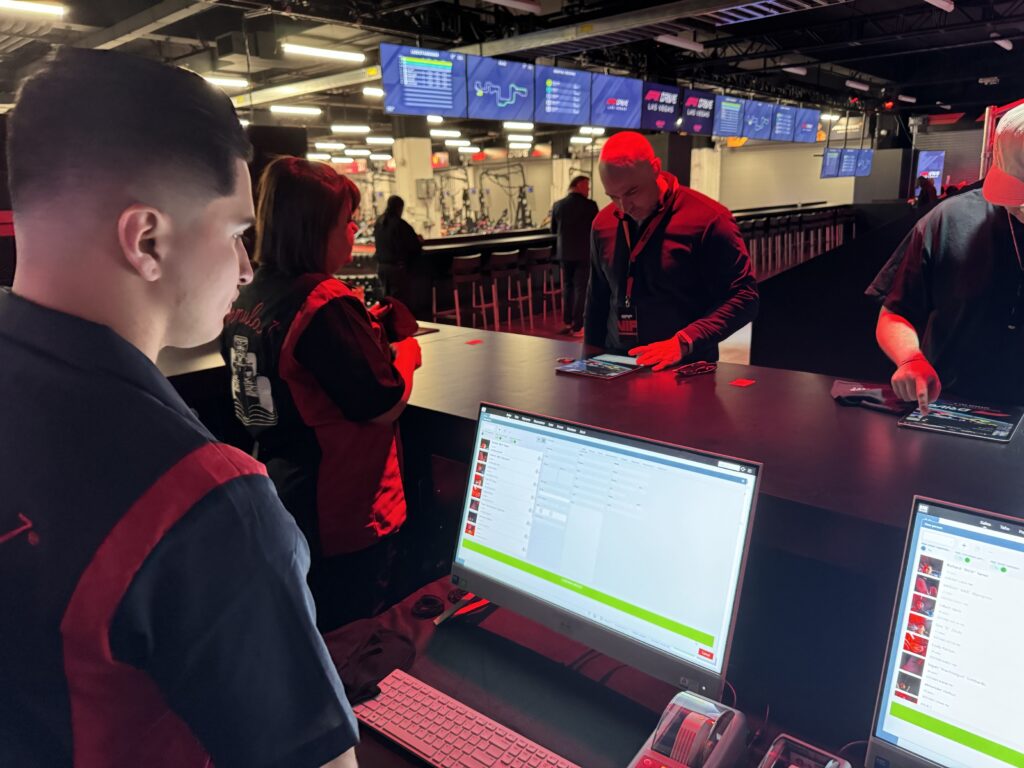
- Entertainment venues: buying admission wristbands, arcade credits, or a birthday party package at a family entertainment center’s front desk — plus the coffee and fries at its café. Each of those is a POS purchase running through the venue’s point-of-sale system.
That last example matters more than people think: leisure venues are some of the highest-volume POS environments anywhere, processing hundreds of small transactions per day across admissions, food, and retail — often from the same family in a single visit.
Don’t Recognize a POS Charge? How to Trace and Dispute It
Now the question behind the question. Most people googling the meaning of a POS purchase are really asking: “is this charge legitimate — and if not, what do I do?”
Yes, POS transactions can be traced — here’s how
Every POS transaction is logged with a merchant ID, terminal ID, exact timestamp, and location. Your bank can see all of it, even when your statement shows a cryptic abbreviation. That makes POS charges among the most traceable payments that exist — far easier to pin down than a cash purchase.
How to identify the merchant behind a confusing descriptor
- Check the date and amount against your memory, calendar, and receipts. A $6.47 “POS” charge on Saturday afternoon is usually the coffee you forgot.
- Search the merchant string. Googling the exact descriptor (e.g., “POS 4482 XYZ HOLDINGS”) often reveals the parent company behind a store or restaurant brand.
- Ask household members. Authorized users on the same account are a top source of “mystery” charges.
- Call the bank. They can pull the full merchant record behind the abbreviation in minutes.
Steps to dispute a fraudulent POS charge (act within 60 days)
The clock matters. Under U.S. federal rules (the Electronic Fund Transfer Act, implemented by Regulation E), you generally must report an unauthorized debit transaction within 60 days of the statement on which it appears. Report a lost or stolen card within two business days and your maximum liability is $50; wait longer and it can rise to $500 — and unauthorized charges made after the 60-day window may not be recoverable at all.
If you’ve confirmed the charge isn’t yours:
- Contact your bank immediately — phone or app, then follow up in writing.
- Lock or cancel the card to stop further charges.
- Document everything: the statement entry, dates, and your report reference number.
- Expect an investigation: banks generally must resolve disputes within 45 days (up to 90 for certain POS and foreign transactions), and may issue provisional credit while they investigate.
The Business Side: What Happens Behind Every POS Purchase
If you run a business — or are planning one — the “POS” on customers’ statements is your side of the handshake. Two things are worth understanding.
Types of POS payments businesses accept today
Modern point-of-sale systems accept far more than swiped cards: chip (EMV) inserts, contactless taps, digital wallets, QR-code payments, gift cards, and stored membership credits. The more of these you accept, the fewer abandoned sales at the counter — and the faster your line moves at peak hours.
Why card-present POS transactions cost businesses less
Payment processors price risk. A card physically present at your terminal — verified by chip and PIN or a tap — is far harder to fake than a card number typed into a website. That’s why card-present POS transactions generally carry lower processing fees than online (card-not-present) payments. For a venue processing tens of thousands of small transactions a year, that difference compounds into real money.
Beyond the payment itself, each POS transaction is a data point: it updates inventory, feeds sales reports, and — when your POS is connected to a CRM — builds a picture of who your customers are and what they buy. A standalone card reader takes money; a connected POS system runs the business.
POS Systems in Leisure and Entertainment Venues
More than payments: bookings, memberships, and F&B in one system
Few businesses stress a POS system like a leisure venue. A family entertainment center, karting track, or indoor playground handles admissions, time-slot bookings, birthday party packages, café orders, retail, memberships, and waivers — often for the same family, within the same hour. When each of those runs on a separate tool, staff juggle screens, queues grow, and revenue leaks through unlinked data.
How BMI Leisure unifies POS, online booking, and CRM
This is the problem BMI Leisure has spent over 25 years solving for entertainment venues in 25+ countries: one platform where the POS, online booking, memberships, waivers, and CRM share the same customer record. A parent who books online, pays a balance at the front desk, and adds pizza at the café is one profile — not three disconnected transactions. That’s what turns thousands of small POS purchases into reporting you can act on and guests you can bring back.
Planning a venue of your own? See our step-by-step indoor playground business plan guide — including the POS and booking technology section every investor expects.
One System for Every Transaction in Your Venue
From front-desk POS to online bookings, memberships, and CRM — BMI Leisure connects every payment to a guest profile, so you sell more and guess less.
Get in Touch with Our TeamFrequently Asked Questions
Can a POS transaction be traced?
Yes. Every POS transaction carries a merchant ID, terminal ID, timestamp, and location, so your bank can trace exactly where and when it happened. If you don’t recognize a charge, contact your bank — under U.S. rules you generally must report unauthorized debit charges within 60 days of your statement.
What is the difference between a debit card purchase and a POS purchase?
They usually describe the same money movement labeled differently. A “POS purchase” typically means you entered your PIN at a point-of-sale keypad and the funds posted immediately. A “debit card purchase” often means the card was run through the credit network with a signature or no verification, which can take a day or two to post.
What is a POS purchase example?
Tapping your debit card for groceries, inserting your card at a restaurant terminal, paying at a gas station keypad, or buying tickets and snacks at a family entertainment center’s front desk. Any in-person payment made through a point-of-sale system is a POS purchase.
Why was I charged a POS fee?
Some banks charge a small fee for PIN-based POS debit transactions, and some merchants add a card surcharge that should be disclosed at checkout. Check your account’s fee schedule first. Running the card as credit (signature) or switching account types often avoids bank-side POS fees.
Is a POS purchase the same as an online purchase?
No. A POS purchase is a card-present transaction — you’re physically at the terminal. Online purchases are card-not-present transactions, processed differently and at higher fraud risk for merchants, and they usually appear on your statement under the merchant’s name rather than a “POS” label.
Sources
- Federal Reserve — Federal Reserve Payments Study: initial 2025 findings (120.6 billion debit card payments in 2024; debit = 64% of card payments). federalreserve.gov
- Consumer Financial Protection Bureau — How do I get my money back after an unauthorized transaction? (60-day reporting rule, liability tiers). consumerfinance.gov
- CFPB — Regulation E §1005.6, Liability of consumer for unauthorized transfers ($50 / $500 / unlimited liability tiers). consumerfinance.gov
- CFPB — Regulation E §1005.11, Procedures for resolving errors (45–90 day investigation timelines, provisional credit). consumerfinance.gov
This article explains U.S. consumer payment rules in general terms and is not legal or financial advice. Figures are from the sources above as of July 2026. Last updated: July 8, 2026.