Most guides to starting a VR arcade business are written by companies selling VR systems or franchises, and their numbers point one way. A handful of older closures and one 2026 annual report point another.
This guide puts both side by side, then walks through the formats, game licensing, costs, staffing and bookings. Vendor figures are labeled as vendor figures; where a number is our own arithmetic, we say so. We make venue management software, including booking and waivers for VR attractions, so we flag where our product comes in. We don’t sell VR hardware, games or franchises.
How to Start a VR Arcade Business in 7 Steps
To start a VR arcade business, decide whether VR will be a standalone venue or an attraction in a larger one, choose a format, license the games for commercial use, budget the system and the fit-out, check the numbers against real capacity, plan staff and safety, and set up group bookings and waivers:
- Standalone or add-on: in a study commissioned by one VR vendor, only 15% of consumers wanted a VR-only venue.
- Choose the format: stations, a free-roam arena, a mall zone or mobile events.
- License the games: a game bought for home use isn’t licensed for a paying venue.
- Budget the build: one free-roam vendor lists $165,000 for a 6-player system, plus fit-out from about $50,000.
- Run the numbers from players per session, sessions per hour and ticket price.
- Plan staff, space and safety, including a briefing area and a minimum age.
- Set up online booking, waivers, parties and corporate events.
Is a VR Arcade Still a Good Business in 2026?
The honest answer is that the evidence disagrees with itself. Here is what the public record and the vendors say:
| Signal | What Happened | Source |
|---|---|---|
| IMAX VR centers | IMAX had closed four of the seven centers in its VR pilot and announced in December 2018 that it would close the remaining three | TechCrunch, quoting IMAX’s SEC filing (Q1 2019 timing per Variety) |
| The VOID | UploadVR reported in July 2020, based on forum photos and an unnamed source, that its Downtown Disney location had received a lease termination notice while closed for the pandemic; The VOID was reportedly in talks with Disney | UploadVR |
| Omni Arena (Virtuix) | 80 systems installed at US entertainment venues; new systems no longer produced or sold since 2025 | Virtuix 10-K, fiscal year to March 2026 |
| Zero Latency | 150+ free-roam arenas in 30 countries; says established centers average about $50,000 a month in VR ticket sales (2024–25 figures it calls illustrative only) | Zero Latency (vendor figures) |
The most telling line is in Virtuix’s annual report. It stopped selling new Omni Arena systems after moving its R&D and marketing to Omni One, its home product, and alongside that pivot it cites a “shift in demand for entertainment attractions from staffed VR attractions such as Omni Arena to unstaffed, lower-tech offerings.” That is a public company explaining a product decision in a filing, not a sales pitch, though it describes one product. The IMAX and VOID closures are older, a 2018 pilot and a pandemic-era event, so they say less about 2026.
On the other side, Zero Latency says it has 150+ venues in 30 countries and is expanding, and the vendors publish strong revenue claims. Those claims come from the companies selling the systems, so treat them as a ceiling to verify, not a forecast.
Where VR works best
One consumer study is consistent with the split. The State of Location-Based VR 2026, commissioned by Zero Latency and run by the research agency Glow, surveyed 2,386 people in the US, Canada, Australia, France and Spain. 78% said they prefer a venue that offers VR alongside other attractions: 40% meant more VR experiences and 38% meant activities such as bowling and mini golf. Only 15% wanted a VR-only venue. The study also found that “trying new technology,” the top reason to book VR in its 2023 edition, had dropped to fourth place.
The study was paid for by a VR vendor that sells into multi-attraction venues, and it measures stated preferences, not operator results. The Virtuix filing also shows that placement inside an entertainment center is no guarantee. Our view, as a judgment and not a finding: adding VR to a venue that already draws groups, such as a karting track, bowling center or family entertainment center, carries less risk than a standalone room of headsets, because it needs no new lease or front-desk team.
Step 1: Choose Your VR Format
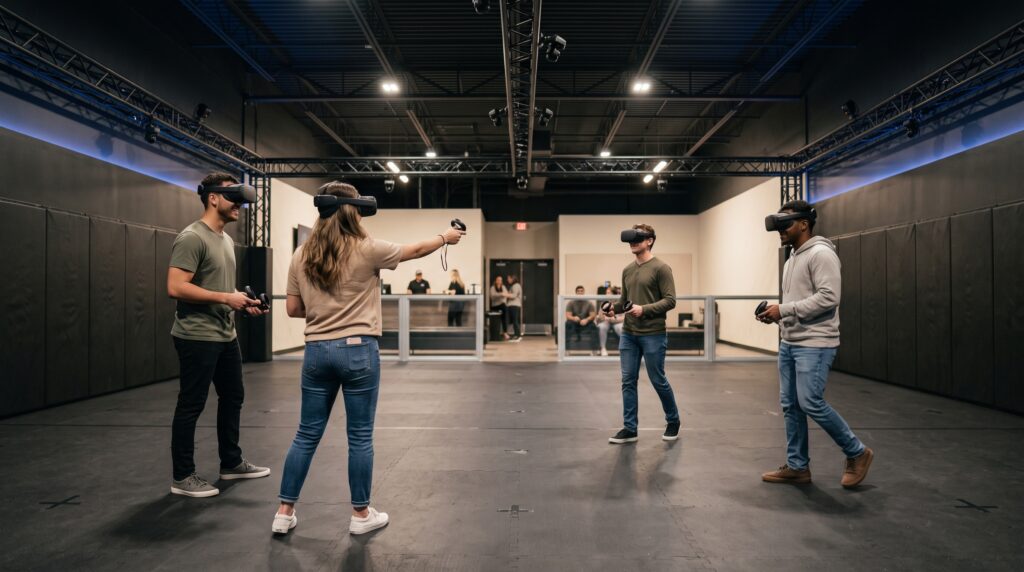
VR attractions come in four main formats (our grouping; vendors such as VR Arena describe the first three). They differ in space, group size and how often people come back:
| Format | How It Plays | Space | Best Fit |
|---|---|---|---|
| Stations or booths | Single players or pairs in fixed spots, short sessions, often PC-based | Depends on station count | Walk-in traffic, add-on to an arcade |
| Mall or cinema zone | A few stations or rides in a high-traffic space | Small footprint | Shoppers and moviegoers, impulse play |
| Free-roam arena | Groups walk freely through a shared virtual world | 32–36 m² for 4 players up to 150–200+ m² for 10 (VR Arena); 98 m² for 6 players, 128 m² for 8 (Zero Latency) | Groups, parties, corporate events |
| Mobile or event VR | Portable setups taken to parties, offices or festivals | Client’s space | Event sales without a fixed venue |
Space figures are each vendor’s own minimums for its system; Zero Latency’s pricing page gives a wider 98–225 m² range, so confirm the figure for your configuration. VR Arena, a franchisor, argues that free-roam arenas bring the most repeat visits, and it sells them, so weigh that. The practical point holds anyway: a format built for groups can sell parties and team-building events, which a single headset in a booth can’t.
Step 2: License the Games for Commercial Use
This is the step new owners most often get wrong. A game bought on a consumer store is licensed for home use. Steam’s subscriber agreement, for example, grants a license “for your personal, non-commercial use” unless commercial use is expressly allowed. Valve runs a separate PC Café Program, which it calls the official way to operate Steam games and VR experiences in a public venue, with setup instructions for VR arcades.
There are three common ways to license content:
- Per-seat or per-title licenses bought through a commercial program or directly from the developer, usually monthly. A 2017 guide by a VR developer, published by UploadVR, describes per-seat monthly licenses priced by each developer and per-minute deals as the main options.
- Arcade management platforms that bundle game launching, licensed content and bookings. Synthesis VR, for example, lists a free Essential plan and an Ultimate plan at $30 per station per month billed annually ($40 billed every six months). SpringboardVR, another early platform, says it now continues under Deploy Reality, the company behind Synthesis VR.
- Turnkey free-roam systems whose license and ongoing fee include their own games. Zero Latency charges an ongoing fee of 16% of ticket sales, net of local sales tax, which it describes as roughly $4 per person per play (a figure that doesn’t match 16% of its own $48 average ticket; see Step 4). It also offers pay-per-play and fixed monthly options.
Check the headset’s commercial terms too. VR Arena recommends headsets sold with a business license. If a vendor can’t show you, in writing, that you’re licensed to charge for a game on a given headset, don’t put it on the floor.
Step 3: Budget the Build
We found no independent survey of VR arcade build costs. What is public comes from vendors, and the figures below are theirs:
| Vendor Figure | What It Covers | Amount |
|---|---|---|
| Zero Latency system license | 6-player free-roam system: hardware, software, resources and onboarding | from $165,000 |
| Zero Latency fit-out estimate | Building work, paid to your own contractors | from about $50,000 |
| VR Arena small arena | Deposits, renovation, design, headsets, computers, Wi-Fi, licenses, launch marketing | from about $50,000 |
| VR Arena larger arenas | Same lines, bigger space and more players | $150,000 – $300,000 |
| Synthesis VR software | Station management and game access on the free Essential plan; bookings and online waivers are listed on the Ultimate plan (the pricing page may not be current) | $0 – $40 per station per month |
Two things stand out. First, the gap between the two free-roam vendors is wide: one entry price covers a full small arena, the other covers the system only, with the building on top. Ask every vendor exactly which lines its price leaves out. Second, budget for ongoing hardware support. Virtuix’s annual report, for example, bills its Omni Care maintenance program for Omni Arena at $2,000 a quarter after the first year. Virtuix no longer produces new Omni Arena systems and now supports existing operators and facilitates second-hand sales, so confirm that any system you buy is still supported.
For a station-based arcade, there’s no sourced total to quote. Price each line yourself: headsets and spares, PCs if you use them, licenses per station, management software, build-out, lease deposits, launch marketing and a cash reserve for the first few months (our suggestion).
Step 4: Check the Numbers Against Real Capacity
Revenue in a VR attraction is capped by how many people can play per hour. Build your forecast from capacity, not from a vendor’s average:
Zero Latency’s own figures don’t fully reconcile: 16% of a $48 ticket is $7.68, not the roughly $4 per play it quotes, so ask whether $48 is per player, per session or per booking before you build a forecast on it.
The vendors’ own payback claims don’t agree with each other. Zero Latency says its partners often see payback within 8 to 12 months, and under 12 months when the system goes into an existing entertainment venue. VR Arena, the franchisor, says its franchise typically pays back in 2 to 3 years and reports revenue from about $10,000 to $12,000 a month for a small arena up to $50,000 to $55,000 for a large one. Both are vendor statements, and we found no published audit of either. Ask each vendor for references from operators in markets like yours and call them.
Step 5: Franchise, License or Independent
There are three routes into the business, and each of the vendors above uses one of them:
- Franchise. VR Arena offers a franchise with a website, CRM, online booking, marketing kit and operating manuals. A franchise gives you a tested playbook in exchange for fees, and US franchise rules generally require the franchisor to give you a disclosure document before you sign. Our entertainment franchise guide explains how to read one.
- License. Zero Latency calls its model a license, not a franchise: you buy the system and pay the ongoing content fee, without the rigid territory restrictions or resale royalties of a typical franchise, according to the company. Exclusive territory is available only in some cases.
- Independent. You choose your own headsets, platform and games. VR Arena suggests this route mainly for owners who already run an entertainment business, such as a bowling center or karting track, and already have customers.
Step 6: Plan Space, Staff and Safety
The arena is only part of the floor plan. Zero Latency lists the other areas a free-roam attraction needs: a server room of about 2.5 to 3.5 m², a game master station, charging storage for headsets, a briefing area for the whole group, a reception and lobby, and a spectator area with screens.
On staffing, the vendors describe a lean model. VR Arena says one game operator per shift is usually enough for an 8–10 player arena, and Zero Latency says one staff member can run a session, with two at peak times. Someone also needs to greet guests, clean headsets between groups and handle breakdowns, so plan for those tasks on top.
Safety is a real cost line. Zero Latency runs a mandatory briefing before every session and live monitoring by a staff member, and recommends a minimum age of 12. Injury claims happen: Virtuix’s annual report discloses that it was named as a co-defendant in a 2024 lawsuit over injuries allegedly suffered on Omni Arena at an entertainment venue; it denied the claims, alleging contributory negligence, and the case was settled after its fiscal year with costs covered by its insurer. Talk to an insurance broker before you open, collect signed waivers from every player, and check permits and occupancy limits with your local building department.
Step 7: Set Up Group Bookings, Waivers and Parties
Free-roam VR sells timed sessions for groups, which makes booking the center of the business. Your system needs to show live availability per arena or station, take payment online, cap each session at the system’s player limit, collect waivers with the player’s age before arrival, and package VR with food, other attractions and party rooms. Corporate events can be a large share of revenue: Zero Latency says weekday team-building and private bookings can account for up to 40%. Our guide to party and event booking software covers that side in detail.
It helps to separate two layers of software. The first runs the VR itself: launching games, managing headsets and licensing content. That layer comes from the VR vendor or a platform such as Synthesis VR. The second runs the venue: bookings, point of sale, waivers, memberships and reporting across every activity you offer. We use the same split for laser tag software.
If VR is one attraction in a larger venue, the second layer matters most, because one system should book the arena, the karting heats and the party room together. Zero Latency, which comes with its own booking platform, says operators can also add it to their preferred booking platform, and its FAQ gives Roller, Peak Pro, Clubspeed, BMI Leisure and Racefacer as examples. That is Zero Latency’s wording, so ask any booking vendor, including us, how its support works today.
Disclosure: BMI Leisure makes venue management software, and VR centers are one of the industries we work with. We don’t launch VR games or license content. For the arcade side of the floor, see our guides to starting an arcade business and arcade management software.
Adding VR to Your Venue?
Tell us which VR format you’re planning and what else your venue offers. We’ll show you how session booking, waivers, parties and point of sale can run from one system across every attraction.
Talk to Our TeamFrequently Asked Questions
Are VR arcades profitable?
Some are, but we found no independent profitability data. Vendors publish strong figures: Zero Latency says its established centers average about $50,000 a month in VR ticket sales (2024–25 figures it calls illustrative only) and often pay back in 8 to 12 months. The public record is more cautious: IMAX announced in December 2018 that it would close its remaining VR pilot centers, and Virtuix stopped selling new Omni Arena systems in 2025 after shifting its focus to its Omni One home product, also pointing to a shift in demand from staffed VR attractions to unstaffed, lower-tech offerings. Results depend on off-peak sessions, content fees and rent.
How much does it cost to open a VR arcade?
It depends on the format, and the public figures come from vendors. Zero Latency lists its 6-player free-roam system from $165,000, with fit-out from about $50,000 on top. VR Arena, a franchisor, says a small arena starts at about $50,000 and larger ones cost $150,000 to $300,000. For a station-based arcade, price each line yourself: headsets, computers, game licenses per station, management software, build-out, deposits, marketing and a cash reserve for the first few months.
How much space does a VR arena need?
Vendor minimums range from about 32 to 36 m² for a 4-player arena (VR Arena) to 98 m² for a 6-player and 128 m² for an 8-player Zero Latency arena. Add space for a briefing area, reception, headset storage, a server room and spectators.
Do I need a license to use VR games in a business?
Yes. Games bought on consumer stores are usually licensed for personal, non-commercial use; Steam’s subscriber agreement says so explicitly. Use a commercial program such as Valve’s PC Café Program, a license from the developer, an arcade platform that includes licensed content, or a turnkey system whose fee covers its games. Get the terms in writing for every title and headset.
Is VR a good add-on for a karting track or family entertainment center?
It can be, with less risk than a standalone VR venue. In a study commissioned by Zero Latency, 78% of 2,386 consumers preferred a venue that offers VR alongside other attractions (40% meant more VR, 38% activities like bowling and mini golf), and only 15% wanted a VR-only venue. An existing venue already has the groups, parties and staff, so VR can add a premium activity without a new lease. Check that your booking system can sell VR sessions and your other activities in one order.
Sources
- Virtuix Holdings Inc. — Annual Report on Form 10-K for the fiscal year ended March 31, 2026, filed June 25, 2026 (80 Omni Arena systems installed in the US; production and sales of new systems stopped in 2025 after the shift to Omni One; shift in demand; Omni Care at $2,000 per quarter after the first year; 2024 injury lawsuit, denied and settled). sec.gov — verified October 8, 2026.
- TechCrunch — IMAX pulls the plug on its dream of VR arcades, by Lucas Matney, December 13, 2018 (SEC filing on closing the remaining centers of IMAX’s VR pilot; four of seven already closed; Q1 2019 timing per Variety). techcrunch.com — verified October 8, 2026.
- UploadVR — The VOID Downtown Disney Location Receives Lease Termination Notice, by Ian Hamilton, July 3, 2020. uploadvr.com — verified October 8, 2026.
- Zero Latency — VR Licence Cost pricing page, Frequently Asked Questions and The State of Location-Based VR 2026 Is Here (August 17, 2026). Vendor figures: system price, fit-out, 16% fee, space, average ticket, revenue, payback, staffing, throughput, minimum age, booking platforms; consumer study commissioned by Zero Latency and conducted by Glow. pricing, FAQ, study summary — verified October 8, 2026.
- VR Arena — How to Start a VR Business: A Complete Guide to Opening a Virtual Reality Arcade in 2025, October 1, 2025 (franchisor; formats, arena sizes, budgets, staffing, revenue and payback claims). vr-arena.games — verified October 8, 2026.
- Valve — Steam Subscriber Agreement (personal, non-commercial license) and Steam PC Café Program documentation. steampowered.com, steamgames.com — verified October 8, 2026.
- UploadVR — How To (Legally) Start A VR Arcade, guest post by VR developer Joe Radak, September 4, 2017. uploadvr.com — verified October 8, 2026.
- Synthesis VR — Pricing page; SpringboardVR — home page (now under Deploy Reality, the company behind Synthesis VR). synthesisvr.com, springboardvr.com — verified October 8, 2026.
Prices, revenue, payback and space figures from Zero Latency, VR Arena and Synthesis VR are the vendors’ own published figures, not independent data; ask for current terms in writing. The consumer study was commissioned by a VR vendor. Capacity and tickets-per-day figures are our arithmetic; Zero Latency’s per-play fee and average ticket do not reconcile, as noted in Step 4. Permit and insurance requirements vary by location. This guide is general information, not financial or legal advice. BMI Leisure is the publisher and sells venue management software, disclosed above. Last updated: October 8, 2026.