Miniature golf keeps drawing crowds because it does something few attractions manage: it’s cheap to play, works for almost any age, and turns a casual visit into a group outing. Opening one through a miniature golf franchise is the fastest, lowest-guesswork way in — you get an established brand, a tested model, and a team that has launched sites before. This step-by-step guide covers the real franchise options and their verified costs, how franchising compares to going independent, and how to run one so it stays profitable long after opening week.
What Is a Miniature Golf Franchise? (Quick Answer)
A miniature golf franchise lets you open and run a mini golf venue under an established brand, using its course designs, systems, and playbooks. You own and operate your location day to day; the franchisor supplies the recipe that keeps the guest experience consistent from one site to the next — in exchange for an upfront franchise fee plus ongoing royalties. The best-known U.S. options are Monster Mini Golf (indoor) and Putt-Putt Fun Centers.
Those payments buy you more than a logo. The demand behind them is real and measurable: the U.S. miniature golf market was worth around $441.6 million in 2026, and the wider family fun center category it sits in reached roughly $23.9 billion, growing at about 3.5% a year since 2021.
What do you get for the franchise fee?
A typical mini golf franchisor provides a package designed to de-risk your launch:
- Course design and layout built around guest flow, safety, and theming.
- Staff training covering service, safety procedures, and daily operations.
- Vetted vendors for construction, décor, lighting, and add-on attractions.
- Marketing templates and brand rules for promotions, social, and paid ads.
- Recommended technology for bookings, POS, waivers, and group events.
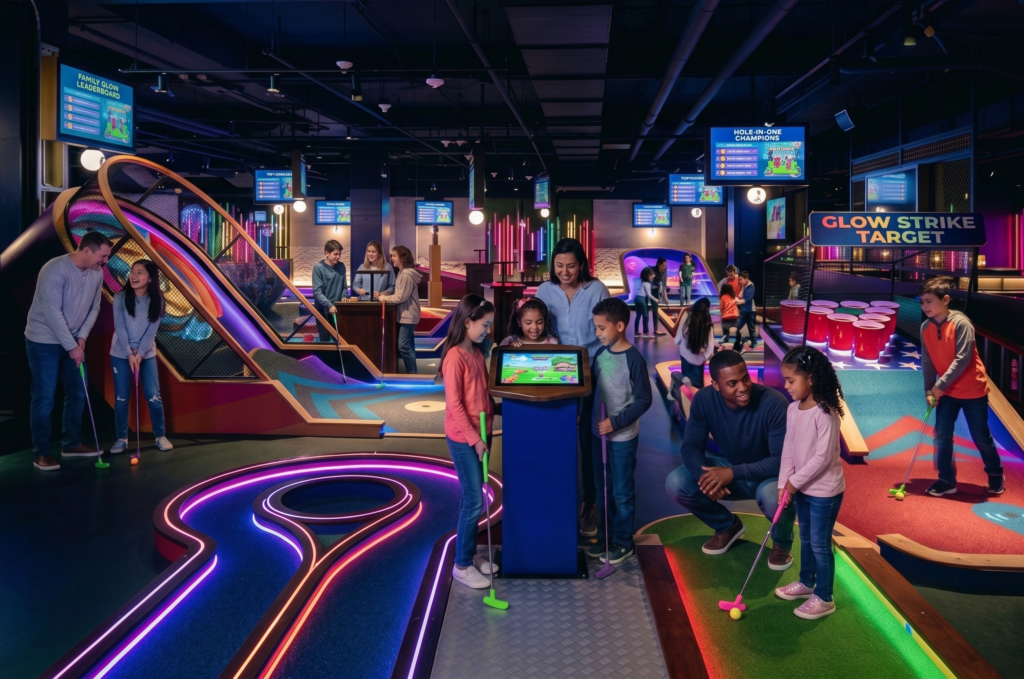
Many modern brands go beyond the course itself, bundling in arcades, party rooms, VR, or food and beverage — so you’re opening a small entertainment center, not just 18 holes. That mix matters, because the venues that add revenue streams around the course are usually the ones that stay busy on quiet weekdays.
Top Mini Golf Franchises Compared (2026)
The franchise shelf in mini golf is short — shorter than most first-time buyers expect. Here are the real options, with figures verified against FDD analyses in July 2026:
| Franchise | Format | Verified figures | Known for |
|---|---|---|---|
| Monster Mini Golf | Indoor, glow-in-the-dark | Total investment $885,235–$1,535,235; $60,000 fee; 7% royalty + 2% marketing; $210,000 min. cash | 18-hole blacklight courses with arcades, in-house DJs and party rooms; the category’s most active franchisor |
| Putt-Putt Fun Centers | Outdoor & fun-center hybrid | Costs not published — direct inquiry via its franchise portal | The classic American brand with decades of family recognition |
| Pirate’s Cove | Outdoor adventure golf | Costs by inquiry | Themed regional outdoor courses in tourist markets |
Two honest observations. First, the thin franchise field means independent ownership is unusually common in mini golf — specialist course builders offer turnkey design and construction without royalties (more on that trade-off below). Second, Monster’s numbers give the clearest financial picture in the category: FDD analysis reports average unit revenue of about $1.04 million, estimated owner-operator earnings of $146,000–$188,000, and a 7.7–9.7 year payback on the initial investment. Solid — and a realistic reminder that this is patient capital, not a fast flip.
Indoor Mini Golf Franchise: Why Most New Builds Go Inside
Search any franchise portal and the momentum is obvious: the growth is indoors. An indoor mini golf franchise trades higher rent and buildout for the thing outdoor courses can never buy — a 365-day calendar:
Year-round revenue, climate control, easy to add arcades, F&B and party rooms; blacklight theming commands premium pricing
Higher rent and build cost; full concepts need roughly 9,000–20,000+ sq ft; design quality really matters
Lower build cost, strong seasonal and tourist appeal
Weather-dependent and seasonal; limited winter hours in most markets
The indoor model is also why modern mini golf is really a small family entertainment center: once you’re paying indoor rent, the economics push you to monetize every square foot around the course — arcade, café, party rooms. That’s the format Monster franchises, and it’s the format most independent “competitive socializing” concepts (adult-oriented mini golf with bars) are building too.
Miniature Golf Franchise vs. Independent Ownership
This is the first real decision, and it shapes everything after it. Both paths can succeed — the question is how much support you want versus how much freedom.
| What to weigh | Franchise | Independent |
|---|---|---|
| Brand & demand | Open with a known name and built-in guest expectations | Build recognition from zero — slower, but fully yours |
| Launch support | Training, vendor list, design guidelines, and playbooks provided | You develop every system, from course design to staffing — or buy turnkey design from course builders (no royalties) |
| Creative control | Follow brand standards for theme, pricing, and F&B | Full control over concept, menu, and pricing |
| Tech & vendors | Often required to use approved suppliers and systems | Pick any software or vendor that fits your budget |
| Cost structure | Franchise fee + ongoing royalties + marketing fee | No royalties, but higher upfront spend on brand and setup |
| Scaling | Repeatable model makes a second or third site easier | Each new site is planned and built from scratch |
The short version: a franchise trades some freedom for a shortcut, and independence trades a shortcut for freedom. If this is your first venue and you value a proven path, franchising lowers the risk. If you have operating experience and a strong concept in mind, independence can be more rewarding — and cheaper over the long run once the royalty math adds up. (Weighing other leisure franchise categories too? See how the math compares in our bowling alley franchise guide.)
How Much Does a Miniature Golf Franchise Cost?
This is where most guides get vague, so let’s be concrete. Total investment swings hard depending on whether the course is indoor or outdoor, themed or traditional, standalone or part of a larger center. Indoor themed builds cost the most; simple outdoor or add-on courses cost the least.
As the real-world anchor, Monster Mini Golf’s 2025 Franchise Disclosure Document lists a total investment of $885,235 to $1,535,235, with a $60,000 franchise fee, a 7% royalty, a 2% marketing contribution, and a $210,000 minimum cash requirement (figures per VettedBiz’s FDD analysis, verified July 2026). Treat that as the category’s clearest benchmark, not a universal number.
| Cost | What it covers | Notes |
|---|---|---|
| Franchise fee | One-time fee for brand rights and onboarding | $60,000 at Monster; check each brand’s FDD |
| Build-out & course | Landscaping or interior fit-out, themed holes, props, lighting | Usually the single largest line item |
| Equipment | Putters, balls, scoring, sound, and any add-ons | Arcades or VR raise this considerably |
| Liquid capital | Cash reserve to run through the early, slower months | Monster requires $210,000 minimum cash |
| Insurance | Liability, property, and workers’ comp | Entertainment-venue policies cost more |
| Technology | Booking, POS, waivers, reporting | A recurring cost, but it pays back in saved admin |
| Ongoing royalties | Percentage of revenue paid to the franchisor | Plus a marketing fee — factor both into projections |
Read the FDD first. Franchise costs, royalties, and requirements are specific to each brand’s current Franchise Disclosure Document — and the fees don’t stop at opening. Royalties and marketing contributions are a permanent slice of revenue, so model them into your margins from day one, and review the FDD with an attorney and accountant before committing.
How to Start a Miniature Golf Franchise, Step by Step
Once you’ve decided franchising is your route, the path to opening follows a fairly predictable order. The franchisor hands you a roadmap, but the local execution — funding, site, hiring, launch — is yours.
Step 1 — Choose the right brand
Brands differ far more than they look. Compare theme and attraction mix, fee and royalty structure, depth of training and support, vendor flexibility, and exactly which technology you’re required to use. Request the Franchise Disclosure Document (FDD) to review financials, territory rights, and obligations, and talk to several current franchisees — both the ones the franchisor recommends and ones you find yourself.
Step 2 — Run the numbers and secure funding
Before you fall for a theme, pressure-test the economics. Add up the franchise fee, build-out, equipment, insurance, and a realistic cash cushion, then map your expected revenue against royalties and rent — with Monster’s verified benchmarks (≈$1.04M average unit revenue, 7.7–9.7 year payback) as your reality check. Many owners finance part of the build (SBA loans are common in the U.S.), so know your liquidity position early — most franchisors require proof of it anyway.
Step 3 — Pick your location
Location decides more of your success than any hole design, and your franchisor will usually want to approve the site. The indoor-vs-outdoor decision (see the format table above) drives the requirements: full indoor concepts typically need 9,000–20,000+ sq ft in climate-controlled strip centers or standalone buildings, while outdoor and add-on courses run smaller. Beyond format, weigh foot traffic and visibility (near entertainment districts or tourist areas), parking and accessibility, nearby competition, and whether the site leaves room to add attractions later.
Step 4 — Build out and set up operations
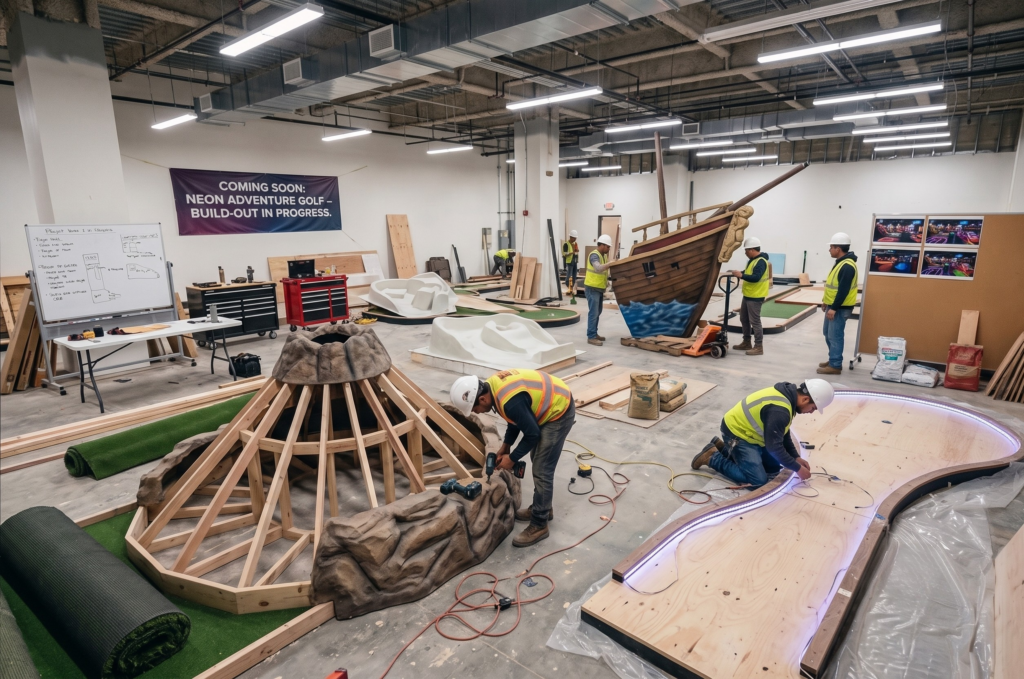
With the lease signed and construction underway, shift to the operating plan: hire guest-focused staff for admissions, course supervision, events, and F&B; lock down safety and maintenance routines (course upkeep, lighting checks, slip prevention); and design your party and group programs early — birthdays, team events, and group bookings are where a lot of mini golf revenue actually comes from. Pair the franchisor’s launch campaign with local partnerships and opening promotions. (For channel-by-channel ideas, see our guide to family entertainment center marketing.)
Step 5 — Choose your management platform
Handling reservations, walk-ins, parties, waivers, payments, and events by hand falls apart fast — especially once you have more than one site. This is the step where the right software quietly makes or breaks the operation, so it gets its own section next.
How the Right Software Keeps a Franchise Scalable
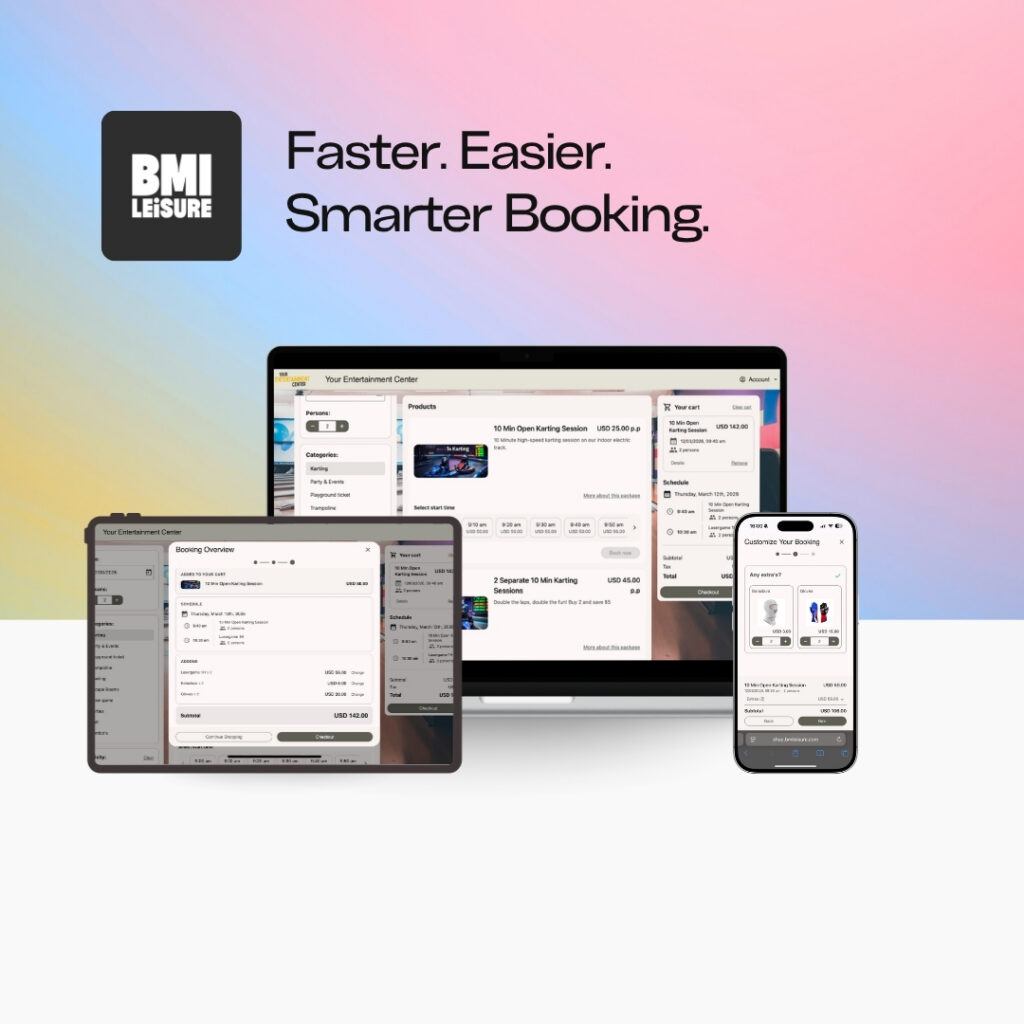
A miniature golf franchise lives or dies on consistency: the same booking flow, the same pricing, the same guest experience at every location. That’s almost impossible to hold together with a patchwork of separate tools. An all-in-one venue management platform pulls the whole operation into one system so a new site opens faster and runs the same as the last one. With BMI Leisure, that means:
- Online booking, POS, waivers, and memberships in one place — fewer systems to train staff on, fewer things to break.
- Party and group bookings handled without spreadsheets, so you capture the high-value events instead of losing them to admin.
- Multi-venue management — sync pricing and products across every location, keep brand standards identical from a single site to 40+, and see it all from one head-office dashboard.
- Reporting and analytics that show peak hours, revenue mix, and which sites need attention.
- CRM & marketing automation — turn one-time putters into party bookings and repeat visits automatically.
This is where BMI Leisure’s background matters. The company started in karting timing (as SMS-Timing) and grew into a full platform precisely because multi-site leisure groups needed one system that scales — the exact problem a franchise faces. Today it’s trusted by 300+ entertainment venues across 70 countries.
Franchise advantage: when each new location plugs into the same setup — identical pricing, products, and guest journey, managed centrally — “franchise-ready” stops being a slogan. Your third site opens faster than your second, and head office can see all of them from one dashboard.
Common Challenges (and How to Handle Them)
Franchising removes a lot of guesswork, but it introduces its own friction. Knowing these early keeps your expectations realistic.
| Challenge | How to handle it |
|---|---|
| High upfront cost | Model royalties and marketing fees into margins from day one; keep a real cash cushion for slow early months |
| Limited flexibility | Choose a brand whose standards you can genuinely live with — the guardrails won’t loosen later |
| Site & staffing | You still secure the lease and run hiring; outdoor courses need seasonal staffing, indoor needs year-round cover |
| Safety & upkeep | Themed and blacklight courses need constant maintenance; meet local accessibility, fire, and F&B rules, not just brand rules |
| Local vs. brand identity | Layer local events and partnerships on top of brand standards to feel part of the community |
Opening One Course — or Building a Chain?
BMI Leisure connects booking, POS, memberships, and multi-venue reporting in one platform — built to scale from a single mini golf site to a full franchise, with head office in control of every location.
Get in Touch with Our TeamFrequently Asked Questions
Are there any mini golf franchises?
Yes. The best-known U.S. options are Monster Mini Golf (indoor, glow-in-the-dark, about $885,000–$1.54 million total investment) and Putt-Putt Fun Centers (the classic brand; costs disclosed by direct inquiry only). Smaller regional brands like Pirate’s Cove also franchise outdoor adventure-golf courses. Many operators alternatively open independent courses with turnkey course-builder support.
How much does it cost to open a miniature golf franchise?
It varies by brand and format. Monster Mini Golf’s 2025 FDD lists a total investment of $885,235–$1,535,235, with a $60,000 franchise fee, 7% royalty, 2% marketing fee, and $210,000 minimum cash. Putt-Putt discloses costs by direct inquiry. Smaller outdoor or add-on courses can start lower. Always confirm current figures in each brand’s FDD.
Is indoor mini golf profitable?
It can be. FDD analysis of Monster Mini Golf reports average unit revenue around $1.04 million, estimated owner-operator earnings of roughly $146,000–$188,000, and a 7.7–9.7 year payback. Profitability improves sharply when a venue adds arcades, food and beverage, memberships, and party bookings around the course — and fills slow weekday hours with groups.
Is a mini golf franchise better than starting independently?
Neither is universally better. A franchise gives you a proven model, brand recognition, and structured support in exchange for fees and less creative control. Going independent gives you full freedom over theme, pricing, and vendors, but you build every system yourself. The right choice depends on your budget, experience, and how much you want to shape the concept.
What software do miniature golf franchises use?
Most rely on all-in-one venue management software that combines online booking, POS, waivers, memberships, and party bookings in one place, with multi-venue reporting on top. For franchises, the key is consistency: the same setup, pricing, and guest experience across every location, managed centrally, so each new site launches faster.
How long does it take to open a miniature golf franchise?
For an indoor build-out, expect roughly six to twelve months from signing the franchise agreement to opening day, depending on site selection, permits, construction, and lead times on themed course elements. Outdoor courses can be faster or slower depending on landscaping and weather. Your franchisor’s onboarding timeline is the best guide.
Sources
- IBISWorld — Miniature Golf Courses in the US ($441.6M market size, 2026). ibisworld.com — verified July 22, 2026.
- IBISWorld — Golf Driving Ranges & Family Fun Centers in the US ($23.9B market size; 3.5% revenue CAGR). ibisworld.com — verified July 22, 2026.
- Vetted Biz — Monster Mini Golf Franchise Insights (2025 FDD analysis) (investment $885,235–$1,535,235; $60,000 fee; 7% royalty; 2% marketing; $210,000 min. cash; AUV $1,044,449; estimated owner earnings $146,223–$188,001; 7.7–9.7 yr payback). vettedbiz.com — verified July 22, 2026.
- Putt-Putt Fun Centers — official franchise page (costs by direct inquiry). puttputt.com
Industry and franchise figures are third-party estimates or FDD analyses as of July 2026 and vary by source, brand, and methodology — treat them as directional. Franchise costs and requirements are specific to each brand’s current FDD; review it with an attorney and accountant before investing. This article is general information, not legal, tax, or financial advice. Last updated: July 22, 2026.