Here’s the thing about a venue gift card that a retail gift card will never be: somebody gives your venue to somebody else. The buyer vouches for you; the receiver — very often a person who has never walked through your door — shows up holding prepaid intent. That makes gift card software for venues less a payment feature than an acquisition channel with an accounting department attached. This guide covers the software that runs it, the calendar that governs it, and the honest math behind the breakage numbers everyone misquotes. Spoiler: if you’re reading this in September, your timing is perfect.
(Transparency up front: we’re BMI Leisure, a venue platform with a gift card module — flagged now, disclosed fully below.)
What Is Gift Card Software for Venues?
It’s the system that lets an entertainment venue sell, deliver, track and redeem gift cards and vouchers — digital and physical — through its own website, front desk and kiosks, with balances living on the same guest records as everything else. The venue-specific part is what happens at redemption: the card pays for sessions, games, food and parties at your POS, and the person redeeming it is very often a brand-new guest someone else sent to your door.
Three Species Share This Search — Pick Yours First
Search for gift card software and three unrelated markets answer. Retail and small-business tools — the Square and VoucherCart world — sell stored value against products; fine for shops, blind to sessions and bookings. Corporate-rewards platforms — Tremendous, Sendoso, the names in this SERP’s ad slots — exist to send incentive cards to employees and customers. They have nothing to do with running your venue’s program, however confidently their ads rank for your search.
And venue gift card and voucher software — this guide — is built for experience businesses: cards redeemable against bookings, sessions and parties, sold through your own channels, tied to guest profiles, ideally as a module of the platform already running your venue. The one-question species test for any vendor demo: show me a voucher booking a lane, a room or a session. If it can’t, you’re in the wrong aisle.
The Gift Card Year: Four Acts
Gift cards are the most seasonal product a venue sells — which means the software decision has a calendar. Here’s the year as your gift card program lives it:
The setup
The unglamorous act that decides everything: card designs (physical cards go to print now), denominations and experience vouchers configured, the webshop flow tested, staff trained on redemption, and kiosks and POS ready to sell and redeem. Venues that start this in November sell gift cards in December with a printer-paper IOU. If you’re evaluating software, this window — right now — is when switching is still cheap.
The sales wave
For most venues, a large share of the year’s gift card revenue lands in these few weeks — much of it in the final days — which is why 24/7 online sales with instant voucher email delivery is the single highest-leverage capability a program can have. The December 24th buyer at 11 PM is real, numerous, and entirely lost to venues whose cards are only sold at a desk that’s closed. Physical cards carry the under-the-tree moment; digital carries the deadline panic; your software should sell both from one balance system.
The redemption wave
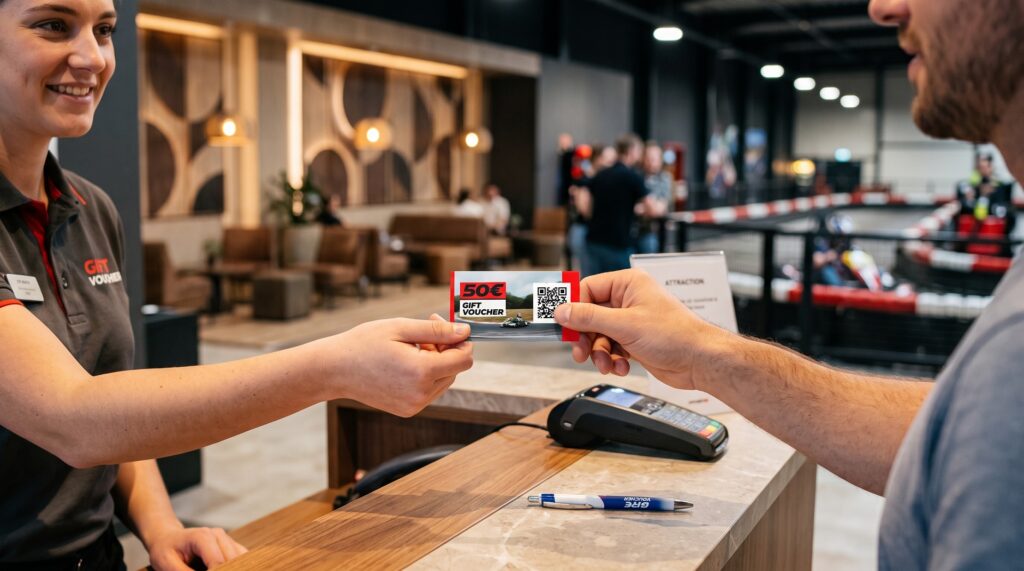
Now the cards come home — attached to people. This is the acquisition act: a healthy share of redeemers are first-time guests, arriving in your slowest season, pre-paid, and often spending past the card’s value once they’re in. The software job: redemption at every till against one balance, the new guest becoming a real profile in your CRM (not an anonymous ticket), and vouchers booking directly into sessions and party slots — because the redeemer who books a February birthday party just became a customer, not a coupon.
The ledger
The act nobody markets: outstanding balances are a liability on your books until redeemed or lawfully lapsed, expiry rules vary by jurisdiction, and finance will ask questions your software must answer — which is exactly why “gift card reconciliation” and “gift card reporting” queries spike among operators. One measurement discipline worth stealing from the actuarial world: per loyalty-liability firm KYROS, avoid comparing the value of cards issued in a period against cards redeemed in that same period — the cohorts don’t match, and the comparison misleads. Your reporting should track each cohort of sold cards through its own redemption curve.
The Honest Breakage Math
Every gift card pitch eventually whispers the same word: breakage — the value that never gets redeemed, kept by the venue. Here’s our honest correction to the industry’s favorite statistic: the widely-quoted “10–20% of gift cards are never redeemed” figures usually conflate balances that are merely unredeemed so far with value that permanently expires. A card sitting in a drawer in March isn’t breakage; it’s a liability with legs. Permanent breakage exists, but it’s smaller than the pitch and regulated differently by jurisdiction.
And — this is the point — breakage is the wrong thing to want. The redeemed card is worth more than the broken one: it delivers a new guest, in your slow season, who out-spends the card and can come back. Plan your program around redemption, let your bookkeeper handle breakage, and be suspicious of any vendor whose ROI math leans on cards nobody uses.
By Venue Type: The Voucher Is the Product
The emerging searches tell the story — this spring, operators started hunting for gift card software for escape room businesses, gift card software for bowling alley operations, golf simulator lounges and axe throwing venues, almost in unison. The shared insight: for experience venues, the best-selling gift isn’t currency, it’s the experience itself, wrapped. An escape room sells “a game for four”; a bowling venue sells a lane-hour with shoes; a golf sim sells a session; and gift card software for family entertainment center operators wraps the birthday party deposit or an arcade credit bundle.
The requirement that separates venue-grade systems from retail tools: vouchers that represent your actual products — sessions, packages, time slots — and redemption that books straight into your calendar, not just a balance credit. If your vouchers can only hold dollars, you’re selling gift cards; if they can hold experiences, you’re selling visits.
Where BMI Leisure Fits
Disclosure: BMI Leisure is our platform, and gift cards are one of its modules — weigh accordingly. Our Gift Card & Vouchers module does what this guide argues for: create, sell and manage digital and physical gift cards, produce bulk vouchers for promotional campaigns or partner distribution, and — in our own feature page’s words — “generate word-of-mouth marketing through gifting and attract new guests.”
Because it’s a module of the venue platform, redemption happens at the same POS and kiosks that run everything else, balances live on guest profiles, and multi-venue groups can honor one card at every location. If your September checklist (Act I, above) is still open, that’s the demo to book this month — and compare us against anyone; the four-acts framework works on every vendor equally.
Sell Visits, Not Just Balances
Digital and physical gift cards, experience vouchers, kiosk and POS redemption, one balance across venues — set up now, ready for the December wave. September is the month.
Explore Gift Cards & VouchersFrequently Asked Questions
What is gift card software for venues?
It’s the system that lets an entertainment venue sell, deliver, track and redeem gift cards and vouchers — digital and physical — through its own website, front desk and kiosks, with balances living on the same guest records as everything else. The venue-specific part is what happens at redemption: the card pays for sessions, games, food and parties at your POS, and the person redeeming it is very often a brand-new guest someone else sent to your door.
How is venue gift card software different from retail gift card tools?
Three species share this search. Retail and small-business tools (the Square and VoucherCart world) sell stored value against products. Corporate-rewards platforms like Tremendous or Sendoso send incentive cards to employees and customers — they don’t run a venue program at all. Venue gift card software is built for experience businesses: cards redeemable against bookings, sessions and parties, sold on your site and at your POS and kiosks, with balances tied to guest profiles — ideally as a module of the platform that already runs your venue.
What happens to gift cards that never get redeemed?
Unredeemed value is called breakage, and honest math matters here: widely-quoted figures like “10–20% never redeemed” usually conflate balances that are merely unredeemed so far with value that permanently expires. Until a card is redeemed or lapses, it sits on your books as a liability, and jurisdictions regulate expiry differently. Treat breakage as an accounting question for your bookkeeper, not a windfall to plan around — the reliable profit in gift cards is the new guest who walks in holding one.
Should venues offer physical gift cards, digital, or both?
Both, because they serve different gifting moments: digital cards win the last-minute buyer (sold 24/7 on your website, delivered by email in minutes) while physical cards win the under-the-tree moment and double as pocket-sized brand advertising. The software requirement is that both types draw on one balance system with one redemption flow at your POS — two formats, one program.
Does gift card software work for escape rooms, bowling alleys and golf simulators?
Yes — and those venues benefit most from experience-shaped vouchers, not just currency: an escape room sells a “game for four” voucher, a bowling alley a lane-hour, a golf simulator a session. The software question is whether vouchers can represent your actual products (sessions, packages) as well as dollar amounts, and whether redemption books directly into your calendar rather than just crediting a balance.
Sources
- BMI Leisure — Gift Card & Vouchers feature page (“Create, Sell, and Manage Digital & Physical Gift Cards”; bulk vouchers for campaigns and partners; “generate word-of-mouth marketing through gifting and attract new guests”). bmileisure.com/features — verified September 2, 2026.
- KYROS — Gift Card Breakage: Which Statistics Matter? (actuarial firm specializing in loyalty-program liability; measurement guidance quoted: avoid comparing value issued in a period against value redeemed in the same period). kyros.com — verified September 2, 2026.
The breakage discussion above is this guide’s own analysis of how commonly-cited figures are constructed, offered as reasoning rather than a statistic — no percentage in this article is presented as an industry benchmark, because the honest ones vary by venue, program and jurisdiction; ask your accountant how gift card liability and lapse apply where you operate. Corporate-rewards platforms (Tremendous, Sendoso) are characterized from their own public positioning for disambiguation, not compared. BMI Leisure is the publisher of this guide and offers gift cards as a module of its venue platform, disclosed above — evaluate it alongside alternatives, in a demo, preferably before the December wave. Last updated: September 2, 2026.