
Every conversation about modernizing an arcade eventually lands on the same table: a bucket of quarters on one side, a stack of plastic cards on the other. The arcade card system — the readers, the rechargeable cards, the software counting every credit — is now the default at new FECs, while coin-op keeps a loyal corner of the market that isn’t going anywhere. This guide covers what a card system actually is (and why it hides behind six different names), whether it really makes more money than coins, what it costs, and how to choose one — with the vendor claims labeled as vendor claims along the way.
What Is an Arcade Card System?
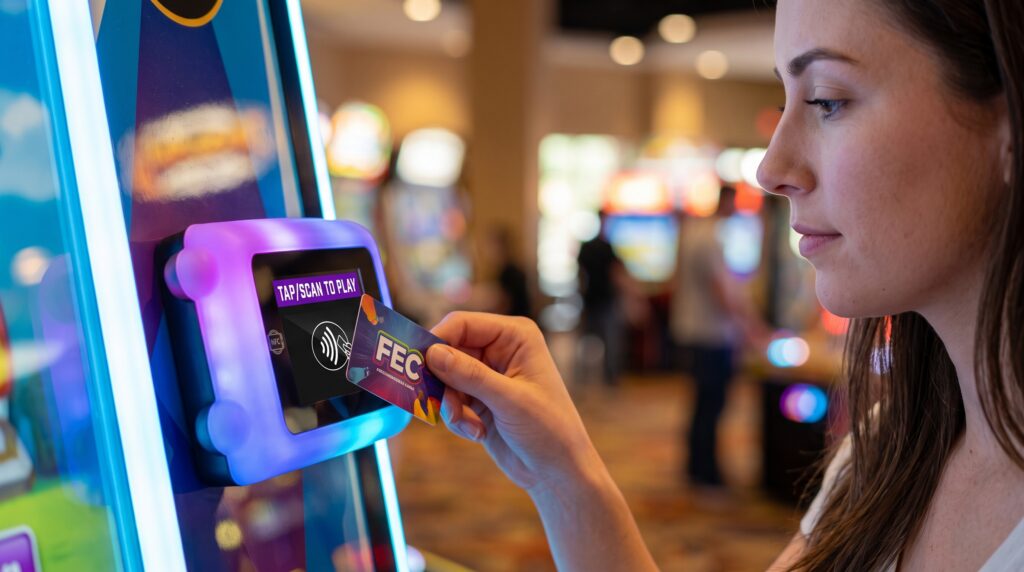
An arcade card system replaces coins and tokens with a rechargeable card (or wristband) that guests load with credits and tap at each game — readers on the machines, self-service kiosks for top-ups, and software tracking every balance and every play centrally. The card is the visible part; the system is the software behind it, which is where the pricing control, the data and the revenue mechanics actually live.
Six Names, One Thing
Before anything else, a decoding service — because this category hides behind more aliases than almost any other in venue software. Arcade card system, arcade game card system, arcade debit card system, arcade swipe card system, arcade card reader system, cashless card arcade system: all six describe the same thing. The variations are historical (magnetic swipe cards came first, tap-to-play RFID replaced them), regional, or just vendor branding. If a distributor quotes you a “debit card system” and a blog compares “cashless systems,” you’re reading about one category. That’s worth knowing before you search for quotes — and it’s why this guide answers all six names at once.
Card System vs Coin-Op: Which Makes More Money?
The question every operator actually has. Instead of adjectives, follow the same $100 of guest intent through both systems and watch where it grows, leaks, or costs you labor:
| The moment |
Coin-op arcade
|
Card system arcade
|
|---|---|---|
| The load | Guest changes $20 into tokens; the other $80 stays in their pocket | Guest loads $25 at a kiosk because the $25 tier came with bonus credits — upsell automated |
| Mid-visit | Out of tokens mid-streak; the walk to the change machine is where spending stops | Re-tap at the nearest kiosk in seconds; the streak — and the spending — continues |
| The price of a play | Locked to coin denominations; repricing a game means opening hardware | Set per game, per daypart, remotely — happy-hour pricing is a software setting |
| What goes home | Leftover tokens in a drawer — goodwill spent, revenue unredeemed but liability-shaped | Leftover credits stay on a card that only works at your venue — a built-in reason to come back |
| The close of day | Staff empty coin boxes, count cash, log jams — hours of labor and shrinkage risk | Reconciliation is a report; the “cash” never left the software |
| What you learned | Which coin box was heaviest | Plays per game, per hour, per guest — which machines earn their floor space and which don’t |
How much does all that add up to? The most-cited number comes from Amusement Connect — a card-system vendor — which claims that “upgrading your arcade with a game card system can give you a 20% boost in sales,” adding that industry benchmarks put 20% as a minimum. Treat that as a vendor’s own number: directionally plausible given the mechanics above, but it’s a company selling card systems describing the upside of card systems. No independent audited figure exists for this market, and anyone who quotes one without that caveat is reselling marketing. What neutral trade press does document is the direction of travel: RePlay Magazine’s cashless systems survey caught the industry mid-transition back in 2020, with vendors across the board reporting accelerating adoption — the shift itself isn’t in dispute; the size of the uplift is what varies by venue.
When Coin-Op Still Wins
The honest counterweight: sometimes the coin is the product. Retro arcades and barcades sell nostalgia, and the weight of a quarter in the hand is part of the experience their customers pay for. Tiny game rooms with a handful of cabinets may never recover reader hardware costs. And vintage cabinet collectors often prefer machines unmodified. If your business is one of these, coin-op isn’t a legacy problem — it’s your brand, and this article’s math doesn’t apply to you.
What Does an Arcade Card System Cost?
Here’s the honest state of pricing in this market: the major card-system vendors quote by venue size rather than publishing price lists, so any specific dollar figure you read in a blog is either a guess or somebody’s old invoice. What you can budget rigorously is the structure — four layers, one of which dominates:
- Readers — the multiplier. Every game that takes the card needs one. Fifty machines means fifty readers plus installation; this line scales with your floor and dominates most quotes. Count your machines before any sales call.
- Kiosks. Self-service sale and top-up stations — typically a few per venue, placed where credits run out (game floor, not just the entrance). They also cut front-desk labor: at Elev8 Fun, kiosk-first operations reached one employee overseeing four kiosks.
- The media. Cards or wristbands — cheap per unit, recurring forever, and worth branding well since they go home in wallets as a physical re-visit reminder.
- The software and support contract. Recurring, structured differently per vendor — some monthly per site, some tied to volume. This is where three-year total cost comparisons beat hardware-sticker comparisons every time.
Set against those lines: the cash-handling labor that disappears, the shrinkage that stops, and the unspent credits that stay with you. Get quotes from at least two vendors, compare at three-year total cost, and make the data features part of the price conversation — the reporting layer is where the 20%-style upside gets captured or missed.
How to Choose: What Should You Look For?
The questions operators are actually asking — “what should I look for in an arcade card system?”, “which is easiest to deploy?”, “easiest to manage?” — collapse into three checks that separate vendors better than any feature list:
- The retrofit test. Deployment ease is mostly reader count and installation logistics. Ask each vendor for a deployment timeline from a venue your size — machines, not months, is the honest unit.
- The integration test. Does the card system plug into your existing POS and platform, or does it arrive with its own parallel till, its own reports and its own guest list? The second option works — as long as you’ve priced running two systems forever.
- The lost-card test. Watch staff block a lost card and reissue the balance, live, in the demo. It’s a moment of software that predicts every day of manageability after launch.
And the brand question — Sacoa, Embed, Semnox or Intercard? That’s a genuinely separate decision with real differences by region and venue mix, and we gave it its own head-to-head: our cashless card systems comparison profiles all four honestly. This guide stays brand-neutral so that one doesn’t have to.
The Question Nobody Puts on the Shortlist
Disclosure: BMI Leisure is our platform, and this is the part where our interest lives — flagged so you can weigh it. Whichever card brand wins your quote comparison, one question will matter more than the brand five years from now: who owns the guest record? A card system alone knows game plays. A venue platform that integrates the card system — ours connects Sacoa, Intercard and Amusement Connect, among others — sells and reloads credits through the same POS and kiosks as everything else, lets credits buy food and drinks, keeps balances attached to guests (transferable when a card is lost), and reports the game floor next to bookings and parties instead of in a separate silo.
Elev8 Fun runs exactly that shape — Intercard on the game floor, our platform around it. Put the question in your RFP either way; whoever you buy from should have a good answer.
Cards, Credits, One Guest Record
Whichever card system runs your game floor, the platform around it decides what the data is worth. See how integrated cashless runs at venues like Elev8 Fun.
Frequently Asked Questions
What is an FEC arcade debit card system?
It’s the same thing as an arcade card system — a rechargeable card (or wristband) that guests load with credits and tap or swipe at each game, with readers on the machines and software tracking every balance centrally. “Debit card system”, “game card system”, “swipe card system” and “cashless card system” are vendor and operator names for one category. In an FEC, the same card typically also pays for food, attractions and parties when the system is integrated with the venue’s platform.
Does a card system make more money than coin-op?
The revenue mechanisms favor cards: unspent credits stay in the venue (coin-op’s equivalent — tokens taken home — helps nobody), top-ups are frictionless at kiosks, game pricing changes remotely instead of being locked to coin denominations, and every play becomes data. Card-system vendor Amusement Connect claims a 20% minimum sales boost — treat that as a vendor’s own number, not an audited industry figure. What’s certain is the cost side: less cash handling, fewer mechanical jams, no coin-counting labor. Coin-op still wins where the coin is the product: retro arcades and barcades selling nostalgia.
How much does an arcade card system cost?
Vendors quote by venue size rather than publishing price lists, so budget by layers: a reader for every game (the biggest multiplier — count your machines), self-service kiosks for sales and top-ups, the cards or wristbands themselves (cheap per unit, recurring), and the software/support contract. Ongoing fees vary by vendor model. The offsets are real too: cash-handling labor drops, and unspent credits stay with the venue. Get quotes from at least two card-system vendors and compare total cost across three years, not the hardware sticker.
Which arcade card system is better for FECs?
The four major dedicated vendors are Sacoa, Embed, Semnox and Intercard, and the honest answer depends on your venue’s mix and region — we compared all four head-to-head in a dedicated guide rather than crowning one here. The complementary question matters just as much: whichever card brand you pick, decide who owns the guest record — the card system alone, or a venue platform it integrates with.
What’s the easiest arcade card system to deploy?
Ease of deployment is decided less by brand than by three practical factors: how many games need readers (retrofit scope), whether the system integrates with your existing POS and booking platform or requires its own parallel stack, and whether staff workflows — selling, reloading, resolving a lost card — happen in software they already use. Ask every vendor for a deployment timeline from a comparable venue, and ask to see the lost-card flow live: it’s the best proxy for day-to-day manageability.
Sources
- RePlay Magazine — Cashless System and Software Survey (September 2020; five cashless/software vendors surveyed — Party Center Software, Semnox, Sacoa, SMART Software, Coin Tech — documenting the industry’s accelerating coin-to-cashless transition). replaymag.com — verified September 1, 2026.
- Amusement Connect — Why You Need a Card System for Your Arcade (vendor’s own claims: “20% boost in sales”, “industry benchmarks state a 20% minimum”; token/ticket elimination, usage data). amusementconnect.com — verified September 1, 2026.
- BMI Leisure — Cashless & Arcade Solutions feature page (digital arcade credits, automated prize redemption, credits usable for food and drinks, loyalty integration). bmileisure.com/features — verified August 24, 2026.
- BMI Leisure — Arcade Integrations feature highlight (integrations with Sacoa, Intercard, Amusement Connect and others; credits sold and reloaded via POS and kiosks, linked to guests, transferable on loss). bmileisure.com — verified August 24, 2026.
- BMI Leisure — Elev8 Fun case study (Intercard cashless on the game floor, BMI platform around it; one employee overseeing four kiosks). bmileisure.com — verified August 18, 2026.
The revenue comparison in this guide describes mechanisms, not guarantees — your results depend on your venue, and the one quantified uplift figure cited (20%) is a card-system vendor’s own published claim, labeled as such because no independent audited figure exists for this market. Hardware and software costs are quoted by venue size across the industry; treat any specific dollar figures you find elsewhere accordingly. BMI Leisure is the publisher of this guide and offers cashless modules and card-system integrations as part of its venue platform, disclosed above; the card-system brand comparison is a separate, linked guide. Last updated: September 1, 2026.