Ask for arcade POS advice online and the top answer is a forum thread telling you a simple retail till plus a card system will do. Ask the vendors and each sells you their whole ecosystem. Both answers are half right — because an arcade pos system isn’t really one decision. It’s an architecture decision (which of three setups runs your venue) followed by a counter-by-counter test (front desk, snack bar, prize wall, party room — the till works differently at each). This guide walks both, in that order, and tells you honestly when the cheap answer is the correct one.
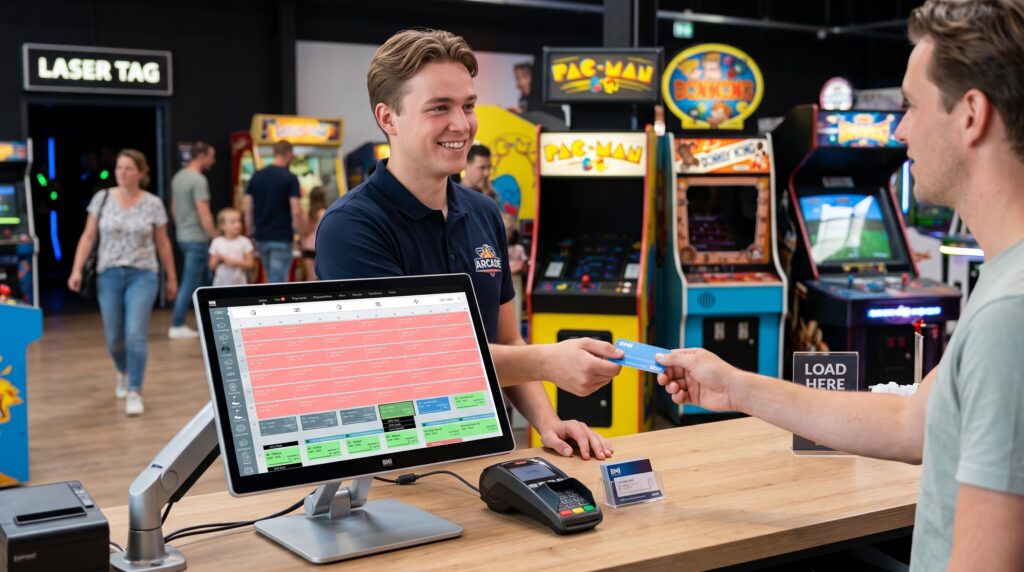
What Is an Arcade POS System?
An arcade POS system is the point of sale built for how arcades actually sell: game credits and card reloads at the front desk, food and drinks at the snack bar, prize redemption at the counter, and party packages — all against one guest record. It differs from retail POS in one structural way: most of what an arcade sells isn’t a product handed over, it’s stored value and entitlements that must follow the guest around the venue.
That stored-value point is the whole category, and it’s why an arcade point of sale earns its own name. A clothing store’s POS closes a transaction and forgets you. An arcade’s till opens a relationship: the $25 loaded at 2 PM becomes game plays at 2:15, a slice of pizza at 3:30 (per our own cashless module, credits should buy F&B too), and a fistful of redemption tickets at 4 that turn into a prize with real inventory cost. Four counters, one balance, one guest. Whether your software can follow that thread is the entire purchase decision.
The Three Architectures That Can Run Your Till
Every POS system for an arcade centre on the market is one of three architectures. Vendors won’t frame it this way, because each vendor only sells one of them — so here’s the map first, brands second:
| Architecture | How it works | Honest fit | The trade-off |
|---|---|---|---|
| A. Your card system’s POS | The till comes bundled with the cashless ecosystem — Embed’s TOOLKIT includes SALES, Semnox sells the Parafait POS, Amusement Connect has Customer Connect | Game-floor-first venues already committed to one card vendor | Strongest at card sales and redemption; F&B, bookings and parties are the ecosystem’s second language |
| B. Generic POS + card system, side by side | Square or Clover rings up snacks; the card system runs games — two tills, two systems | Small game rooms where the snack bar is simple and parties are rare | Cheapest entry, but two guest records that never meet — no single view of what a visit is worth |
| C. Venue platform POS + integrated card system | The platform’s POS runs F&B, parties, bookings and memberships, and connects to the card system you already own | Arcades that are really FECs — parties, food, multiple attractions, growth plans | One guest record across everything; the platform choice becomes the big decision — see our leisure software guide |
Two lane notes before going deeper. If your real question is which card system — Sacoa against Embed against Semnox against Intercard — we compared the four brands head-to-head in a dedicated guide; this article stays brand-neutral on that choice. And if you’re still weighing coin-op against cards at all, that’s a business-model question with its own economics — a separate analysis we’re publishing this month.
The Four Counters: Where an Arcade POS Earns Its Keep
Architecture picked, walk your own floor. An arcade has four points of sale, and they make different demands on the software. A system that shines at one counter and limps at another is how venues end up with the shadow-spreadsheet problem.
🎟️ Counter 1: The Front Desk — selling stored value
The till here sells game cards, reloads, time passes and memberships — value that lives on a card or wristband, linked to a guest so a lost card isn’t lost money. This is where an arcade management POS differs most from a cash register: it’s issuing credentials, not just taking payment. Peak-day test: can a kiosk take over the routine sales and reloads? At Elev8 Fun, moving registration and top-ups to kiosks reached one employee overseeing four kiosks — front-desk staffing scaling with service, not queues.
🍕 Counter 2: The Snack Bar — retail speed, shared guest
This is the one counter where a generic POS genuinely competes — food and drink is what Square and Clover were built for. The arcade-specific demand is a single detail with big consequences: can arcade credits pay here? If game-card balances spend at the snack bar, stored value becomes venue-wide currency — removing a reason not to buy that pizza; if not, you’ve built a border crossing inside your own venue. This is the integration test in miniature.
🧸 Counter 3: The Prize Counter — the strangest till in retail
Redemption is inventory management wearing a game’s clothing: tickets in, plush toys out, shrinkage everywhere. The POS must track prize stock and its cost against tickets redeemed — because redemption economics can quietly decide arcade margins. This is also the counter where card-system POS products (built around exactly this flow) are legitimately at their best; any platform you evaluate should either match it or integrate it.
🎂 Counter 4: The Party Room — the till that inherits a booking
The party sale didn’t start at a counter — it started on your website days earlier, with a package, a deposit and a guest list (the full party booking chain). The POS question is whether that booking lands in the same system the day-of charges run through: the balance due, the extra pizzas, the add-on game cards for ten kids. If the party lives in one tool and the till in another, Saturday’s most valuable transaction is also its most manual.
Can I Run My Arcade on Square or Clover?
The forum answer deserves a straight treatment, because for a real slice of operators it’s correct. Square’s POS is built for retail, restaurants and services — and it’s genuinely good at them. Its own product pages, though, contain no mention of game cards, prize redemption or party bookings, because that’s not its market. So the honest rule is scope, not brand: if your arcade is games plus a simple till — a card system running the floor, drinks and candy at the counter, few parties — architecture B works, costs least, and you should take the savings. You’re accepting two disconnected systems, and at that scale the disconnection barely bites.
The outgrowing moment is predictable, because it’s always the same three triggers: parties become a revenue line (bookings, deposits, day-of billing), redemption inventory starts mattering to margins, or a second location appears and suddenly best arcade POS for multi-location operators is your search history. Each trigger is a job generic POS was never built for — and the same pattern we documented at the till level in our FEC POS guide and across venue types in our entertainment POS overview. (The same test applies to a VR arcade POS, by the way — stations instead of cabinets, but the identical architecture question underneath.)
Who Owns the Guest Record?
Strip the demos away and the architecture question reduces to this: when a guest loads $25, buys pizza, redeems tickets and books next month’s birthday party, how many systems hold a piece of that guest? Architecture B answers “at least two, and they don’t talk.” Architecture A answers “one — as long as everything stays inside the card vendor’s ecosystem.” Architecture C answers “one — the platform — with the card system plugged in.”
The plugged-in part is not theoretical. Our own platform integrates arcade card systems including Sacoa, Intercard and Amusement Connect: credits are sold and reloaded through the same POS and kiosks that sell everything else, linked to the guest (transferable if a card is lost), spendable on food and drinks, and reported alongside every other revenue stream. Elev8 Fun runs exactly this shape — BMI platform for booking, F&B, kiosks and parties, Intercard on the game floor — one operation, one guest record, two systems doing what each does best.
Where We Sit in This Taxonomy
Disclosure: BMI Leisure is our platform, so read this paragraph as the vendor speaking. In the three-architecture map above, we are architecture C — a venue platform whose POS runs the front desk, snack bar and party room (with a simplified high-speed mode for busy bars), and whose arcade integrations connect the card system rather than replace it.
We’re the right conversation for the arcade that’s really an FEC — parties, food, growth plans, maybe a second site. We’re the wrong one for a ten-machine game room, where architecture B and the money it saves is our sincere recommendation. If you’re unsure which you are, the four counters above are the tiebreaker: count how many of them are real revenue lines for you.
Four Counters. One Guest Record.
Front desk, snack bar, prize wall and party room on one POS — with your card system integrated, not replaced. See how it runs at venues like Elev8 Fun.
Explore the POSFrequently Asked Questions
What is an arcade POS system?
An arcade POS system is the point of sale built for how arcades actually sell: game credits and card reloads at the front desk, food and drinks at the snack bar, prize redemption at the counter, and party packages — all against one guest record. It differs from retail POS in one structural way: most of what an arcade sells isn’t a product handed over, it’s stored value and entitlements that must follow the guest around the venue.
What’s the best POS for an arcade center?
It depends on which of three architectures fits your venue. Small game rooms often run a generic POS like Square for snacks plus a separate card system for games — cheap, but two disconnected guest records. Card-system vendors (Embed, Semnox, Amusement Connect) offer POS built into their ecosystems — strong on the game floor. Venue platforms run their own POS for F&B, parties and bookings and integrate the card system — one guest record across everything. Pick the architecture first; the brand second.
Can I run my arcade on Square or Clover?
For the snack bar alone — yes, and plenty of small arcades do. Square’s POS is built for retail, restaurants and services, and it handles drinks and candy fine. What it has no concept of is game cards, prize redemption inventory, or party bookings — its own pages never mention them. The honest rule: if your arcade is games plus a till, a generic POS plus your card system works, at the cost of two systems that don’t share a guest. The day parties, memberships or redemption tracking matter, you’ve outgrown it.
Do I need a separate POS if I already have a card system?
Your card system likely includes one — Embed’s TOOLKIT bundles SALES, Semnox sells a Parafait POS, Amusement Connect has Customer Connect. Built into the ecosystem, they’re strongest at card sales and redemption. The question to ask is what runs everything else: F&B at busy hours, party deposits taken online, bookings, memberships. If the answer is spreadsheets and a second till, that’s the gap a venue platform’s POS fills — while integrating the card system you already own rather than replacing it.
What’s the best arcade POS for multi-location operators?
One with native multi-venue architecture: central products and pricing, one guest database across sites, and group-level reporting — so a game card or credit balance loaded at one location is recognized at all of them, and management compares venues on one screen. Card-system vendors offer multi-site dashboards for the game floor; the platform layer adds the same consolidation for F&B, parties and bookings. Ask any vendor to show two locations managed from one login before you sign.
Sources
- Semnox / Parafait — arcade industry and POS pages (“1800+ venues across 50+ countries”; centralized POS across all transaction points and centers). parafait.com — verified August 24, 2026.
- Amusement Connect — Customer Connect Point of Sale (“pay with Cash, Credit, Arcade Credits, or a split combination”; integrated with the vendor’s card-reader dashboard). amusementconnect.com — verified August 24, 2026.
- Embed — company homepage (TOOLKIT core bundle: SALES, PRIZES, REPORTS, Mobile Wallet — the POS inside the card ecosystem). embedcard.com — verified August 24, 2026.
- Square — Point of Sale product page (retail, restaurants and services positioning; no arcade, game-card, redemption or party-booking capabilities mentioned). squareup.com — verified August 24, 2026.
- BMI Leisure — Arcade Integrations feature highlight (integrations with Sacoa, Intercard, Amusement Connect and others; credits sold/reloaded via POS and kiosks, linked to guests, spendable on F&B). bmileisure.com — verified August 24, 2026.
- BMI Leisure — Elev8 Fun case study (BMI platform with Intercard integration; one employee overseeing four kiosks). bmileisure.com — verified August 18, 2026.
Vendor capabilities reflect each company’s own published pages as of the verification dates above and may change. BMI Leisure is the publisher of this guide and competes in the venue-platform architecture described (C), disclosed above; card-system vendors named here are described as architecture examples, and our brand-by-brand comparison of card systems is a separate, linked guide. Generic POS tools (Square, Clover) are recommended sincerely where they fit — evaluate any option, ours included, against your own four counters in a live demo. Last updated: August 24, 2026.