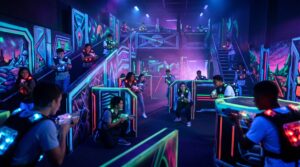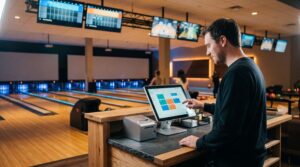
Eatertainment, a blend of “eating” and “entertainment,” describes venues where food and drink sit alongside an activity such as bowling, arcade games, golf or ping pong, so guests come to play and stay to eat, or the other way round.
Many explanations of eatertainment are written from the restaurant side and focus on definitions and examples. This guide adds what the definitions leave out: how the largest public operators actually split their revenue between food, drinks and play, according to their annual reports, and what it takes to run both under one roof. We make venue management software for activity venues, so we flag where our product comes in.
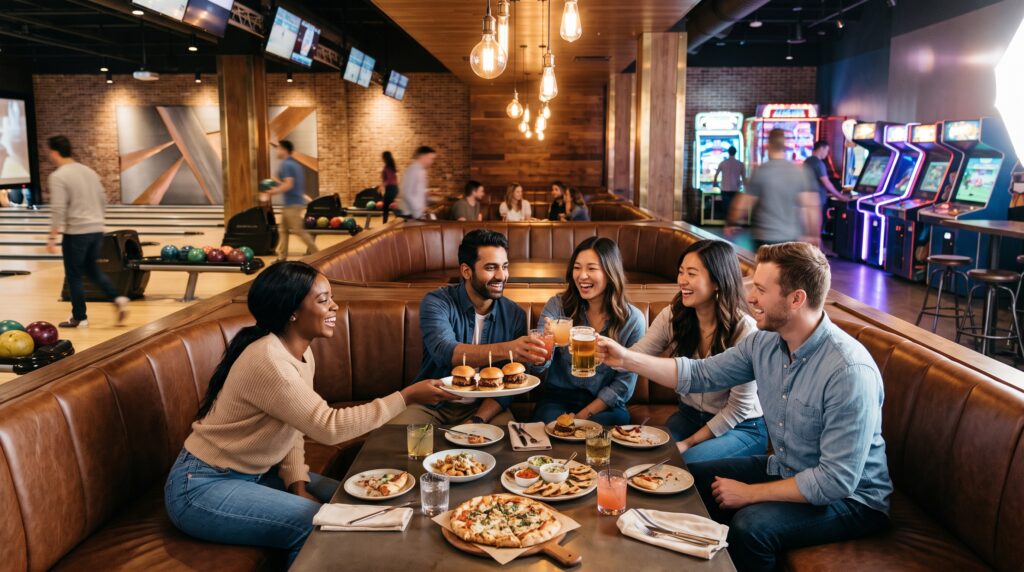
What is eatertainment? It’s a venue concept that combines a full food and beverage operation with an activity, under one roof and usually on one bill. Typical formats:
- Arcade and sports bar, such as Dave & Buster’s.
- Upscale bowling with lounge seating and an enhanced menu, such as the Lucky Strike brand.
- Golf, putting and social games, such as Topgolf, Puttshack, ping pong or pickleball venues.
- Family entertainment centers with bowling, laser tag and arcade plus food, such as Main Event.
At two large public operators, the activity brings in most of the revenue: about 63% at Dave & Buster’s and 65% at Lucky Strike Entertainment (45% bowling plus 20% amusement and other, our sum) in their latest fiscal years.
Eatertainment Meaning and Other Names
The word is a portmanteau. SevenRooms, a restaurant software company, defined it in 2019 as “a guest experience that involves food and/or beverage dining before, after, or during other activities.” In practice, the term covers anything from a bar with oversized lawn games to a venue like Level 99 in Boston, which investor Ron Shaich described to Restaurant Business as 40,000 square feet with 40 challenges, a farm-to-table restaurant and a brewery.
Some restaurant-tech vendors, such as Rex Reservations, use the term competitive socializing for venues built around group games like axe throwing, darts and mini golf, and experiential dining for concepts where the meal itself is the entertainment. These are vendor labels, not formal categories. In our experience, operators who started as family entertainment centers, bowling centers or karting tracks often reach the same model from the other direction: they add a real kitchen and bar to an activity venue.
Common Eatertainment Formats
| Format | Examples | What guests do |
|---|---|---|
| Arcade, sports bar and restaurant | Dave & Buster’s (“Eat Drink Play and Watch”) | Play redemption and simulation games with a game card, eat, drink and watch live sports |
| Bowling-led venues | Lucky Strike (upscale), AMF (traditional, updated) | Bowl; upscale brands add lounge seating, arcades and enhanced food and beverage, while AMF is traditional bowling in an updated format |
| Family entertainment centers | Main Event Boomers | Main Event: bowling, laser tag, arcade games, virtual reality, food and drinks. Boomers: a family entertainment concept with various attractions |
| Golf-based concepts | Topgolf Puttshack | Golf concepts that Restaurant Business lists among eatertainment brands; Puttshack pairs technology with its courses |
| Social games | Spin (ping pong), Chicken N Pickle (pickleball) | Ping pong in a lounge setting (Spin); pickleball with dining (Chicken N Pickle) |
| Challenge-based venues | Level 99 | Challenge-based entertainment (art installations and puzzles), with a restaurant and brewery on site |
Venue descriptions come from the operators’ annual reports and from Restaurant Business. Brand names are trademarks of their owners; BMI Leisure has no affiliation with them.
How Eatertainment Venues Make Money: The Public Numbers
Two large eatertainment operators in North America are listed companies, so they publish their revenue mix every year. Here is what their latest annual reports show:
| Revenue line | Dave & Buster’s (fiscal year to Feb. 3, 2026) | Lucky Strike Entertainment (fiscal year to June 28, 2026) |
|---|---|---|
| Activity | Entertainment: 62.9% | Bowling: 45% · Amusement & other: 20% |
| Food | 25.5% | Food & beverage: 35% |
| Beverages | 11.6% | |
| Total revenue | $2.10 billion | $1.25 billion |
| Locations | 243 (179 Dave & Buster’s, 64 Main Event) | 366 (Lucky Strike, Bowlero, AMF, Boomers and others, including 5 water parks) |
So in these two companies, about a third of revenue comes from food and drink and roughly two-thirds from the activity. That is worth knowing, because SevenRooms, a restaurant software company, wrote in 2019 that F&B spend “can account for 85% of sales” in eatertainment. In the same post, Pinstripes, a bowling and bocce venue, reported an 80% food and beverage and 20% gaming split. The mix clearly varies by concept, and these two public activity-led operators report the opposite balance.
The margin difference
The product costs tell a second story. Dave & Buster’s reports that its cost of entertainment was 8.1% of entertainment revenue, while its cost of food and beverage was 24.8% of food and beverage revenue. Lucky Strike reports $96.6 million of location food and beverage costs against $431.1 million of food and beverage revenue, or about 22% (our arithmetic). Staff, rent and equipment come on top of both lines, and these are company-wide figures, not a single venue’s.
The practical reading, in our view: the activity carries the higher product margin, and food and drink extend the visit and raise spend per guest. Dave & Buster’s itself credits its higher food and beverage revenue in fiscal 2025 to “an improved menu and higher food attachment rates associated with operational enhancements to the Eat and Play combo promotion.”
Is Eatertainment Still Growing?
After the pandemic, eatertainment boomed. Restaurant Business reported in October 2023, citing foot-traffic tracker Placer.ai, that visits to eatertainment concepts in January 2023 were up more than 20% year over year, and that traffic at Bowlero (a bowling brand of the company now named Lucky Strike Entertainment) was up nearly 20% in February 2023 and Topgolf traffic up more than 22%, both against 2019.
The latest annual reports are more mixed:
- Dave & Buster’s revenue fell 1.4% to $2.10 billion in fiscal 2025, with comparable store sales down 5.0%, “due primarily to a reduction in walk-in business.” It reported a net loss of $48.7 million, after a $58.3 million profit the year before.
- Lucky Strike Entertainment grew revenue 4% to $1.25 billion in fiscal 2026, “primarily attributable to revenue from newly acquired or leased locations, with same-store revenues essentially flat.” Amusement and other revenue rose 11%. It reported a net loss of $35.8 million, against a $10.0 million loss the year before.
Demand for going out to eat and play is real, but the category is competitive and walk-in traffic can soften. Dave & Buster’s says it remains focused on growing special events sales, including “optimized online booking and entertainment offerings tailored towards group events.” In our view, planned group visits are the part of the business an operator can sell in advance.
What It Takes to Run an Eatertainment Venue
Running a kitchen and an activity floor together is harder than running either one. These are the operational pieces that decide whether the model works:
- One guest, one tab. A group that bowls, eats and plays arcade games should be able to pay once. SevenRooms makes the same point from the restaurant side: one tab open for three hours is simpler than three separate bills.
- Orders that reach the lane or table. Food has to arrive at the right lane, bay or table, so orders need to be tied to seating or service zones.
- Packages that bundle food and play. Eat-and-play combos, birthday parties and corporate events raise food attachment and fill quiet hours. Our party booking guide covers the booking side.
- Capacity on two clocks. Lanes, bays and games turn over by the hour, while tables turn over by the meal. Online booking has to manage both so groups don’t wait for one after finishing the other.
- Cashless play. Game cards or wristbands with credit, as at Dave & Buster’s, keep the arcade moving and make bundles easy to sell.
Indoor Karting Barcelona is a real example of an activity venue run this way. It combines a karting track, an eight-lane bowling center, a laser tag arena and a restaurant that fills with birthday parties at weekends, all sold from one system. “As we have more than one activity, the BMI Leisure point of sale makes it very easy to get all the clients onto the different activities at the same time,” says owner Oliver Vervaet. Read the full case study.
Disclosure: BMI Leisure makes venue management software for activity venues. Our food and beverage module automates kitchen orders and supports kiosks and mobile ordering, and our order and table management can link devices to service zones for targeted order routing. For the checkout side, see our guide to entertainment POS systems. If you’re planning a venue from scratch, our guides to starting a family entertainment center and bowling alley software go further.
Running Food and Activities Under One Roof?
Tell us what you run today and what you want to add. We’ll show you how bookings, food and beverage orders and activities can run from one system.
Talk to Our TeamFrequently Asked Questions
What does eatertainment mean?
Eatertainment combines “eating” and “entertainment.” It describes venues that pair a full food and beverage operation with an activity, such as bowling, arcade games, golf, ping pong or pickleball, so guests eat, drink and play in one visit, usually on one bill.
What do you call a restaurant with entertainment?
It’s usually called an eatertainment venue. Some restaurant-technology vendors use the label competitive socializing for venues built around group games such as axe throwing, darts or mini golf, and experiential dining for concepts where the meal is the entertainment, such as dinner theaters. These are vendor labels rather than formal categories.
What are examples of eatertainment?
Well-known examples include Dave & Buster’s (arcade, sports bar and restaurant), Lucky Strike (upscale bowling), Main Event (bowling, laser tag, arcade and virtual reality), golf-based concepts such as Topgolf and Puttshack, Spin (ping pong) and Chicken N Pickle (pickleball). Many family entertainment centers, bowling centers and karting tracks with a full kitchen work the same way.
How do eatertainment venues make money?
From both the activity and food and drink. At the two public operators we looked at, the activity is the larger share: Dave & Buster’s earned 62.9% of its fiscal 2025 revenue from entertainment and 37.1% from food and beverages, and Lucky Strike Entertainment earned 65% from bowling, amusement and other (45% plus 20%, our sum) and 35% from food and beverage in fiscal 2026. At Dave & Buster’s, the cost of entertainment was 8.1% of entertainment revenue against 24.8% for food and beverage, and food and drink extend the visit.
Is eatertainment profitable?
It can be, but results vary by operator and year, and neither of these two listed operators reported a profit in its latest year. Dave & Buster’s revenue fell 1.4% in fiscal 2025 and it reported a net loss of $48.7 million, after a $58.3 million profit the year before. Lucky Strike Entertainment’s revenue rose 4% in fiscal 2026, mostly from newly acquired or leased locations, and it reported a net loss of $35.8 million. In our view, rent, staffing and group bookings sold in advance matter as much as the concept.
Sources
- Dave & Buster’s Entertainment, Inc. — Annual Report on Form 10-K for the fiscal year ended February 3, 2026 (revenue mix, product costs, comparable store sales, net income, store count, Eat and Play combo, special events). sec.gov — verified October 21, 2026.
- Lucky Strike Entertainment Corporation — Annual Report on Form 10-K for the fiscal year ended June 28, 2026 (revenue mix, food and beverage costs, net loss, same-store revenue, location count by brand). sec.gov — verified October 21, 2026.
- Restaurant Business — Eatertainment booms as result of perfect storm, October 23, 2023 (Placer.ai traffic data; Spin, Chicken N Pickle, Puttshack, Level 99). restaurantbusinessonline.com — verified October 21, 2026.
- SevenRooms — What Is Eatertainment? Hear It From The Experts, February 7, 2019 (definition; “85% of sales” claim; Pinstripes 80/20 split; one-tab point). sevenrooms.com — verified October 21, 2026.
- Rex Reservations — What Is Eatertainment? The Most Popular Concepts Right Now, April 24, 2026 (“competitive socializing” and “experiential dining” labels). reservewithrex.com — verified October 21, 2026.
Financial figures come from each company’s annual report for the fiscal year shown and cover the whole company, not a single venue. Product-cost percentages are as reported, except Lucky Strike’s food and beverage cost ratio, which is our arithmetic. Brand names are trademarks of their owners. BMI Leisure is the publisher and sells venue management software, disclosed above. Last updated: October 21, 2026.