
Families have never had more ways to spend a Saturday — streaming, mobile games, the FEC across town. Winning that Saturday is what family entertainment center marketing is really about: not just filling seats once, but building the kind of local reputation and repeat-visit habits that keep your venue busy on a rainy Tuesday too. This guide walks through the strategies, channels, promotions and systems that actually move attendance and revenue — with a simple 90-day plan you can start this week.
What Is Family Entertainment Center Marketing?
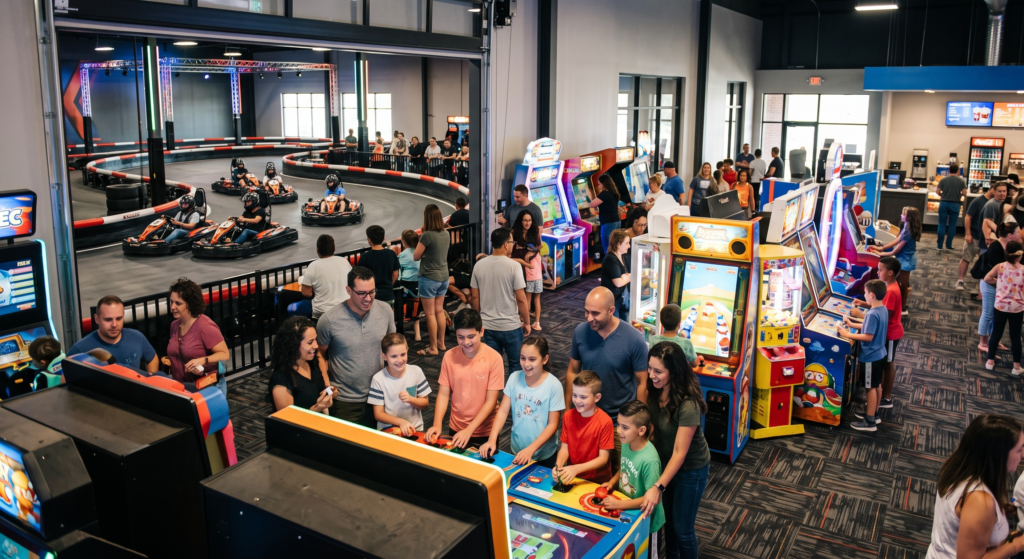
Family entertainment center marketing is how an FEC attracts new families, brings past guests back, and grows revenue across local search, social, email, SMS, on-site and partnership channels. What makes it its own discipline: you’re selling an experience, not a product someone takes home — and you’re marketing to two people at once, the kid who wants the fun and the parent who books and pays.
That double audience changes everything. Your ad has to spark a child’s excitement and answer a parent’s practical questions in the same breath. Add strong seasonality, weather swings, and revenue that depends on repeat visitors. Playbooks borrowed from retail or restaurants tend to miss all three. Great FEC marketing is built around three things: getting found locally, converting the visit, and — the part that pays the bills — earning the next visit.
Why FEC Marketing Looks Different in 2026
The tailwind is real: IAAPA’s quarterly State of the Global Attractions Industry reports show encouraging attendance across most regions, and market analysts project sustained growth for family entertainment centers through the decade. Indoor, weather-proof venues that rely on repeat visits — exactly your model — are a big reason the sector keeps growing.
But a rising tide floats every boat, including your competitors’ down the road. Families in 2026 decide fast, on a phone. They compare you against every other option before they leave the couch. That raises the bar on three fronts:
- Discoverability. If you’re not the obvious answer to “things to do with kids near me,” you’re invisible at the exact moment a family is choosing.
- Trust at a glance. Real photos, current hours, honest pricing and answered reviews now do more selling than any slogan.
- Repeat mechanics. Growth compounds when memberships, parties and win-back campaigns are built into how you operate — not bolted on when things get slow.
The 7 Marketing Strategies That Actually Fill FECs
You don’t need all of these on day one. Pick the two or three that match where your gaps are — slow weekdays, thin party calendar, low repeat rate — and go deep before adding more. Here’s what works, and how to run it.
1. Own local search (Google Business Profile + local SEO)
This is unglamorous and it’s the foundation of every family entertainment center advertising plan. When a parent searches “family fun center [your city],” you want to be the top, obvious pick. Claim and fully complete your Google Business Profile, keep hours and pricing current, upload real event photos regularly, and reply to every review — the good and the bad. Reviews carry more weight than most owners realize: 71% of consumers regularly read online reviews for local businesses, and 83% read them on Google, per BrightLocal’s Local Consumer Review Survey. Then make sure your website answers the questions parents actually type: How much does it cost? What ages is it for? Can I book a birthday party? Do you have food and concessions? Put those answers up front, not three clicks deep.
2. Turn social proof into reach (organic + paid social)
Your venue is inherently photogenic — use it. Post short video of the real energy on the floor, not stock imagery. Encourage guests to tag you with a venue hashtag; user-generated content is free, trusted marketing. Then put a modest paid budget behind your best-performing organic posts, targeted at local parents. On social, a handful of authentic, consistent posts beats a polished campaign nobody shares. When you’re ready to go deeper on paid, our guide to advertising a location-based venue covers the platform playbook in detail.
3. Email and SMS that bring guests back
This is where repeat revenue is won. Email is your workhorse for newsletters, seasonal events and party reminders; SMS is your sharpest tool for time-sensitive nudges — a weekday flash offer, a party-slot reminder, a “we miss you” note to a family that hasn’t visited in 60 days. Both get dramatically more powerful when they’re connected to booking data. The family that always books parties gets party offers; the weekday crowd gets weekday deals.
4. Make parties and group bookings effortless
Birthday parties, school field trips, team celebrations and corporate events are where many FECs earn the biggest, most predictable slices of revenue. The single biggest leak here is friction: if a parent has to call to get pricing or availability, you’ll lose them to the venue that lets them book online in ninety seconds. Make party booking self-serve, then market it — a reminder timed to a child’s upcoming birthday converts remarkably well.
5. Memberships and loyalty for repeat revenue
Turning one-time visitors into regulars is the highest-leverage move in the whole industry. Memberships, loyalty rewards and return-visit incentives lift lifetime value and smooth out your slow periods. A structured refer a friend campaign then turns those happy regulars into your acquisition channel. They work best stacked with parties and seasonal events: the family that comes for a birthday becomes the family with a monthly pass, and the family that brings the next one.
6. Community partnerships (including local influencers)
Your community is your most underused channel. Team up with local restaurants for dinner-and-play packages, hotels for visitor bundles, schools for fundraising nights, and sports leagues for team celebrations. Sponsor a Little League team, donate a party package to a school auction, show up at the town festival. It rarely shows up cleanly in a spreadsheet, but it shows up as word-of-mouth and the kind of local reputation that makes families choose you by default. These are the same dynamics we break down in our guide to face to face marketing.
The modern extension of community marketing is local influencer partnerships: regional family bloggers and parent creators whose audience is exactly your 15-mile radius. A hosted visit in exchange for an honest post typically costs a fraction of paid ads and lands with far more trust. Prioritize genuinely local creators with engaged followings over raw follower counts — a parent with 8,000 local followers beats a generic account with 80,000 spread nationwide.
7. On-site experience as marketing
The visit itself is your best ad. Short lines, easy re-loads on game cards, a snack bar that runs fast, staff who make it feel special — that’s what gets photographed, posted and recommended. Marketing brings the first visit; the experience earns the review that brings the next ten. We’ve collected the tactics that work in our guest engagement strategies guide.
Channel cheat sheet: where to spend your energy
| Channel | Best for | Effort | What to measure |
|---|---|---|---|
| Google Business Profile + local SEO | Getting found by nearby families | Low, ongoing | Profile views, direction requests, calls, website clicks |
| Organic social | Trust, community, UGC | Medium, ongoing | Reach, saves/shares, follower growth |
| Paid social | Fast reach to local parents | Medium | CTR, cost per booking, ROAS |
| Repeat visits, events, newsletters | Low once set up | Open rate, clicks, bookings driven | |
| SMS | Time-sensitive offers & reminders | Low | Opt-in growth, redemptions, bookings |
| Parties & groups | High-value, predictable revenue | Medium | Party bookings, avg group size, return rate |
| Community & influencers | Local reputation & word-of-mouth | Medium | Referral visits, partner-driven bookings |
Promotions and Pricing: Grow Revenue Without Training Discount Hunters
The most common FEC marketing mistake is treating marketing as a synonym for discounts. Constant discounting trains families to wait for the next deal, squeezes your margins, and attracts price-shoppers who never become regulars. Smart promotions add value and create urgency instead of just cutting price.
The shift is simple: stop asking “what can I take off the price?” and start asking “what can I add that costs me little but feels like a lot?” A few frameworks that consistently outperform blanket discounts:
- Fill specific gaps. A “Weekday Play Pass” targets slow afternoons without touching your busy weekends.
- Add value, don’t cut price. “Free $10 game card with any party booked by Friday” beats “20% off” — it drives action and protects margins.
- Bundle to lift the average ticket. A family package of admission + game credits + food costs more than the sum feels like — and raises revenue per visit.
- Use light dynamic pricing. Charge a little more at peak demand, a little less off-peak. Airlines and cinemas have done it for decades; FECs can too.
- Upsell at every touchpoint. Online checkout can suggest add-ons, the front desk can offer an upgrade, your site can frame the mid-tier package as the smart choice.
How Your Software Multiplies Every Marketing Effort
Here’s the quiet advantage modern FECs have: the best marketing tools for family entertainment aren’t marketing tools at all — they’re the operational systems that already run your venue. When bookings, POS and guest profiles connect, marketing you couldn’t do by hand starts running automatically.
One guest profile, every channel
When every purchase — a wristband, a walking taco, a birthday party — ties back to a customer profile, you can segment by real behavior instead of guesswork. Party bookers get party offers. Weekday visitors get weekday deals. Families who haven’t been in two months get a win-back. That’s simply impossible when your data lives in spreadsheets and separate apps.
Automation that runs while you sleep
Pre-visit emails, post-visit feedback surveys, birthday reminders, abandoned-cart follow-ups and membership renewals can all run on their own once they’re set up — marketing automation that keeps guests engaged while your team focuses on the floor.
Reporting that tells you what to repeat
Integrated reporting shows which campaigns actually drove bookings, which channels convert, and which guest segments are worth the most. You stop guessing, double down on what works, and cut what doesn’t.
This is exactly what BMI Leisure’s all-in-one platform is built for: online booking, POS, memberships, party packages, wristbands and reporting on one system. Your marketing and your operations finally speak the same language — from a single venue to a 40-location group.
A Simple 90-Day FEC Marketing Plan You Can Run
A family entertainment center marketing plan only works if you’ll actually stick to it. This one is deliberately lightweight — one revenue goal a month, a small channel mix, and three campaign types you rotate. Copy the table, swap in your own goals, and go.
| Month | Primary goal | Signature campaign | Watch this metric |
|---|---|---|---|
| Month 1 — Get found & fill weekdays | Lift weekday attendance | “Weekday Play Pass” + GBP refresh (photos, hours, reviews) | Weekday foot traffic, profile views |
| Month 2 — Grow party revenue | More birthday & group bookings | Birthday spotlight with a limited-time bonus add-on | Online party bookings, avg group size |
| Month 3 — Bring guests back | Raise repeat-visit rate | Membership push + 60-day win-back email/SMS | Repeat-visit rate, redemptions |
Whatever the month, a reliable structure is to run three campaigns at once: one traffic-driver (fills the calendar), one party or group campaign (high-value revenue), and one retention play (brings people back). Track a short list of numbers — attendance, online bookings, revenue per campaign, repeat-visit rate — and let the data tell you where to put next month’s budget. For more ways to grow the same visit, see 3 ways to increase revenue in entertainment centers.
Common FEC Marketing Mistakes (and What to Do Instead)
| Mistake | Why it hurts | Do this instead |
|---|---|---|
| Leaning on discounts | Trains guests to wait for deals; erodes margins; attracts price-shoppers | Add value (bonus credits, add-ons), run limited-time bundles, sell memberships |
| Not tracking results | You can’t tell which channel actually drives bookings, so budget gets wasted | Use promo codes and UTM links; ask new guests how they heard about you |
| One message for everyone | First-timers, party parents and regulars want different things | Segment by behavior and tailor the offer to each group |
| Party booking hidden behind a phone call | Parents drop off the moment they have to call for pricing | Put self-serve online booking front and center |
| Disconnected tools | Manual work caps how much marketing you can run | Unify bookings, POS and guest data on one platform |
BMI Leisure connects your online booking, POS, memberships and guest data — so your marketing targets the right families, runs on autopilot, and shows you exactly what fills the venue.
Get in Touch with Our TeamFrequently Asked Questions
What is family entertainment center marketing?
It’s how an FEC attracts new families, brings past guests back, and grows revenue across local search, social, email, SMS, on-site and partnership channels. It differs from retail marketing because you sell an experience, you market to two decision-makers at once (kids and parents), and long-term growth depends on repeat visits like parties, memberships and group events.
How do family entertainment centers attract more customers?
Combine local visibility with repeat-visit engines. Keep your Google Business Profile accurate and full of real photos, answer the questions parents search (price, ages, parties), then use email and SMS to bring past guests back with timely offers. Parties, memberships and community partnerships turn one-off visits into regular ones — which is where most FEC revenue comes from.
What marketing channels work best for FECs?
For most venues: Google Search and Google Business Profile, organic and paid social (Facebook, Instagram, TikTok), email to past guests, SMS for time-sensitive offers, birthday and group-booking campaigns, and local partnerships with schools, leagues, influencers and hotels. A short, consistent mix beats trying to be everywhere.
How much should a family entertainment center spend on marketing?
The U.S. Small Business Administration recommends 7–8% of gross revenue for businesses under $5M, and most FECs land in a 5–10% range — weighted higher during a launch, a new attraction, or a slow season. What matters more than the exact percentage is measurement — tie every campaign to bookings with promo codes or UTM links so you can shift budget toward what actually fills the venue.
How do you create a family entertainment center marketing plan?
Set one revenue goal for the month (more weekday visits, more parties), pick two or three channels where local families already are, and run one traffic campaign, one party/group campaign and one repeat-visit campaign. Track attendance, online bookings, revenue per campaign and repeat-visit rate. Keep it simple and repeatable.
Do FECs need marketing software?
Not to start — a Google Business Profile and a basic email tool go a long way. Software becomes worth it when manual work slows you down and your guest data, bookings and campaigns live in separate places. An all-in-one venue platform connects bookings, POS and guest profiles so marketing runs automatically instead of by hand.
Sources
- IAAPA — The State of the Global Attractions Industry (quarterly reports on global attendance and spending trends). iaapa.org
- Mordor Intelligence — Family Entertainment Center Market (market size, growth drivers, repeat-visit and F&B monetization trends). mordorintelligence.com
- BrightLocal — Local Consumer Review Survey 2025 (71% of consumers regularly read local business reviews; 83% use Google to read them). brightlocal.com
- U.S. Small Business Administration — How to Get the Most From Your Marketing Budget (7–8% of gross revenue guideline for businesses under $5M). sba.gov
Industry figures are third-party estimates as of 2026 and vary by source and methodology — treat them as directional. Marketing budgets, channel performance and pricing depend on your venue, market and season; test against your own numbers before scaling any campaign. Last updated: July 21, 2026.