Here’s the most expensive mistake buyers make with leisure management software: demoing the wrong category. The same three words describe software for a council swimming pool and software for a go-kart track — two products that share almost nothing beyond a booking calendar. Half the platforms Google shows you are built for memberships and fitness classes; the other half for timed sessions, birthday parties and arcade cards. This guide separates the two markets first, then walks through the features, the vendors on each side, and the seven questions that lead to the right platform.
What Is Leisure Management Software? (Quick Answer)
Leisure management software runs the daily operations of a leisure business — online bookings, scheduling, payments, point of sale, memberships or sessions, and reporting — in one platform. The term covers two distinct markets: software for sports and fitness facilities (gyms, pools, leisure centres) and software for leisure and entertainment venues (FECs, karting tracks, trampoline parks, arcades).
That two-market split is not a technicality — it decides which shortlist you should be building. The leisure industry software you’ll find ranking for this term is mostly built for the first market, because the phrase “leisure centre” is how the UK describes public sports facilities. If you run an entertainment venue and start booking demos from that list, you’ll spend three weeks discovering that class timetables are not party bookings. So let’s fix that first.
One Term, Two Different Markets
Everything about these two software families — data model, workflows, hardware, even the sales process — follows from what the business actually sells:
| Sports & fitness facilities | Leisure & entertainment venues | |
|---|---|---|
| Who | Gyms, swimming pools, council leisure centres, sports complexes, universities | FECs, karting tracks, trampoline parks, arcades, bowling, escape rooms, multi-activity venues |
| What they sell | Recurring memberships, class places, court & lane hours | Timed sessions, admissions, birthday parties, events, game credits |
| Core workflows | Membership billing, class timetables, check-ins, leagues | Session capacity, party bookings, digital waivers, cashless arcade, F&B |
| Revenue peak | Weekday mornings & evenings | Weekends and school holidays |
| Typical vendors | Legend, EZFacility, PerfectGym, XN Leisure, DASH | BMI Leisure, ROLLER, CenterEdge, Semnox |
Which side are you on? Three questions settle it:
- Is your main product a recurring membership or a one-off visit?
- Does a typical Saturday involve class registers — or waivers, party rooms and a prize counter?
- Do you measure success in member retention — or in spend per visit and rebooked parties?
First answers in each pair: you need fitness-side software, and you can shortlist straight from the left column. Second answers: you need activity leisure venue software from the right column — and most of this guide is written for you, because that’s the market we know first-hand.
Core Features Every Leisure Management System Needs
Both markets agree on the spine of the platform. Whatever you run, these six belong in every demo:
- Online booking. Guests book courts, lanes, classes or sessions 24/7, against real availability. For venues, leisure venue booking software must also handle deposits and party packages — not just time slots. (Ours: online booking.)
- Point of sale. One tab for admissions, retail and F&B, sharing its database with bookings — more on POS below. (Ours: POS.)
- Scheduling & capacity. No double-booked courts, no oversold sessions, no manual spreadsheets reconciling the two.
- Guest records & CRM. Members or party parents, the principle is the same: every visit builds a profile that marketing can act on. (Ours: CRM & marketing automation.)
- Reporting. Utilization, revenue per guest, peak-hour analysis — visible daily, not quarterly. (Ours: reporting.)
- Multi-site management. If you operate — or plan — more than one location, central pricing, products and reporting stop being a luxury. (Ours: multi-venue management.)
The Features That Differ by Segment
The spine is shared; the muscles are not. This is where demos go wrong, so check the column that matches your business:
Fitness-side platforms live and die by recurring revenue mechanics: direct-debit membership billing, class timetables with waitlists, member check-in and access gates, leagues and court scheduling, retention reporting. Legend, for example, describes itself around member management and direct debit collections for UK leisure operators; EZFacility self-reports millions of sessions scheduled and memberships sold for gyms and sports facilities.
Entertainment-side platforms are built around the visit: timed sessions with live capacity management, digital waivers signed at booking and tied to the guest profile, a party & events engine with deposits and F&B pre-orders, and — for venues with game floors — cashless arcade payments. If arcade is part of your mix, we’ve published a separate deep-dive comparing the four major cashless card systems.
Leisure POS Systems: The Front-Desk Decision
Searches for a “leisure POS system” usually mean one of two situations: a venue running a generic retail POS that can’t sell time, or a venue running separate booking and till systems that don’t talk to each other. Both end the same way — queues at the desk and reports that never reconcile.
A leisure POS differs from retail POS in one fundamental way: its products are perishable time. A 2 PM karting session that doesn’t sell can’t be sold at 3 PM. That’s why the POS must share a live database with bookings and capacity — selling a walk-in admission at the desk has to update the same session availability your website sells against. It also changes what reporting means: instead of item margins alone, you’re tracking revenue per session, per guest and per hour — the numbers we cover in our guide to POS reports.
Practical rule: buy the platform first, and take the POS that lives inside it. A standalone till bolted onto booking software is the most common — and most regretted — architecture we see in venues that migrate to us.
Access Control & Entrance Management
The quiet workhorse of leisure operations is the entrance. Fitness facilities solved it years ago with membership gates; entertainment venues are catching up fast, and leisure park access software now spans three layers:
- Identify: RFID wristbands or cards carry the guest’s session rights — which activities, which time window.
- Verify: gates and readers check those rights per activity zone, so a 60-minute jump session actually ends at minute 60 (activity access control).
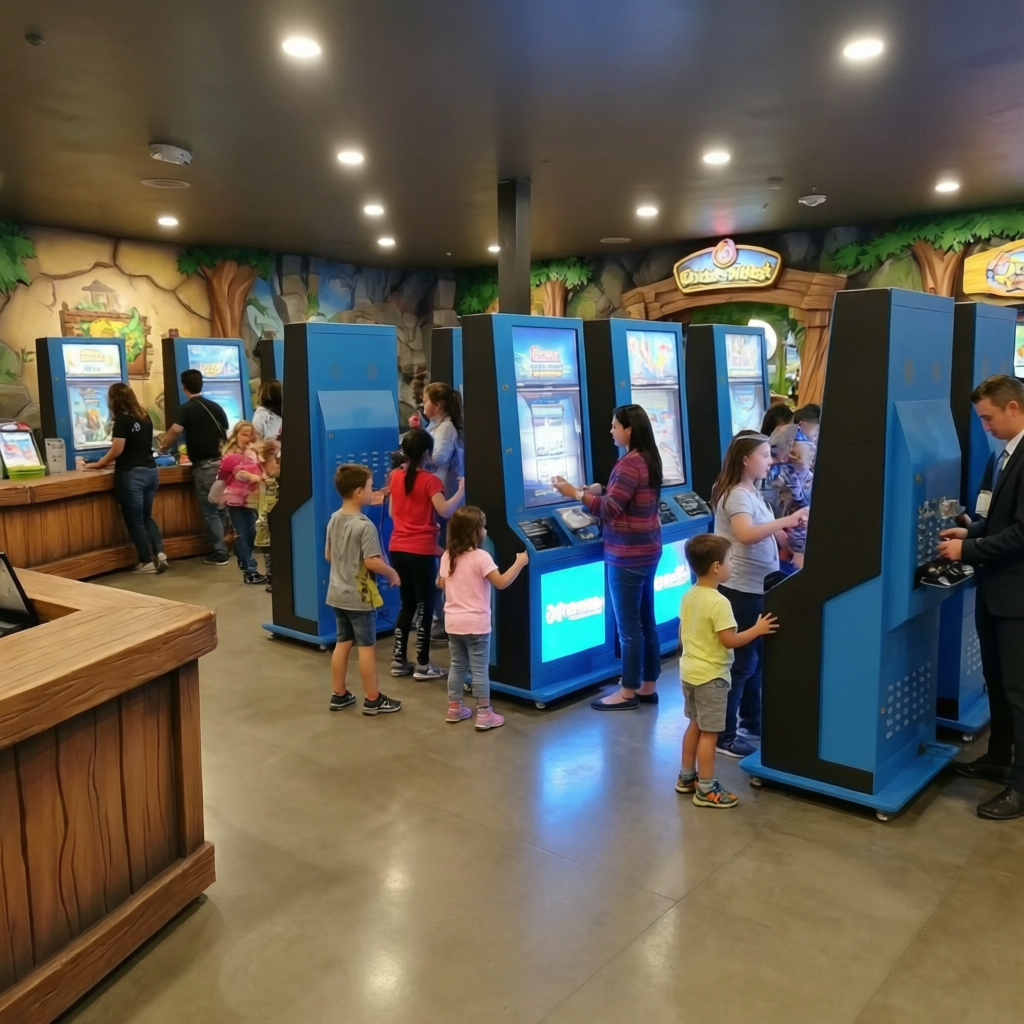
- Self-serve: self-registration and kiosks move check-in off the front desk entirely, which is where entrance queues actually get solved.
If your venue sells multiple attractions with different capacities — trampoline court, karting track, soft play — access control is the difference between capacity limits that exist on paper and limits that enforce themselves.
The Vendor Landscape by Venue Type
This is deliberately not a ranking — the right vendor depends on which market you’re in, and pretending one list fits both is exactly the confusion this guide exists to undo. Every description below comes from each vendor’s own published pages, verified July 30, 2026:
| Vendor | Built for | In its own words (own claims) |
|---|---|---|
| Sports & fitness facilities | ||
| Legend | UK public & private leisure operators, trusts, universities | “Complete leisure management software solution”; 20+ years; clients incl. Parkwood Leisure, Halo Leisure |
| EZFacility | Gyms, sports facilities, training businesses | Self-reports 4.5M sessions scheduled and 2.4M memberships sold annually |
| PerfectGym | Sports & leisure centers, gym chains | “Over 65 Leisure Centers”; white-label member app; ISO 27001 |
| XN Leisure | Local authorities, trusts & charities, private sector | “All-in-one leisure management software” for gym, spa, sports and recreation centres |
| DASH (formerly DaySmart Recreation) | Community recreation, ice rinks, multi-sport complexes | Rebranded from DaySmart Recreation in 2026; 20+ years in recreation scheduling |
| Leisure & entertainment venues | ||
| BMI Leisure (us) | Karting, FECs, trampoline parks, multi-activity venues | 300+ venues in 70 countries; born in karting timing 25+ years ago — full disclosure below |
| ROLLER | Trampoline parks, FECs, water parks, attractions | Self-reports 3,000+ attractions and 8M bookings per month |
| CenterEdge | FECs, amusement parks, waterparks | “Advanced point-of-sale and cashless technology”; 20+ years; US-based support |
| Semnox (Parafait) | FECs, arcades, amusement parks, F&B | Self-reports 2,800+ sites in 60+ countries; RFID and cashless focus |
Fitness-side buyers: your evaluation is memberships, billing and class flows — this guide’s segmentation section is where our useful advice for you ends, and the vendors above are where to start. Venue-side buyers: keep reading.
Where BMI Leisure Fits (Full Disclosure)
We’re BMI Leisure, the publisher of this guide, and we compete only on one side of the table above: leisure and entertainment venues. The platform started 25+ years ago in karting timing and grew into all-in-one venue management — bookings, POS, waivers, parties, access control, F&B, CRM and multi-venue reporting — now running 300+ venues across 70 countries. Multi-site is where we’re most at home: groups like TeamSport UK and Elev8 Fun run their operations on the platform, and verticals from karting to trampoline parks each get purpose-built modules rather than a generic calendar.
Honest limits: if you run a gym, pool or council leisure centre, we are not your platform — start with the fitness-side vendors above. And if you run a very small single-activity venue that only needs a booking page, a full venue platform may be more than you need today.
How to Choose: 7 Steps That Prevent a Bad Purchase
- Place yourself on the map. Fitness side or venue side — everything downstream depends on it.
- List your revenue streams, not your features. Sessions, parties, memberships, F&B, arcade, retail. The platform must sell and report every one of them natively.
- Decide the multi-site question now. Migrating a one-venue system across five locations later is a rebuild, not an upgrade.
- Map the integrations. Payments, accounting, access hardware, arcade card systems — ask for published documentation, not promises.
- Demand the hard demo. Your busiest Saturday, end to end: peak booking load, a party with changes, a waiver exception, a refund. Skip the canned tour.
- Price the year, not the license. Setup, training, hardware, payment processing and support — total cost of ownership is the only comparable number, since most vendors on both sides quote per venue.
- Call two references your size. Not the flagship logos — operators with your headcount and your attraction mix, one year after go-live.
Run an Entertainment Venue? See Your Saturday on One Platform
Bookings, POS, waivers, parties, access control and reporting — one system, built for leisure venues for 25+ years and running 300+ of them today. Bring your hardest workflow to the demo.
Book Your DemoFrequently Asked Questions
What is leisure management software?
Leisure management software runs the daily operations of a leisure business — online bookings, scheduling, payments, point of sale, memberships or sessions, and reporting — in one platform. The term covers two distinct markets: software for sports and fitness facilities (gyms, pools, leisure centres) and software for leisure and entertainment venues (FECs, karting tracks, trampoline parks, arcades).
What is the difference between leisure management software and gym management software?
Gym management software is one branch of leisure management software, built around recurring memberships, class timetables and check-ins. The other branch serves entertainment venues, built around timed sessions, party bookings, digital waivers, capacity management and arcade payments. The two share features like booking, POS and CRM, but the workflows are different enough that vendors specialize in one side.
How much does leisure management software cost?
Most vendors on both sides of the market quote custom pricing based on venue size, modules and payment processing volume — typically a monthly SaaS subscription plus transaction fees and optional hardware such as POS terminals, kiosks and access gates. When comparing quotes, ask every vendor for total cost of ownership in year one, including setup, training, hardware and payment fees.
What is a leisure POS system?
A leisure POS system is the point of sale built into a leisure management platform. Unlike generic retail POS, it sells time — sessions, court hours, parties, admissions — alongside food, drinks and retail, on one guest tab. Because it shares a database with bookings and CRM, a sale at the front desk updates capacity, guest history and reporting in real time. See how operators use the resulting data in our POS reports guide.
Sources
- Legend — homepage (leisure management positioning, 20+ years, named UK clients). legendware.co.uk — verified July 30, 2026.
- EZFacility — homepage (target markets, sessions/memberships/payments metrics). ezfacility.com — verified July 30, 2026.
- PerfectGym — Sports and Leisure Center Management Software page (65+ leisure centers claim, feature set). perfectgym.com — verified July 30, 2026.
- XN Leisure — homepage (local authority / trusts / private sector positioning, product claims). xnleisure.com — verified July 30, 2026.
- DASH — homepage (rebrand from DaySmart Recreation, recreation facility types, 20+ years claim). dashplatform.com — verified July 30, 2026 (daysmart.com/recreation now 301-redirects here).
- CenterEdge — homepage (FEC/amusement positioning, POS and cashless focus, 20+ years claim). centeredgesoftware.com — verified July 30, 2026.
Vendor information reflects each company’s own published pages as of July 30, 2026 and may change — verify details during your evaluation. BMI Leisure is the publisher of this guide and serves the leisure & entertainment venue segment; we’ve disclosed that above, and fitness-side vendor descriptions are drawn from their own pages. Last updated: July 31, 2026.