Nothing at a karting track gets argued about more than a lap time. Timing is the product — it’s what turns ten laps into a race, a first visit into a rivalry, and a rental customer into a regular chasing two tenths. Yet most buying guidance for kart timing systems is written by whoever is selling it. This guide explains how kart timing systems actually work, separates the three very different buyers who search for them, compares the main vendors on both sides of the market from their own published pages — and tells you, honestly, which kind of system your operation needs.
What Is Kart Timing Software? (Quick Answer)
Kart timing software records each kart’s lap times via transponders and track loops, then turns that data into live positions, fastest laps, race results and rankings — displayed on trackside screens, apps and leaderboards. Rental tracks typically buy it integrated with venue management (bookings, POS, safety); competition organizers buy precision timing hardware with dedicated race software.
How Kart Timing Systems Work
Every serious timing setup — rental or competition — is the same four-part chain. Understanding it is the fastest way to read any vendor’s spec sheet:
- Transponder on the kart. A small device on each kart broadcasts a unique ID. This is how the system knows which kart crossed the line — no cameras or manual clicking involved.
- Detection loops in the track. Wires embedded at the start/finish line (and optionally at sector points) sense each transponder as it passes and timestamp the crossing.
- Decoder. A trackside unit collects those timestamps and feeds them to the software — this is the piece precision vendors compete on, down to thousandths of a second.
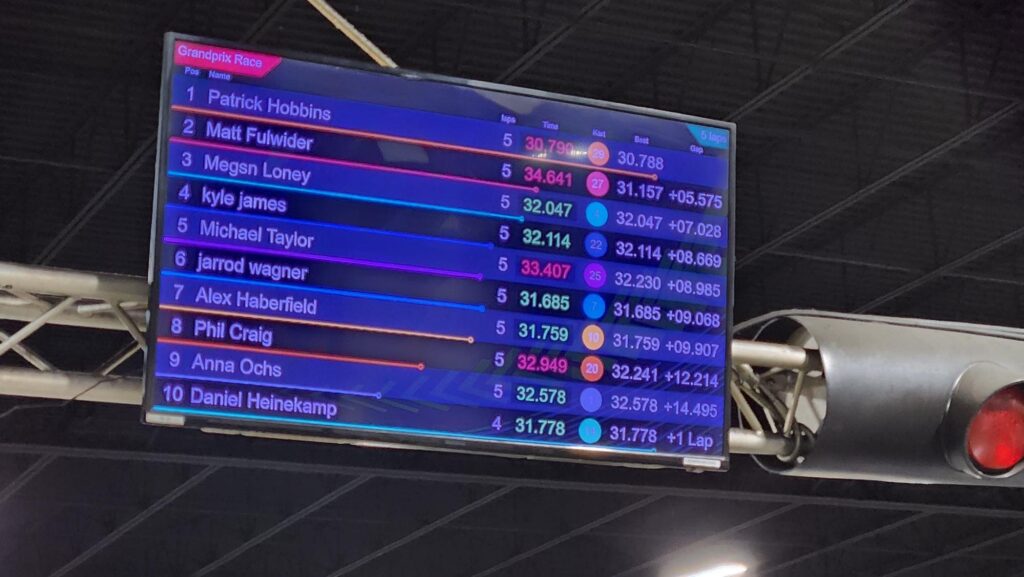
- Timing software. The software matches timestamps to drivers, calculates laps, gaps, positions and best laps in real time, and pushes everything to race control, TV screens, apps and post-race emails.
The hardware chain is mature technology — the differences you’ll actually feel day-to-day live in step four: what the software does with the data, and what else it’s connected to.
Three Buyers, Three Different Systems
“Kart timing” means three different purchases depending on who’s searching. Finding yourself on this table saves you half the demos:
| You are… | You need | Typical options |
|---|---|---|
| A hobby driver timing your own laps | A GPS lap-timer app or a simple clip-on infrared timer — no track infrastructure | Consumer GPS apps (RaceChrono and similar) or battery-powered IR lap timers — not covered further here |
| Track Operators A rental track / leisure venue running public sessions daily | Timing integrated with bookings, kart allocation, safety and POS | BMI Leisure, RaceFacer, Apex Timing, Pixelcom, Clubspeed |
| A club or event organizer running sanctioned competition | High-precision timing hardware + dedicated race software | MYLAPS, RACE RESULT, LapSnapper |
The rest of this guide covers the second and third rows — and the honest boundary between them, because some operations genuinely need both.
How We Compared (And Who We Are)
Full transparency: this guide is published by BMI Leisure, and timing is not a feature we added — it’s where we come from. The platform began as SMS-Timing more than 25 years ago, timing karts before it ever printed a receipt, and today runs karting operations at 300+ venues worldwide.
That history is exactly why you should read our vendor descriptions with scrutiny. So we applied the same rules as our other comparisons: every vendor below is described from its own published pages, verified July 30, 2026; scale and accuracy figures are labeled as each vendor’s own claims; and the one vendor that publishes hardware pricing is quoted exactly, because invented price ranges help nobody.
Rental & Leisure Track Systems Compared
These platforms treat timing as one part of running the venue — sessions, bookings, karts and guests in one system:
| Platform | Timing & race control | Beyond timing (own claims) | Notable |
|---|---|---|---|
| BMI Leisure Us | Native timing & race control: heats, pause/resume, flexible race formats | Bookings, POS, CRM, F&B, safety & positioning, multi-venue | Born as SMS-Timing 25+ yrs ago; 300+ venues |
| RaceFacer | Timing, session management, kart allocation, displays | Registration kiosks, booking, POS, garage module, driver social network | Published pricing from $385/month; RaceSafety remote safety |
| Apex Timing | Rental session timekeeping + GoRacing for competition | Management modules for indoor/outdoor tracks | Spans leisure AND sanctioned competition |
| Pixelcom | Timing with Arrive & Drive mode (no registration needed) | TV software, POS, mobile app for trackside operation | Yellow-flag automatic speed limitation |
| Clubspeed | Race Control: kart swaps, driver changes, slowdown | Bookings, POS, Proskill global driver ranking, garage management | Uses MyLaps/AMB or DeHaardt timing hardware; K1 Speed (35+ locations) |
BMI Leisure
We’ll make our case and let you judge it. Because the platform grew out of timing, race control isn’t a bolt-on: our timing & race control software runs flexible race formats with full control over heats — pause, resume, edit — and links every driver and kart to the booking, so the front desk and the pit computer always agree.
Results go live to TV displays and LED boards, and lap data lands on the guest profile, where CRM turns a fast lap into a comeback email. Groups like TeamSport UK and US tracks like Speedway Indoor Karting run on it daily. Honest limit: we’re built for venues, not sanctioned championships — a national karting federation timing an FIA event needs the competition hardware below.
RaceFacer
RaceFacer positions itself as an “innovative all-in-one solution for rental go-kart and multiactivity centers.” Its timing module sits alongside registration (including GDPR-compliant kiosks), booking, POS, kart allocation, session management, displays, results, reports and a garage module — plus a distinctive extra: a driver-facing social network where guests track their stats across tracks. It also offers RaceSafety, its remote race safety product, and — unusually for this market — publishes its prices: the Silver package lists at $385/month, Gold at $589/month, and a Race and Events module (live timing for races with large fields) at $99/month. One tier detail worth checking against your plans: online booking and payment, gift vouchers, marketing tools and the multi-activity calendar sit in the Gold tier only.
Apex Timing
Apex Timing covers both sides of the divide: rental-track timekeeping for indoor and outdoor sessions, and GoRacing, its competition product, which it describes as timing and managing karting events “from regional to international.” It cites 10+ years of experience and 20+ connected partners — including, notably, MyLaps and RaceResult, which tells you how interconnected this industry’s timing layer really is.
Pixelcom
Pixelcom’s timing software is built around operational speed: an Arrive & Drive mode runs sessions without requiring participant registration, a mobile app lets staff manage races from anywhere on track, and its safety integration automatically limits kart speed under a yellow flag. TV software and POS round out the suite.
Clubspeed
Clubspeed’s Race Control manages races, kart swaps, driver changes and slowdown features, with bookings, POS and its Proskill ranking system that lets guests compare themselves against drivers at other tracks. A detail worth noting from its own pages: Clubspeed integrates MyLaps/AMB or DeHaardt hardware for the timing layer itself. Its flagship reference is K1 Speed, which runs it across 35+ locations.
Competition & Club Racing Timing
If you organize sanctioned races — club championships, regional series, endurance events — your priorities flip: raw precision, protest-proof results and portable hardware beat booking integrations. Three established options, from their own pages:
- MYLAPS — the X2 system claims 1/1000th-second accuracy with instant driver identification in all weather. TR2 transponders are rated to 260 km/h and sold on 1-, 2- or 5-year subscriptions or a no-subscription “Go” option; Orbits 5 software (Basic to Advanced tiers) handles multi-heat events and uploads practice results to its Speedhive platform.
- RACE RESULT — the rare vendor with fully public pricing: the Ubidium decoder lists at $3,790, MotorKart V3 transponders at $85 each (0.004 s true accuracy at up to 120 km/h, 3.5-year battery), and the wireless Loop Box for sector timing at $2,390 — no software subscription. It states its transponders resist electrical interference and work with electric karts.
- LapSnapper — a lighter-weight option: the Pro3 system claims 0.001-second lap accuracy with an Android app, USB decoder and magnetic start/finish strip, no subscription fees and a 12-month warranty. A pragmatic fit for club tracks and practice days.
Timing Alone vs Timing Inside Your Venue Software
Here’s the buying decision underneath all of this. Competition hardware answers one question superbly: who was fastest, provably? A rental track asks different questions all day long: which drivers are in the 3 PM heat, did they sign the waiver, which kart is due for maintenance, and how do we get Saturday’s fastest first-timer to come back on Thursday?
That’s why rental-side platforms — ours included — treat the lap time as the start of a data chain rather than the end of one. When timing lives inside the venue platform, the heat list builds itself from bookings, race results attach to guest profiles for rankings and marketing, and the same positioning data feeds safety & positioning — knowing where every kart is, slowing them remotely on an incident — plus tools like Mobile Marshall for staff on the track floor. The lap time entertains the guest; the connected data runs the business.
If you run sanctioned competition, buy precision hardware (MYLAPS, RACE RESULT) and dedicated race software — booking integration is irrelevant on race day. If you run a rental track, buy timing inside your venue platform so sessions, safety and guest data work as one system. If you’re a rental track that also hosts league nights and corporate GPs — the most common case — pick a venue platform with real race formats first, and check it can pace a championship, not just a 10-minute session.
Buyer’s Checklist: 7 Questions Before You Sign
- Which buyer are you? Rental venue, competition organizer, or both — everything else follows from this.
- What’s the full hardware bill? Transponders (per kart), loops, decoder, screens, installation. As verified reference points: RACE RESULT’s published kit prices ($3,790 decoder, $85 transponders) show the hardware line, and RaceFacer’s published software tiers ($385–$589/month) show the subscription line. Most vendors quote both privately.
- Which race formats, exactly? Sprint, endurance with driver changes, multi-heat GPs with finals — ask for a demo of your format, not the default 10-minute session.
- Does timing talk to bookings? For rental tracks: can a booking become a heat list automatically, and do results attach to the guest profile? If staff re-type names between systems, you’ll feel it every busy Saturday.
- What happens on an incident? Yellow-flag speed limiting, remote slowdown, kart positioning — safety features differ more between vendors than timing accuracy does.
- Where does the data go afterward? Post-race result emails, driver rankings, repeat-visit campaigns — lap data is the best marketing asset a track owns, if the system can use it. (This is where timing meets reporting.)
- Who fixes it at 7 PM on a Saturday? Support hours, spare transponder logistics, and what the track does while timing is down. Ask every vendor; enjoy the pause.
Building a new track from scratch? Timing is one line of a bigger budget — our go-kart track cost breakdown covers the rest. And if you’re comparing full venue platforms beyond timing, start with our guide to choosing karting software.
Timing Built Into Your Whole Track Operation
We’ve timed karts for 25+ years — and connected every lap to bookings, safety, screens and marketing at 300+ venues. Bring your race formats to a demo and watch them run.
Book Your DemoFrequently Asked Questions
How do go-kart timing systems work?
Each kart carries a transponder that emits a unique signal. Detection loops embedded in the track at the start/finish line (and optionally at sector points) register the exact moment each transponder passes. A decoder sends those timestamps to the timing software, which calculates lap times, positions and fastest laps in real time and pushes results to screens, apps and leaderboards.
How accurate are kart timing systems?
Professional systems measure to the millisecond. MYLAPS states 1/1000th-second accuracy for its X2 system, RACE RESULT publishes 0.004-second true accuracy at up to 120 km/h for its MotorKart transponder, and LapSnapper claims 0.001-second lap measurement. For rental tracks, consistency across a full day of sessions matters as much as raw precision.
What is a kart transponder?
A small electronic device mounted on each kart that broadcasts a unique ID. When the kart crosses a detection loop in the track surface, the system timestamps that exact ID — which is how the software knows which kart set which lap time. Rental tracks install one per kart; competition drivers often own personal transponders on subscription or one-off purchase models.
Can kart timing software integrate with booking software?
Yes — and for rental tracks it’s the deciding factor. Venue-grade platforms link timing to bookings, so registered drivers are automatically assigned to karts and heats, and results attach to their guest profile for rankings and marketing. See how it works in our timing & race control software. Standalone competition systems generally don’t handle bookings at all.
How much does a kart timing system cost?
Two verified reference points from vendors that publish prices: RaceFacer lists its software at $385/month (Silver) and $589/month (Gold), and RACE RESULT lists its Ubidium decoder at $3,790, MotorKart transponders at $85 each and its Loop Box at $2,390 with no software subscription. Most other venue platforms are quoted per track based on modules and hardware. Budget for transponders, loops, decoder, screens and installation — not just software.
Sources
- RaceFacer — Go Kart Timing Software Features (all-in-one positioning, timing/registration/booking/POS/garage modules, RaceSafety, driver social network). racefacer.com — verified July 30, 2026.
- RaceFacer — Pricing (Silver $385/month, Gold $589/month, Race and Events module $99/month; per-tier feature breakdown). racefacer.com/pricing — verified July 30, 2026.
- MYLAPS — Kart Racing (X2 system 1/1000s claim, TR2 transponder specs and subscription options, Orbits 5, Speedhive). mylaps.com — verified July 30, 2026.
- Apex Timing — homepage (rental session timekeeping, GoRacing competition product, 10+ years, 20+ partners). apex-timing.com — verified July 30, 2026.
- Pixelcom — Timing Software (Arrive & Drive mode, yellow-flag speed limitation, TV software, trackside mobile app). pixelcom.io — verified July 30, 2026.
- Clubspeed — Go-Kart Software (Race Control features, Proskill, MyLaps/AMB and DeHaardt hardware integration, K1 Speed 35+ locations). clubspeed.com — verified July 30, 2026.
- RACE RESULT — Karting Solution (Ubidium $3,790, MotorKart V3 $85 / 0.004 s at 120 km/h / 3.5-yr battery, Loop Box $2,390, no subscriptions). raceresult.com — verified July 30, 2026.
- LapSnapper — Pro3 Lap Timing System for Karting (0.001 s claim, components, no subscription, 12-month warranty). lapsnapper.com — verified July 30, 2026.
- K1 Speed — How Go-Kart Scoring and Lap Timing Systems Work (transponder/loop/software explanation from a major operator). k1speed.ca — verified July 30, 2026.
Vendor information reflects each company’s own published pages as of July 30, 2026 and may change — verify specs, pricing and references during your evaluation. BMI Leisure is the publisher of this guide; our platform began as SMS-Timing and competes in the rental/leisure segment, which we’ve disclosed above. The only prices quoted are those RACE RESULT and RaceFacer publish openly; no other figures are estimated. Last updated: August 3, 2026.