Three different kinds of software answer to the name amusement park management software — and buying the wrong kind is the most expensive mistake on this shortlist. One kind runs your guests: tickets, gates, POS, passes. One kind runs your rides: inspections, work orders, safety compliance. And one kind, despite ranking in the same searches, runs municipal playgrounds and rec leagues. This guide sorts the three, shows what the guest-side platform must actually do, and helps a family or regional park — the operator this category serves worst — build a shortlist that fits its scale.
What Is Amusement Park Management Software?
Amusement park management software is the platform that runs a park’s guest-facing operation in one system: online ticketing and timed entry, point of sale for food and retail, access control at gates and rides, season passes and memberships, group and party bookings, and reporting across it all. It is a different category from ride-maintenance software (a CMMS), which handles inspections and work orders — most parks that need both run one of each and integrate them.
The operational test is continuity. A ticket sold on your website at 9 PM should become the credential scanned at your gate at 11 AM, the wristband that pays for lunch, and the guest profile your season-pass renewal email goes to in March. When those are four separate systems, staff re-enter data all day and management assembles reports by hand. When they’re one platform, the park runs on one guest record.
Amusement vs. Theme Park Software: Two Names, One Category
Buyers ask whether theme park management software is a separate product. It isn’t — and the search data itself says so: Ahrefs assigns “amusement park management software” and “theme park management software” to the same parent topic, and the same vendors rank for both. The label doesn’t change what you need. Two other things do: your park’s scale, and whether the problem you’re solving is guests, rides, or both — which is exactly where the category splits.
The Three Species That Share This Search
| Species | What it runs | Example vendors | You need it if… |
|---|---|---|---|
| Venue management platform | Tickets, gates, POS, passes, bookings, guest data | The lane this guide covers — see the shortlist section | Your pain is queues, re-entered data and revenue leakage |
| Ride-maintenance CMMS | Preventive maintenance, inspections, work orders, safety compliance | MAPCON (Lite from $595), Mobaro | Your pain is ride uptime, inspection paperwork and audits |
| Parks & recreation software | Municipal facilities: rec leagues, public pools, community classes | The “Parks & Rec” category pushed in ads | You run a city department, not a commercial park |
The confusion is profitable for nobody but the ad networks. A commercial park searching this term almost always wants the first species — but the SERP mixes all three, and even the AI answers blend maintenance features into venue-platform lists. If a vendor demo opens with work orders when you asked about ticketing (or the reverse), you’re in the wrong species, not the wrong brand.
Does Park Software Handle Ride Maintenance?
Generally no — and it shouldn’t. Ride inspections and preventive maintenance are a safety-compliance discipline with its own software category (CMMS), its own audit trail, and vendors like MAPCON — whose theme-park product is built entirely around scheduled maintenance, inspections and work orders — or Mobaro. Venue platforms run the guest side. A park that needs both runs both and integrates them, and an honest vendor on either side of that line will say so in the first meeting.
Destination Park or Family Park? Two Different Purchases
The second sorting question is scale, and the market splits cleanly:
Destination parks — millions of annual visits, dynamic pricing, multi-park passes — buy enterprise ticketing suites. accesso runs “1,100+ destinations” across 31 countries and processes over $5 billion a year, with Six Flags among its named clients; Gateway Ticketing’s Galaxy platform serves major theme parks, zoos and museums. These are serious systems with procurement cycles to match: multi-month implementations, enterprise contracts, and modules a 200,000-visit park will never switch on.
Family, regional and indoor parks — the venues actually typing this search — are better served by all-in-one venue platforms, where ticketing, POS, access control and guest data come as one product at venue-platform pricing. This is the lane where ROLLER, CenterEdge, Clubspeed and our own platform compete, and the lane the rest of this guide covers. Buying enterprise ticketing at family-park scale means paying for Six Flags plumbing you’ll never use; buying a venue platform at Disney scale means outgrowing it. Know which purchase you’re making before any demo.
What the Platform Must Cover: One Saturday, One Guest Record
Instead of a feature list, follow a single family through one visit. Every timestamp below is a capability — and every capability your stack is missing turns into a queue, a clipboard or a lost sale at exactly that moment.
Tuesday, 9:14 PM — the booking. A parent books Saturday’s visit and a birthday party room from the couch: timed-entry tickets sold against live capacity, a package priced per child, a deposit taken. This is the amusement park booking software layer, and it’s also where waivers go out to every attending family — the full party booking chain runs before your staff know the party exists.
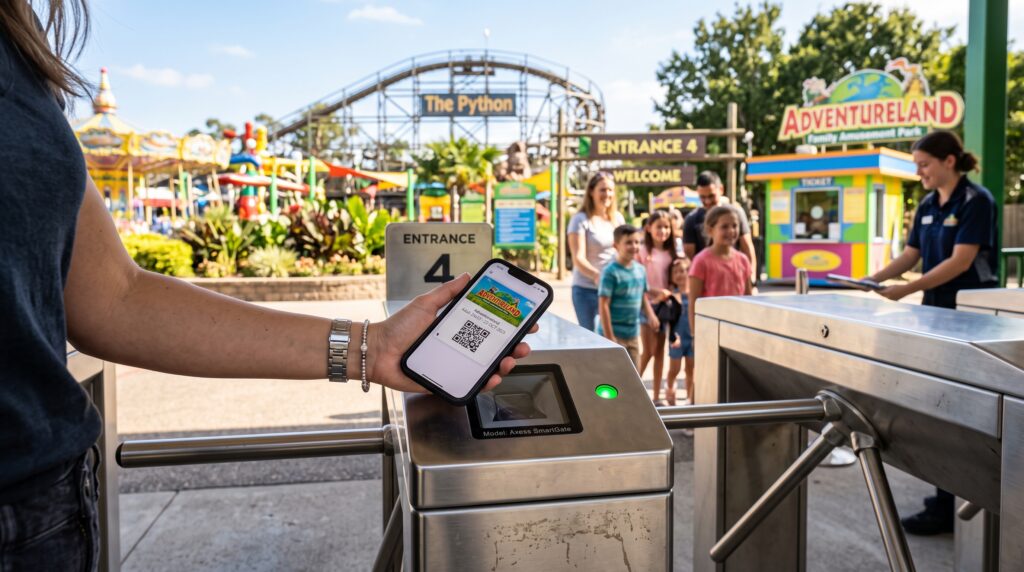
Saturday, 10:58 AM — the gate. The QR code (or the RFID wristband issued at check-in) validates against the same record the Tuesday booking created. The gate already knows the time slot, the party group, and which zones this ticket opens. No paper list, no re-registration — and the capacity system counted the family into the session the moment they scanned.
12:40 PM — lunch. A wristband tap pays at the F&B till. Same guest record, so the park finally knows what a visit is worth end to end — not three registers with three separate reports.
2:00 PM — the party room. The kitchen got its order from the booking, the runsheet assigned the room and the staff, and the guests arrived waiver-signed. The office phone rang zero times to make this happen.
4:30 PM — the top-up. Credits reloaded at a self-service kiosk by the arcade, not at a staffed counter. Peak-day staffing scales with sales, not queues.
The following March — the renewal. The season pass renews on recurring billing, the birthday child’s next party email goes out on schedule, and management reads the whole year — per zone, per till, per park in the group — from one dashboard instead of a month-end spreadsheet ritual.
Now run the same clock backward through your current stack and count the systems involved. That number, minus one, is your integration bill — and your case for a platform.
Note what’s deliberately absent: deep comparisons of amusement park ticketing software and POS vendors belong in their own guide — for the till-level decision today, our FEC POS buyer’s guide covers the same platform species at single-venue depth, and our entertainment POS overview maps the wider POS landscape.
Best Amusement Park Management Software: How to Shortlist
The “best platform” question deserves a straight answer, so here is the straightest one available. On G2’s amusement park management category, Clubspeed rates 4.7, ROLLER 4.3 and CenterEdge 3.9 — real ratings from real operators, worth reading in full. We compete in this lane too, but we aren’t yet listed in that G2 category — disclosure below. All the more reason to treat review sites, not this page, as your neutral referee; and weigh any vendor’s absence from them as a question to ask in the demo. What this page can give you is the demo method:
- Follow one guest end to end. Ask the vendor to demo a ticket bought online becoming a gate scan, a wristband tap at F&B, and a guest profile with the whole visit on it. Continuity is the product; watch for the seams.
- Price the whole stack. A platform quote should cover ticketing, POS, access control and passes. If gates, waivers or kiosks are third-party add-ons, price the integrations before comparing numbers.
- Test the peak day. Ask how the system behaves at your busiest hour — kiosk throughput, gate speed, offline mode at the till. Averages don’t crash; peaks do.
- Check your species and scale first. If the demo is work orders, it’s a CMMS. If the reference clients are all million-visit parks, you’re shopping the enterprise lane. Both are fine products in the wrong meeting.
Scoring Ourselves With the Same Test
Disclosure: BMI Leisure is our platform. So instead of a pitch section, here is our own scorecard against the four demo tests above — including the question we fail on purpose. Verify every row in a demo, not on this page:
| The test | Our answer | How to verify it |
|---|---|---|
| One guest, end to end | The Saturday timeline above is our architecture: booking, gate, wristband, till and party room write to one guest record | Ask to see a real guest’s timeline on screen — booking to last tap |
| The whole stack, one price | Ticketing, POS, access control, passes and party bookings are modules of one platform; arcade card systems integrate rather than duplicate | Request one quote, then compare it line by line against a stitched stack |
| The peak day | Kiosks, gate scanning and offline till behavior are built for the Saturday spike, and proven across the multi-activity venues we run | Bring your busiest day’s real numbers and make us demo against them |
| Species and scale | Our honest no: we’re a venue platform for family, regional and indoor parks and multi-activity operators — not an enterprise ticketing suite for destination parks | If you run millions of visits, shop the accesso/Galaxy lane above and don’t let us talk you out of it |
One Park. One Guest Record.
Timed ticketing, gates, POS, wristbands and party bookings on one platform — built for family, regional and indoor parks, and proven at 300+ venues. Bring your peak day to a demo.
Book a DemoFrequently Asked Questions
What is amusement park management software?
Amusement park management software is the platform that runs a park’s guest-facing operation in one system: online ticketing and timed entry, point of sale for food and retail, access control at gates and rides, season passes and memberships, group and party bookings, and reporting across it all. It is a different category from ride-maintenance software (a CMMS), which handles inspections and work orders — most parks that need both run one of each and integrate them.
Is theme park management software different from amusement park software?
No — they are two names for the same software category, and search data confirms it: keyword tools like Ahrefs assign both spellings to the same parent topic, and the same platforms rank for both. Vendors use the terms interchangeably. What actually changes the software you need is not the label but the scale of the park and whether you need guest operations, ride maintenance, or both.
What is the best amusement park management software?
It depends on your park’s scale. Destination parks with millions of visits typically run enterprise ticketing suites like accesso or Gateway’s Galaxy. Family and regional parks are better served by all-in-one venue platforms — on G2’s amusement park category, Clubspeed rates 4.7 and ROLLER 4.3 — and BMI Leisure (our platform, disclosed) competes in this same lane. Shortlist by fit, then demo: watch a ticket become a gate entry, a wristband tap and an F&B sale in one guest record.
Does amusement park software handle ride maintenance?
Generally no — and it shouldn’t. Ride inspections, preventive maintenance schedules and work orders are the job of a CMMS (computerized maintenance management system) such as MAPCON or Mobaro, built around safety compliance rather than guest transactions. Venue management platforms run the guest side: tickets, gates, POS, passes. A park that needs both runs both, and the honest vendor on either side will tell you so.
What does amusement park booking software do?
It sells timed-entry tickets, season passes, group visits and birthday parties on your website, 24/7, against live capacity — so the park controls crowd flow before anyone arrives. In a proper platform the booking layer is not standalone: the ticket bought online becomes the credential scanned at the gate, the waiver signed at home, and the guest profile your marketing uses afterward.
Sources
- MAPCON — Theme Park Maintenance Software (CMMS scope: preventive maintenance, inspections, work orders; MAPCON Lite from $595). mapcon.com — verified August 20, 2026.
- accesso — company site (1,100+ destinations, 31 countries, $5B+ processed annually; clients including Six Flags and Holiday World). accesso.com — verified August 20, 2026.
- Gateway Ticketing Systems — company site (Galaxy platform; theme parks, waterparks, zoos, museums). gatewayticketing.com — verified August 20, 2026.
- G2 — Best Amusement Park Management Software category (ROLLER 4.3, Clubspeed 4.7, CenterEdge 3.9). g2.com — ratings verified August 5, 2026; corroborated in search results August 20, 2026.
- BMI Leisure — Capacity Management, Activity Access Control and Multi Venue Management feature pages (capabilities referenced in the checklist). bmileisure.com/features — verified August 2026.
Vendor capabilities, ratings and pricing reflect each company’s own published pages or public review listings as of the verification dates above and may change. BMI Leisure is the publisher of this guide and competes in the venue-platform category described, disclosed above — G2 and comparable review sites are the neutral referee for vendor comparisons; evaluate any platform, ours included, in a live demo against your own peak day. Ride-maintenance vendors (MAPCON, Mobaro) and enterprise ticketing suites (accesso, Gateway) serve adjacent categories and are described for disambiguation, not compared. Last updated: August 20, 2026.