Running one karting track is an operations job. Running three is a different discipline: one brand across several buildings, guests who visit more than one of them, and a head office that needs this Saturday’s numbers from every site — comparable, and today. The software decision changes with it. Single-track tools copied per location don’t scale into a group; they multiply chaos at each new opening. This guide covers what karting management software for multiple tracks actually has to do differently, the questions growing operators ask, and what the transition looks like when a real 38-track group makes it.
What Multi-Track Operators Need (Quick Answer)
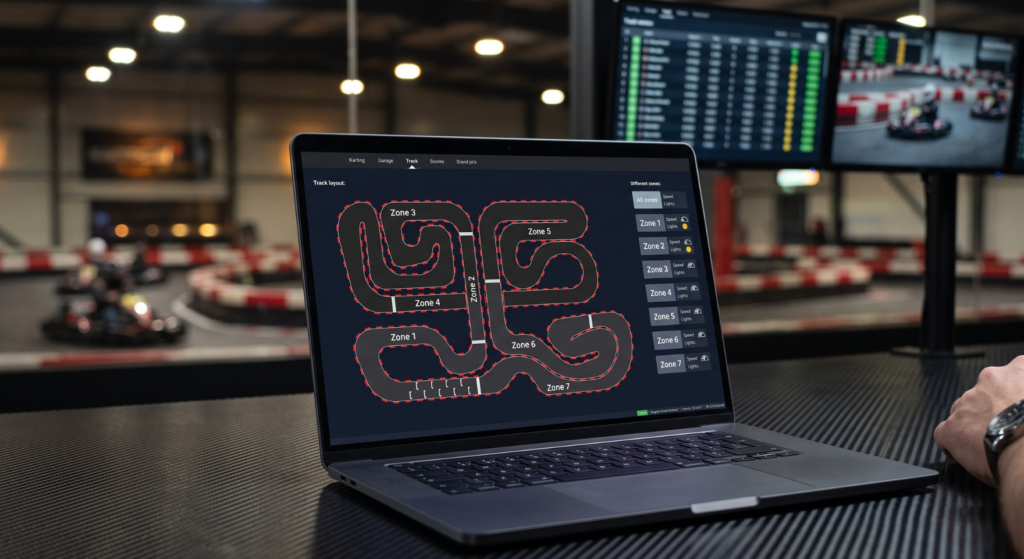
Beyond everything a single track needs — booking, timing, waivers, POS — a multi-track group needs native multi-venue architecture: pricing, products and promotions controlled centrally; one guest database valid at every site; track-by-track reporting on the same definitions; and a rollout playbook for the next opening. The test: can you see and run two venues from one screen?
What Changes When You Run More Than One Track
Five things break first when a single-site setup gets copied across a group:
- Standardization. A price change, a new package or a season promotion should be one central action — not a task repeated per venue, drifting a little each time. On our platform this is the multi-venue layer: pricing, promotions and policies standardized centrally, while day-to-day operational data stays venue-specific.
- One guest, every site. A racer from your north track walks into your south track: their profile, waiver, membership and lap history should walk in with them. Separate databases per venue mean re-registration, unusable memberships and marketing blind spots.
- Comparable reporting. “Which track had the better Saturday?” is only answerable if every site reports revenue, sessions and F&B on the same definitions, in one place — the group-level view of reporting that spreadsheets emailed by site managers never quite deliver.
- Vouchers, gift cards and members that cross sites. A gift card sold in one venue and redeemed in another is an accounting problem unless the platform treats them as central objects — which is exactly how it should work.
- Staff mobility. A marshal or manager moving between sites shouldn’t need retraining because each track configured its own system differently.
The Multi-Track Capability Checklist
| Controlled centrally HQ Level | Managed per venue |
|---|---|
| Product catalog, pricing and promotions | Daily schedule and session calendar |
| Guest profiles, memberships, waivers | Local staff and roles |
| Gift cards and vouchers (valid group-wide) | Track configuration: karts, heats, formats |
| Reporting definitions and dashboards | Local F&B menu variations |
| Brand templates: emails, receipts, displays | Venue-specific events and leagues |
Bring this table to every demo and ask the vendor to show each row live. Platforms built venue-first show it in minutes; single-site products stretched across a group start explaining workarounds.
Which Karting Management Software Is Best for Multiple Tracks?
Shortlist platforms with native multi-venue architecture — central pricing and products, one guest database, comparable reporting — rather than single-site software duplicated per location. BMI Leisure runs multi-track groups like TeamSport (38 tracks in three countries) on this model. Whichever vendors you evaluate, the demo test is the same: two venues, one screen.
We’re the publisher here, so take the shortlist advice as method rather than verdict: the honest way to choose between platforms is our separate guide to choosing karting software, which covers the evaluation framework brand by brand. What this pillar adds is the multi-track lens — because a platform that’s excellent for one venue can still be the wrong buy for a group.
How Does Karting Software Improve Guest Experience?
Operators increasingly ask this exact question — often to an AI assistant — and the answer is a loop, not a feature. The guest books online, signs the waiver and pays before arriving. Check-in already knows them; the reservation is already a heat list entry with a kart assigned. They race; their results land on their profile; the follow-up email brings their best lap and a reason to return. Every seam removed from that loop is queue time converted into track time.
The numbers from a real group making that transition: after TeamSport moved its operation onto our platform, online bookings grew from 35% to over 90% of sales — meaning the overwhelming majority of guests now arrive already booked, signed and paid, and the venue serves them instead of processing them.
Does It Include CRM and Marketing Automation?
Venue-grade platforms do — and karting’s version is unusually powerful, because every race generates data most industries would pay for. One CRM profile holds bookings, waivers, spend and lap times across every track in the group. That’s what turns marketing automation from generic blasts into precision: the lapsed racer gets an email with their own best lap and a challenge to beat it; the fast regular gets invited to league night; the birthday parent gets next year’s reminder — and a membership sold at one track works at all of them.
Does It Work for Multi-Activity Centers?
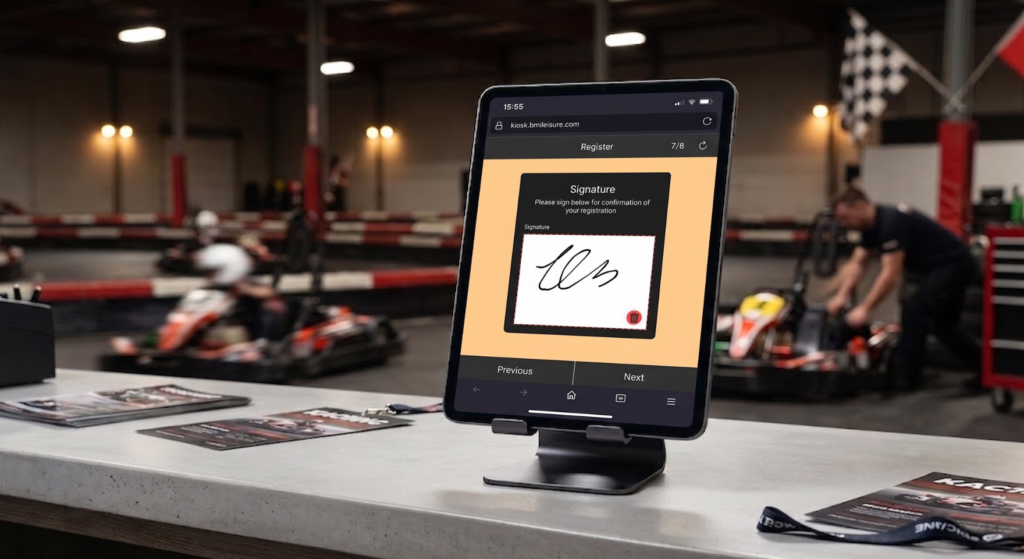
Increasingly, the “karting venue” isn’t only karting — it’s karting plus bowling, arcade, VR or F&B under one roof. That’s a harder software problem than it sounds: the platform has to run race timing and control for the track and sessions, capacity and one guest tab for everything else. It’s the configuration we run at multi-activity venues across our 300+ sites, and it’s worth testing explicitly in any demo: book a kart heat and a bowling lane for the same family, on one tab, and watch what happens.
Growing Venues: What Should Track #1 Buy to Be Ready for Track #3?
The most expensive software decision in this industry is made by single-track operators who plan to grow: buying for today’s venue instead of the group they intend to build. Migrating single-site software across a growing group later is a rebuild — data, training, hardware, mid-season. Buying for growth costs little more on day one:
- Multi-venue architecture from the start — even while you run one site. The second venue then becomes configuration, not migration.
- Central catalog discipline early. Name products, prices and packages as if three venues already shared them.
- A guest database built to span sites — memberships and vouchers defined group-wide from day one.
- A vendor with multi-track references. Ask specifically: “walk me through your largest group customer, and what their second-venue rollout looked like.”
What the Transition Looks Like: TeamSport, 38 Tracks
The clearest picture of multi-track software is a group that outgrew its old stack. TeamSport operates 38 tracks across the UK, Germany and the Netherlands — over 1.3 million visitors a year, 1,000+ employees. Before consolidating, the picture was familiar: an outdated timing platform, manual customer-data exports between disconnected systems, repetitive per-venue admin for every product change, and monthly sales reports that took half a month to assemble.
After moving onto our platform: online bookings up from 35% to over 90%, monthly sales reports generated within seconds, manual F&B margin auditing eliminated, and call-center staffing cut in half with employees redeployed to guest-facing roles. Their Sales Director’s summary of the criteria is the one we’d hand any multi-track buyer evaluating anyone, us included: “This isn’t just race timing, it’s all of it.” The same connected model runs single-flagship operations too — like Speedway Indoor Karting in Indianapolis, where racing history, licenses and bookings live in one app. Full details in the TeamSport case study.
Rolling It Out Across Tracks
Groups don’t migrate all at once — they roll out. The pattern that works: (1) pick a pilot venue (not your busiest), migrate and run it a full cycle including a peak Saturday; (2) standardize the catalog and reporting definitions at the pilot — this is where the group’s future consistency is actually built; (3) replicate venue by venue in low season, moving experienced staff to each go-live; (4) switch on group reporting last, once every site speaks the same definitions. Budget the rollout calendar with the vendor before signing — their answer tells you how many groups they’ve actually done this with.
How the Modules Fit
This pillar is the group-level view; each module has its own buyer’s guide when you’re ready to go deep: kart timing systems (the module karting lives on), booking software (calendar tools vs platforms), self-serve kiosks (the queue killer), and the wider leisure software landscape. For the head-on product view, our karting management software page covers the platform itself.
Running — or Building — a Multi-Track Group?
One platform runs TeamSport’s 38 tracks: central pricing, one guest database, group reporting in seconds. Bring your org chart and your rollout questions to a demo — including the hard ones about migration.
Book Your DemoFrequently Asked Questions
Which karting management software is best for multiple tracks?
Shortlist platforms with native multi-venue architecture: central pricing, products and promotions, one guest database across sites, and track-by-track comparable reporting — not single-site software copied per location. BMI Leisure runs multi-track groups like TeamSport (38 tracks across three countries) on this model; evaluate any platform by asking to see two venues managed from one screen in the demo.
How does karting management software improve guest experience?
By connecting the full loop in one system: guests book online, sign waivers and pay before arriving; check-in already knows them; the reservation becomes a race heat automatically; results attach to their profile; and follow-up brings them back. TeamSport grew online bookings from 35% to over 90% of sales after moving to a connected platform — queues shrink when the guest arrives already processed.
Does karting management software include CRM and marketing automation?
Venue-grade platforms do — and in karting the CRM is unusually powerful because every race generates data. One guest profile holds bookings, waivers, lap times and spend across every track in a group, so marketing automation can target a lapsed racer with their own best lap, promote league nights to fast regulars, and make a membership valid at every location.
What should a growing karting venue look for in software?
Buy at track one what track three will need: multi-venue architecture (even if you run one venue today), central product and pricing control, a guest database that spans sites, comparable reporting, and a vendor with references from multi-track groups. Migrating single-site software across a growing group later is a rebuild — choosing for growth on day one is far cheaper.
Sources
- BMI Leisure — TeamSport UK case study (38 tracks across UK/Germany/Netherlands, 1.3M visitors/year, online bookings 35%→90%+, reports from half a month to seconds, call-center staffing halved, Mark Brayford quote). bmileisure.com — verified August 11, 2026.
- BMI Leisure — Speedway Indoor Karting case study (Indianapolis; racing history, licenses and bookings in one app). bmileisure.com — verified August 11, 2026.
- BMI Leisure — Multi-Venue Management feature page (central pricing/promotions/policies; members, vouchers and discounts centralized with venue-specific operational data; franchise remote management). bmileisure.com — verified August 11, 2026.
This pillar draws primarily on BMI Leisure’s own operating experience and published case studies, verified August 11, 2026 — a deliberately first-party piece, disclosed as such. Customer results (TeamSport, Speedway) are specific to those operations and not a guarantee of outcomes. For brand-by-brand comparisons, see our karting software and module guides linked above. Last updated: August 11, 2026.