The second venue is where leisure software breaks. One site runs fine on almost anything. Then you open location two, and suddenly a price change means logging into two systems. A member is a stranger at the sister venue. And the group report is a spreadsheet someone assembles from exports every month. Multi venue management software exists to make N locations behave like one operation — and this guide covers what that actually requires, how it differs from the franchise tools that share its name, and what it looked like for a group opening a new venue every year.
What Is Multi-Venue Management Software?
Multi venue management software is a venue platform built so a group can run several locations as one operation: products, pricing and promotions managed centrally, one guest database shared by every site, and comparable reports across venues in real time — while each location keeps its own day-to-day operational data. The test is simple: two venues, one screen.
The distinction that matters is architectural, not cosmetic. Plenty of single-venue systems can be installed at five locations — that gives you five islands. A true multi-venue platform decides, by design, which data is shared and which stays local. Our own Multi Venue Management module draws that line explicitly: members, vouchers and discounts are centralized, while operational data remains venue-specific. Central where the brand lives; local where the day runs.
You feel the missing architecture in three symptoms. The monthly group report is built by hand. A promotion goes live on different dates at different sites, because someone had to set it up five times. And your best customer walks into your newest location — and gets asked to fill in a registration form.
Multi-Venue Platform vs. Franchise Management Software
Search for software to run a leisure group and you’ll meet a category that shares your vocabulary but not your problem. Franchise management software — FranConnect, FranchiseSoft and similar platforms — is built for franchisors managing franchisees. What does that mean in practice? Per FranchiseSoft’s own descriptions: capturing franchise-sale leads, automating “royalty fee calculations, invoicing, and financial reporting for the entire system,” and running franchisee training and compliance audits. Software-review sites frame the category the same way — tools for brands “from pre-launching franchises to organizations with over 500 franchisees.”
None of that runs a venue. It doesn’t take a booking, ring up a pizza, open a gate or time a race. It governs the business network; it has no opinion about Saturday.
| Comparison | Franchise management software | Multi-venue management software Venue Ops |
|---|---|---|
| Built for | Franchisors overseeing franchisees | Groups operating the venues themselves |
| Core objects | Franchise leads, royalties, SOPs, audits | Bookings, POS transactions, guests, gates |
| Answers | “Are my franchisees compliant and paying?” | “How did every venue trade this weekend?” |
| Example vendors | FranConnect, FranchiseSoft | Venue platforms with native multi-venue architecture — see our leisure software guide for the vendor landscape |
If your leisure group is franchised, you may genuinely need both layers — royalty and compliance tooling for the network, and a venue platform for operations. What you can’t do is buy the first and expect it to do the second. The venue side does meet the franchise model halfway, though: our multi-venue module is built to manage standardized pricing and policies remotely across franchised locations. That’s the operational half of the franchise equation.
The Six Capabilities That Make It “Multi”
- Central products and pricing. Change a price, launch a package or run a promotion once, and it lands at every venue — with per-site overrides where local markets genuinely differ.
- One guest database. A member, a signed waiver, a gift card balance and a booking history follow the guest to any location in the group. This is also where group-level CRM and marketing becomes possible: one profile to segment, not five fragments.
- Group reporting that needs no assembly. Same metrics, same definitions, every venue, one screen — so comparing sites is a glance, not a project. When TeamSport consolidated its group onto one platform, monthly reports that took half a month to assemble became available in seconds.
- Permissions per venue and per role. A site manager sees their site; group management sees everything; head office edits what’s central. Autonomy where you grant it, control where you need it.
- Multi-gate access control. How do you manage multi-gate venue entry? Every gate — front door, activity entrance, the second building — validates the same credential (QR code, card or RFID wristband) against the same guest record in real time. Zone capacity is enforced by the system, and one blocked credential is blocked everywhere.
- Multi-location venue POS. Activities, F&B and retail in one transaction stream per venue, consolidated across venues — spend per guest visible group-wide. The single-venue version of this argument is our FEC POS buyer’s guide; multi-venue adds the consolidation layer on top.
Best Multi-Venue Management Platforms: How to Actually Shortlist
Asking for “the best multi-venue management platforms” gets you brochures; asking for the architecture gets you answers. Every vendor claims multi-location support — the question is whether it’s native or bolted on. Three demo tests separate them in under an hour:
- The two-venues-one-screen test. Ask to see two locations managed live from one login — products, calendars and reports side by side. If the answer involves switching accounts, it’s single-venue software wearing a group badge.
- The price-push test. Watch a price change made centrally arrive at both venues. Ask what happens when one venue needs an exception — the good answer is a scoped override, not a fork.
- The stranger test. Look up a guest at a venue they’ve never visited. Their membership, waiver and balance should already be there. If they need to re-register, there is no group — just neighbors.
Add the boring-but-decisive questions: how new venues are onboarded (days or months?), what the group reporting actually looks like with real data, and how the platform handles cashless card systems if your game floors run one. For the single-venue layer underneath all this, our leisure management software guide maps the category.
Case: Elev8 Fun — a New Venue Every Year on One Platform
The clearest picture of multi-venue software is a group built to replicate itself. Elev8 Fun converts vacant big-box retail spaces into large family entertainment centers — opening a new location every year, per its published case study. Its Director of Operations, Brian Lopez, arrived carrying a lesson from a previous venture: separate systems for booking, food service and communication, in his words, created chaos.
The group’s answer was to standardize the whole stack on one platform before scaling: unified booking, F&B and communication, a self-serve kiosk experience co-developed with our team, and integration with the Intercard cashless system running its game floors. Two numbers tell the operational story. Registration and waiver queues shifted to kiosks at a ratio of one employee overseeing four kiosks. And every new location now opens with the same kiosk-first, one-platform blueprint from day one.
“BMI is a turnkey solution for attractions,” Lopez says in the case study. “The system can handle everything from A to Z.”
That’s the multi-venue payoff in its purest form: expansion becomes copy-paste. The next venue inherits the products, the pricing, the kiosk flow and the reporting of the last one — instead of re-solving five software decisions per opening.
Does This Look the Same for Every Venue Type?
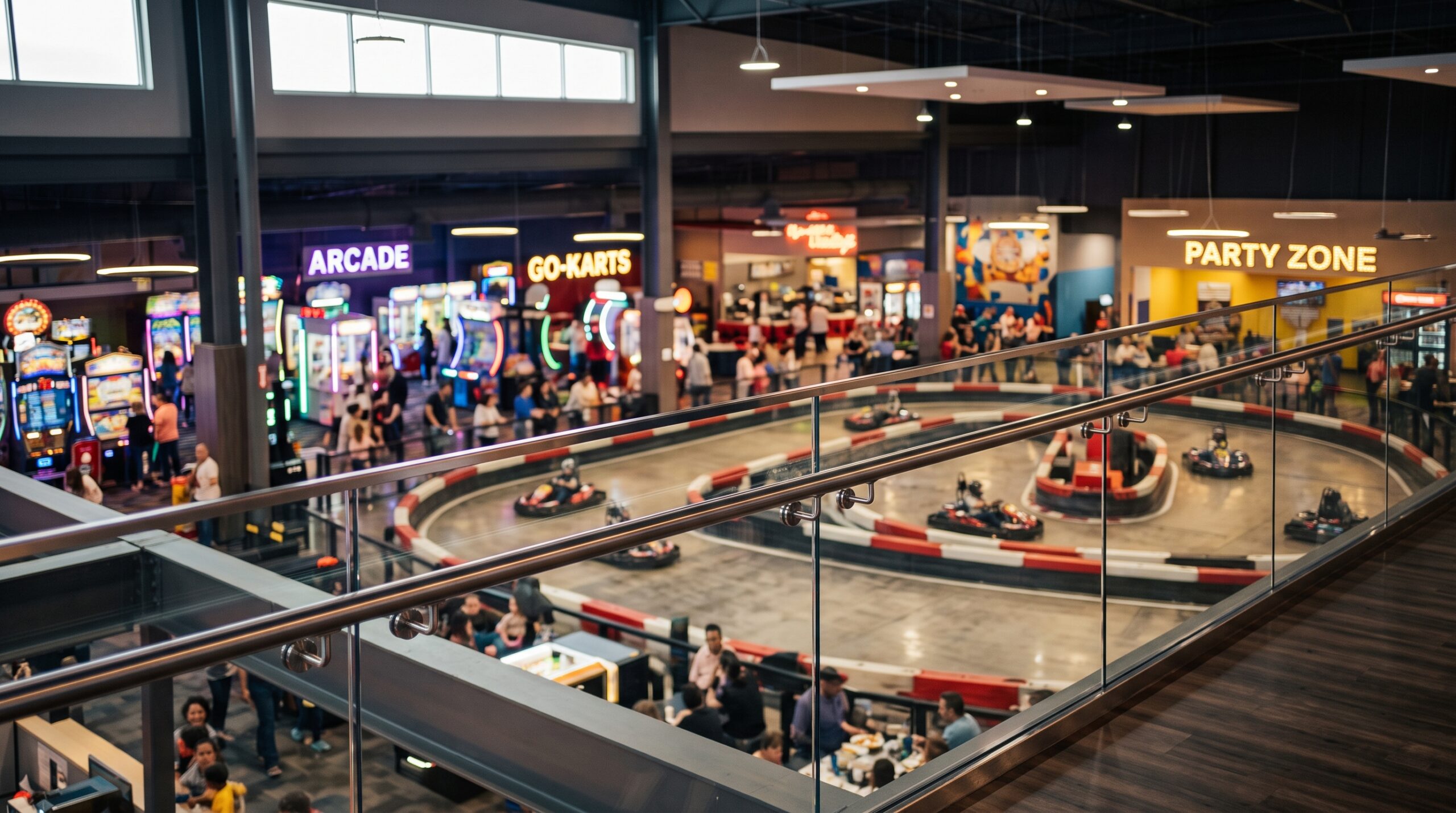
The architecture is constant; the pressure point moves. Arcade multi-venue management lives and dies by cashless consistency — a game card or wristband loaded at one location should spend at all of them, which makes the card-system integration the first demo question. Multi-activity centers stress the POS and booking layers hardest: karting plus bowling plus F&B in one visit is already a multi-system problem at a single site, and a group multiplies it — this is the “multi-attraction venue software” case, where the attraction mix varies but the guest record can’t.
FEC groups like Elev8 lean on replication — standardized packages, kiosks and party products per opening. And karting groups add a layer nobody else has: timing, race formats and league data that must follow drivers across tracks. We wrote a dedicated guide to karting management software for multi-track operators, with TeamSport’s 38-track consolidation as its spine (online bookings grew from 35% to over 90% of sales after the move).
Where BMI Leisure Fits
Disclosure: BMI Leisure is our platform — weigh this section accordingly, and demo alternatives beside it. Multi-venue is not a module we added; it’s an architecture we operate for groups like TeamSport (38 tracks, three countries) and Elev8 Fun (a new FEC every year). The hybrid model described above — members, vouchers and discounts centralized; operational data per venue — is how our Multi Venue Management feature works, with pricing and policies managed remotely, including across franchised locations.
The rest of the platform — booking, POS, access control, timing, CRM — shares the same guest record. That’s what makes the stranger test above passable in the first place.
Two Venues. One Screen.
Central pricing, one guest database, group reporting in seconds — the architecture TeamSport runs across 38 tracks and Elev8 Fun replicates with every opening. Bring your expansion plan to a demo.
Explore Multi-Venue ManagementFrequently Asked Questions
What is multi venue management software?
Multi venue management software is a venue platform built so a group can run several locations as one operation: products, pricing and promotions are managed centrally, every site shares one guest database, and management sees comparable reports across venues in real time — while each location keeps its own day-to-day operational data. The test is simple: two venues, one screen. If each site runs its own island of software and the group report is assembled by copying exports, you have single-venue software installed several times, not a multi-venue platform.
Is franchise management software the same as multi-venue management software?
No — they are different categories that share a word. Franchise management software (FranConnect, FranchiseSoft and similar) is for franchisors managing franchisees: capturing franchise-sale leads, automating royalty fees, delivering training and running compliance audits. Multi-venue management software runs the venues themselves: bookings, POS, access control, guest data and reporting across locations. A franchised leisure group may use both — one to govern the network, one to operate the sites.
What are the best multi-venue management platforms?
Shortlist by architecture, not brochure: the platform must offer central control of products and pricing, one guest database across sites, group-level comparable reporting, and per-venue permissions — natively, not as a bolt-on. Then apply the demo test: ask to see two venues managed from one screen, a price change pushed to every site, and a guest looked up at a location they’ve never visited. Platforms built venue-first (BMI Leisure among them — we’re the publisher here) pass this differently than single-site tools duplicated per location.
How do you manage multi-gate venue entry?
Through access control that reads the same guest record at every gate: the guest’s ticket, session rights and signed waiver live in the platform, so any gate — front door, activity entrance, second building — validates the same credential (QR, card or RFID wristband) against the same database in real time. Capacity limits are enforced per zone, and one blocked credential is blocked everywhere at once.
What is the best POS for a multi-activity venue?
One that treats activities, F&B and retail as one transaction stream: a guest books karting, buys pizza and loads arcade credit on one tab, and the venue sees it as one guest, not three systems. For multi-activity groups, add the multi-venue layer: central products and pricing, group reporting, and spend visible per guest across every location. We compared the platform species in our FEC POS buyer’s guide.
Sources
- BMI Leisure — Multi Venue Management feature page (centralized members/vouchers/discounts, venue-specific operational data, standardized pricing across venues, remote management for franchise operations). bmileisure.com/features/multi-venue-management — verified August 18, 2026.
- BMI Leisure — Elev8 Fun case study (big-box conversions, one new location per year, unified stack, Intercard integration, 1:4 employee-to-kiosk ratio, Brian Lopez quotes). bmileisure.com — verified August 18, 2026.
- BMI Leisure — TeamSport UK case study (38 tracks across three countries; online bookings from 35% to over 90% of sales; group reports from half a month to seconds). bmileisure.com — verified August 18, 2026.
- FranchiseSoft — homepage capability descriptions (royalty fee calculation and invoicing automation, franchise lead capture, sales lifecycle, franchisee training). franchisesoft.com — verified August 18, 2026.
- Capterra — Franchise Management Software category (category framing “from pre-launching franchises to organizations with over 500 franchisees”; audit and compliance capabilities). capterra.com — verified August 18, 2026.
Vendor capabilities reflect each company’s own published pages as of August 18, 2026 and may change. BMI Leisure is the publisher of this guide and offers multi-venue management as part of its venue platform, disclosed above — the TeamSport and Elev8 Fun results are our customers’ published case studies, and your outcomes depend on your operation; evaluate alternatives in a live demo. Franchise management platforms (FranConnect, FranchiseSoft) serve a different category and are described here for disambiguation, not compared. Last updated: August 19, 2026.