
Nobody staffs an arcade with one person. There’s whoever runs the till, whoever minds the game floor’s money, whoever counts the plush toys behind the prize wall, whoever books Saturday’s parties, whoever emails the regulars, and whoever adds it all up at night. Arcade management software is the same org chart, written in software — and the smartest way to evaluate it is role by role: which jobs the platform does natively, which your card system already does, and which are quietly being done by a spreadsheet with no name on the door.
Whatever label the vendor uses — arcade centre management software, arcade venue software, cloud arcade platform — the org chart is the same. This guide walks all six roles, routes you to our deep dives where a role deserves one, and stays honest about when you don’t need any of it yet. (Transparency first: we’re BMI Leisure, a venue platform that serves arcades — flagged now, disclosed fully below.)
What Is Arcade Management Software?
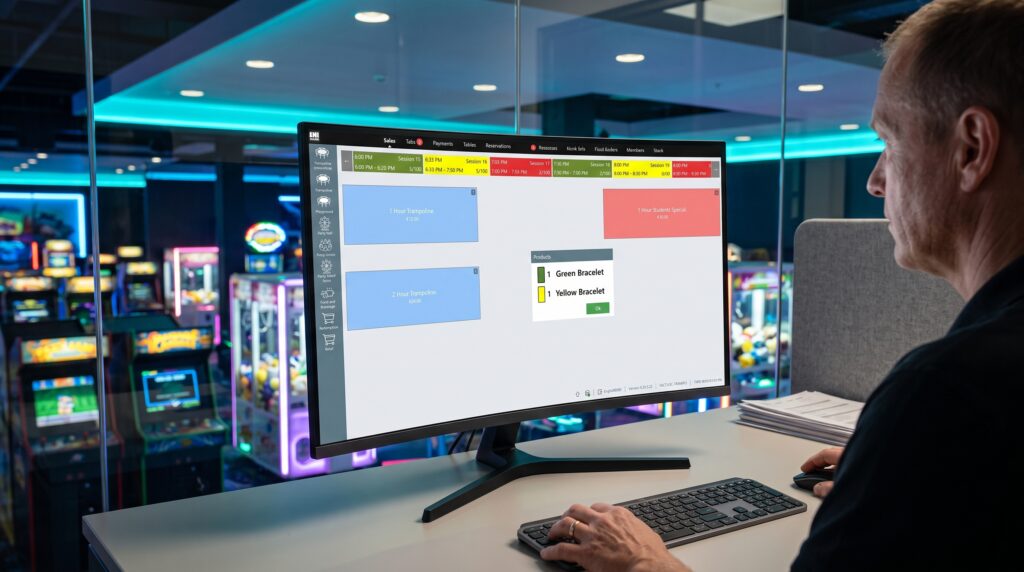
Arcade management software is the platform that runs an arcade venue’s whole operation — the POS selling cards and food, the cashless system powering the game floor, redemption and prize inventory, party and group bookings, loyalty and memberships, and the reporting underneath — on one guest record. Think of it as six staff roles in one system: cashier, banker, quartermaster, host, marketer and auditor.
One aisle-check before anything, because this search neighborhood is crowded with impostors: this guide is about software for arcade venues. It is not about Arcade, the AI product-demo tool whose brand owns the shorter search term, and not about MAME-style emulator software for retro cabinets. If a homepage talks about “interactive product walkthroughs” or ROM front-ends, wrong aisle.
The Org Chart: Six Roles Your Software Has to Fill
Feature lists blur; job descriptions don’t. Here is the arcade’s software org chart — six roles, each with the same practical decision: does your platform do this natively, does another system you already own do it, or is a spreadsheet doing it unpaid?
| Role | What it runs | Deep dive |
|---|---|---|
| The Cashier | POS at every counter: cards, food, prizes, parties | Arcade POS guide |
| The Banker | Cashless credits, cards and wristbands, balances on guest records | Card system guide · brand comparison |
| The Quartermaster | Redemption and prize inventory | This guide, below |
| The Host | Parties, groups and reservations | Party booking guide |
| The Marketer | Loyalty, memberships and campaigns | This guide, below |
| The Auditor | Game-level and venue-wide reporting | This guide, below |
1. The Cashier — the POS layer
Sells game cards and reloads at the desk, food at the snack bar, prizes’ retail cousins, and party packages — ideally against one guest record at every counter. This role has its own full anatomy (the four counters, the three till architectures, the no-frills Square-plus-card-system option for small rooms) in our arcade POS system guide — the deep dive this hub won’t duplicate.
The hire decision: generic till + card system (cheap, two disconnected guests) vs. card-vendor POS (game-floor-first) vs. platform POS with the card system integrated (one record). Full comparison in the POS guide.2. The Banker — cashless credits and the card system
Issues the venue’s currency: rechargeable cards or wristbands, balances linked to guests (transferable when a card is lost), top-ups at kiosks, and credits that ideally spend at the snack bar too — stored value as the venue’s economy. It’s a mature specialist market: Semnox’s Parafait suite alone reports 1,800+ venues across 50+ countries. What a card system costs, whether it out-earns coin-op, and why the category hides behind six names is our separate arcade card system guide; the brand match — Sacoa vs Embed vs Semnox vs Intercard — has its own head-to-head.
The hire decision: the card system is the one role you’ll almost certainly staff with a specialist — the platform question is whether it plugs in or lives in its own silo.3. The Quartermaster — redemption and prize inventory
The strangest supply chain in hospitality: tickets in, plush toys out, margins decided at the prize wall. The software job is treating redemption as inventory. Prize stock and cost tracked against tickets redeemed, reorder points, and shrinkage visible instead of mysterious. Card-system suites are historically strongest here; whatever you run, this role should feed the same reports as everything else, not a separate binder.
The hire decision: if redemption drives your margins, demo this role first — it’s where game-floor-first suites earn their keep.4. The Host — bookings, parties and groups
Arcade revenue’s quiet giant: the birthday booked online days earlier with a deposit, a guest list, and day-of billing for the extra pizzas and the second round of credits. The host role is the difference between “the till knows the party exists” and Saturday’s most valuable transaction being also its most manual — the full chain (packages, deposits, host-shared invitations) is our party booking guide. Reservation-style queries are back in this category’s search data for a reason: operators are tired of running parties out of an inbox.
The hire decision: point tools book parties; platforms land the booking, the waivers where needed, and the day-of spend on one record. Price the difference in staff hours.5. The Marketer — loyalty, memberships and campaigns
The role most arcades leave unstaffed. Loyalty is where cashless data becomes revenue: rewarding frequent players, memberships with recurring billing, and offers based on what a guest actually plays and spends — our own cashless module frames it as integrating “with loyalty programs to reward frequent players” and tracking “spending habits to offer personalized deals.” Loyalty-program queries joined this category’s search family this spring; the operators asking have noticed their card system knows who the regulars are and nobody is doing anything with it.
The hire decision: loyalty bolted on as a separate app is a fourth guest record. Loyalty native to the platform is the same record that already holds plays, parties and pizza.6. The Auditor — reporting and the numbers
Every role above produces data; the auditor makes it one story. Game-level performance (which machines earn their floor space), revenue in real time, credit liability outstanding, party pipeline, and — for groups — the same numbers comparable across locations. The operator questions appearing in this category’s conversational searches (“can arcade software track revenue in real time?”, “can it help reduce downtime?”) are auditor questions. The answer is yes — and machine-level play data is also how you spot a cabinet earning nothing before its lease renews.
The hire decision: if a report takes longer than a coffee to produce, the role is vacant — whatever your stack’s brochure says.“Is Intercard an Arcade Management Software?” — What People Now Ask Their Assistants
Something new is visible in this category’s search data: since May 2026, operators have been asking assistants to evaluate card-system brands — Embed, Intercard, Sacoa, Semnox — “on arcade management software” (per Ahrefs matching-terms data reviewed September 2026). The question deserves a straight answer, because it’s a species confusion with money attached.
A card system is the banker — one role, done by a specialist: readers, cards, balances, play tracking. Arcade management software is the whole org chart. The four brands operators name are excellent bankers, and none of them is trying to be your host, marketer and auditor at platform depth — just as no venue platform matches a dedicated card system’s reader hardware. They’re not substitutes; well-run arcades typically run one inside the other.
So the evaluation question to ask isn’t “is Intercard good management software?” — it’s “which platform does my card system plug into, and who owns the guest record when both are running?” For the banker choice itself, our four-brand comparison is the deep dive; for platform brands, our best FEC software guide profiles eight honestly, ourselves included.
The VR Corner: Same Org Chart, Stations Instead of Cabinets
VR arcade queries have their own growing lane in this category’s data, and the operational answer is reassuring: a VR arcade is the same org chart with one substitution. Cabinets become stations — bookable, time-boxed, with a hard capacity per slot — so the banker’s stored value meets the host’s session calendar: guests book a station like a party room and spend credits like a game card. If your floor mixes free-roam VR with classic cabinets, the platform question is whether both live on one guest record; the till-level detail is the POS guide’s territory (the same architecture question applies, stations or cabinets).
What Does It Cost — and When You Don’t Need It Yet
No published price list exists in this market: platforms quote by venue, and the card-system layer prices by hardware (readers scale with your machine count — usually the dominant line, as our card system guide details). Budget in layers, then compare at three-year total cost across at least two quotes:
- The software — subscription or licence, quoted by venue.
- Cashless hardware — a reader per machine; the multiplier that dominates most quotes.
- Kiosks — sale and top-up stations, placed where credits run out.
- Payment processing — fees that add up fast at volume; compare them explicitly.
- Setup and training — plus what support costs on a full Saturday.
Set against those lines what the connected setup returns: less cash handling, automated redemption tracking — and the revenue mechanics vendors advertise, like Amusement Connect’s claimed “20% boost in sales” from going cashless (a card-system vendor’s own number, quoted as such; the trade press documented the direction of the shift, not the size).
And the exit ramp, stated plainly, consistent with every guide in this series: a small game room with a simple snack counter doesn’t need this org chart yet. A generic till plus your card system holds at low volume. The triggers that change the answer are the usual four — parties become a revenue line, redemption starts deciding margins, loyalty becomes worth running, or a second location appears. Until one fires, save the money.
Where We Plug Into This Org Chart
Disclosure: BMI Leisure is our platform, so read this section as the vendor speaking. In the org chart above we’re the platform layer: the cashier at every counter, the host running parties and bookings, the marketer with loyalty on the same record, and the auditor reporting it all — with the banker integrated rather than replaced: our arcade integrations connect Sacoa, Intercard, AmusementConnect and others, so credits sell and reload through the same POS and kiosks as everything else, stay linked to guests (transferable on a lost card), spend on food and drinks, and land in the same reports as the rest of the venue.
The proof that shape works at scale: Elev8 Fun runs it — our platform around the venue, Intercard on the game floor — while opening a new venue yearly, with kiosk-first operations reaching one employee overseeing four kiosks. We’re the right conversation for the arcade that’s really an FEC: parties, food, growth plans, maybe a second site. For the ten-machine game room, our sincere recommendation is the one our POS guide already made — a simple till, your card system, and our bookmark for the day a trigger fires.
Six Roles. One Guest Record. Your Card System Included.
Cashier, banker, quartermaster, host, marketer, auditor — the whole org chart on one platform, with Sacoa, Intercard or AmusementConnect plugged in. The shape Elev8 Fun replicates with every opening. Bring your busiest Saturday to a demo.
Explore Cashless & ArcadeFrequently Asked Questions
What is arcade management software?
Arcade management software is the platform that runs an arcade venue’s whole operation — the POS selling cards and food, the cashless system powering the game floor, redemption and prize inventory, party and group bookings, loyalty and memberships, and the reporting underneath — on one guest record. Think of it as six staff roles in one system: cashier, banker, quartermaster, host, marketer and auditor. One warning for searchers: it is unrelated to Arcade the AI product-demo tool, and to MAME-style emulator software for game cabinets.
What is the best software for arcade management?
Judge candidates by the org-chart test: can one system act as your cashier (POS for cards, food and retail), banker (cashless credits with balances on guest records), quartermaster (redemption and prize inventory), host (party and group bookings), marketer (loyalty and campaigns) and auditor (game-level revenue reporting) — without staff re-keying between tools? Dedicated card-system suites are strongest on the game floor; venue platforms add parties, F&B and multi-venue reporting around them. For platform brands see our best FEC software comparison; for card brands, our Sacoa vs Embed vs Semnox vs Intercard guide.
Is a card system like Embed, Intercard or Sacoa the same as arcade management software?
Not quite — and operators increasingly ask assistants exactly this. A card system is the cashless layer: readers on the machines, rechargeable cards or wristbands, and software tracking play. Arcade management software is the wider platform that runs everything else too — parties, food, bookings, loyalty and reporting — usually with the card system integrated inside it rather than replaced. The practical question isn’t which one is ‘better’; it’s which platform your card system plugs into, and who owns the guest record when both are running.
How much does arcade management software cost?
Vendors in this market quote by venue rather than publishing price lists, so budget by layers: the software subscription or licence, the card-system hardware if you run cashless (readers scale with your machine count — usually the biggest line), kiosks, payment processing, and setup. The offsets are real: less cash handling, automated redemption tracking, and unspent credits that stay with the venue. Compare at three-year total cost across at least two quotes, and price the reporting layer seriously — it’s where the upside gets captured or missed.
Do I need management software for a small arcade?
Honestly, maybe not yet. A small game room with a simple snack counter can run on a generic retail till plus its card system — two disconnected tools, but at low volume the disconnection barely bites. The outgrowing triggers are predictable: parties become a revenue line, redemption inventory starts mattering to margins, loyalty becomes worth running, or a second location appears. Fire one of those and the org chart below is your shopping list.
Sources
- BMI Leisure — Cashless & Arcade Solutions feature page (digital arcade credits; automated prize redemption and ticket tracking; loyalty-program integration; real-time game performance and revenue tracking; credits usable for food and drinks; spending-habit tracking for personalized deals). bmileisure.com — verified September 15, 2026.
- BMI Leisure — Arcade Integrations feature highlight (works with Sacoa, Intercard, AmusementConnect and others; credits sold and reloaded via Booking/POS and kiosks; linked to guests and transferable on loss; credits spend on non-arcade products; reporting via BI tools). bmileisure.com — verified September 15, 2026.
- BMI Leisure — Elev8 Fun case study (platform + Intercard on the game floor; a new venue opened yearly; one employee overseeing four kiosks). bmileisure.com — verified September 9, 2026.
- Semnox / Parafait — arcade industry page (“1800+ venues across 50+ countries”; POS, cashless, F&B and party on one interface). parafait.com — re-verified September 15, 2026.
- Amusement Connect — Why You Need a Card System for Your Arcade (“20% boost in sales” — the vendor’s own claim, quoted as such). amusementconnect.com — re-verified September 15, 2026.
- RePlay Magazine — Cashless System and Software Survey (September 2020; the industry’s coin-to-cashless transition documented by trade press). replaymag.com — verified September 1, 2026.
- Ahrefs — matching-terms data for the “arcade software” keyword family (the May-2026 birth of management, venue, loyalty, token, redemption and reservation queries; the “evaluate [card brand] on arcade management software” conversational family; VR arcade growth). Data reviewed September 10, 2026.
Vendor capabilities reflect each company’s own published pages as of the verification dates above and may change; the one quantified uplift figure cited (20%) is a card-system vendor’s own published claim, labeled as such. BMI Leisure is the publisher of this guide and sells the platform layer described, disclosed above; card-system brands are described as the specialist banker role, and both brand comparisons — card systems and platforms — are separate, linked guides precisely so this hub ranks nobody. Evaluate any stack, ours included, with the org-chart test in a live demo. Last updated: September 16, 2026.