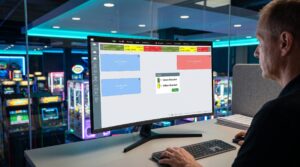
A museum sells a ticket to a building. A trampoline park sells a ticket to a 60-minute session that 80 other people also want, that needs a signed waiver for every jumper, and that has to turn into a wristband at the desk. Both are called attraction ticketing software, and that shared name is why so many entertainment venues end up evaluating the wrong shortlist.
This guide is for the second kind of venue: trampoline parks, karting tracks, family entertainment centers, soft play, adventure and amusement parks. Whether you searched for FEC ticketing software, amusement park ticketing software or a ticketing system for a race track, it covers what the ticket actually has to do at your kind of venue, the five criteria that separate the platforms, and how ticketing joins up with waivers, kiosks and the arcade. (Transparency first: we’re BMI Leisure and we sell venue software to exactly these venues. Where we fit, and where we don’t, is laid out near the end.)
What Is Attraction Ticketing Software?
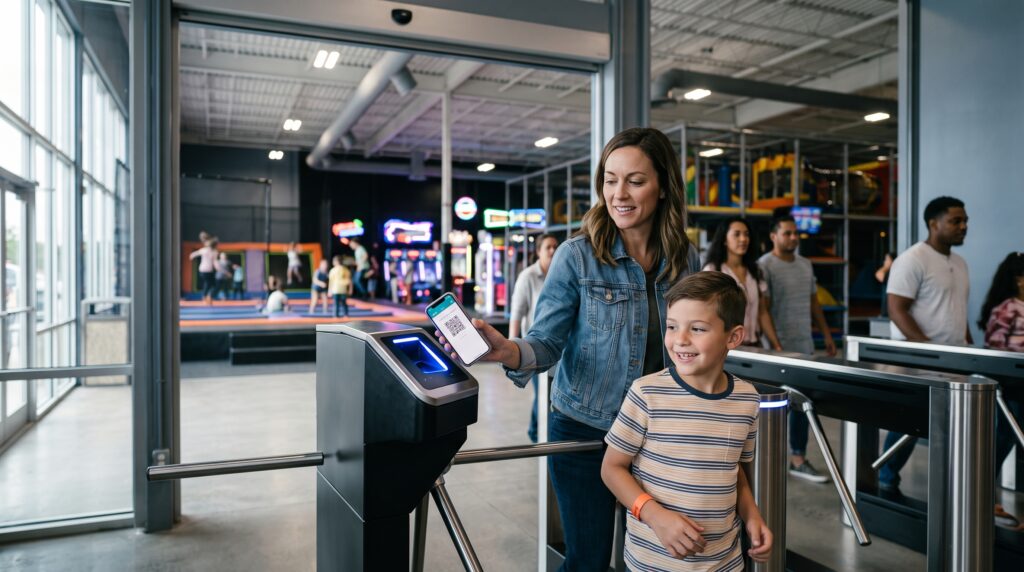
Attraction ticketing software sells admission online, at the desk and at kiosks against live capacity, then turns each ticket into access at the gate by barcode, QR code or wristband. For entertainment venues it also has to handle what the ticket really is: a timed session, a race heat or a day pass, usually with a digital waiver attached and a guest who will spend more once inside.
The Venue Matrix: What “a Ticket” Has to Do at Your Venue
Most ticketing checklists fail here because they treat a ticket as a ticket. Trampoline park ticketing is a different job from soft play ticketing, which is a different job again from selling race heats. In practice the thing you sell changes shape by venue type, and the software has to model that shape natively or your staff will model it by hand. Find your row first:
| Venue | What the ticket is | Capacity rule | Waiver | How it becomes access |
|---|---|---|---|---|
| Trampoline park | A timed jump session (30, 60, 90 min) | Headcount per session slot | Every jumper, minors signed by a parent | Session-colored or RFID wristband |
| Karting track | A heat or race package | Karts per heat, heats per hour | Every driver, plus age and height rules | Check-in to a heat, assigned kart |
| Family entertainment center | Day pass, attraction bundle or pay-per-attraction | Per attraction, not per building | Only for some attractions | Wristband or shared arcade card |
| Soft play / indoor playground | Session for child + accompanying adult | Children/session, by age zone | Parent or guardian | Timed wristband, parent-child pair |
| Adventure / ropes / aerial park | A timed course entry | Climbers per course per slot | Every participant, plus briefing | Zone access per course |
| Amusement / water park | Day admission plus add-ons (rides, cabanas) | Park daily cap + ride limits | Usually none; attraction-specific | Turnstile scan, wristband add-on |
If your venue spans several rows (an FEC with a trampoline court and a go-kart track, for example), that’s the most important fact to bring to a demo. A platform that handles one row natively and fakes the others will show it within ten minutes. Our deep dives cover the venue types in detail: trampoline parks, karting, family entertainment centers, indoor playgrounds, adventure parks and amusement parks.
Five Criteria for Choosing Attraction Ticketing Software
1. Capacity has to be live and shared by every channel
Capacity is the product. If the website, the kiosk and the front desk each hold their own view of how many spots are left, one of them will oversell your busiest slot. The test is simple: book the last spot online while a colleague tries to sell it at the desk, and watch which system wins. On a trampoline park, preventing overbooking and staying within venue capacity is a safety requirement as much as a revenue one.
2. The ticket unit has to match your venue
Check that the platform sells your row of the matrix natively: sessions with start times, heats with kart counts, bundles across attractions, parent-and-child pairs. Workarounds such as “create a product called Heat 14:20” are how staff end up running the schedule on a whiteboard.
3. One inventory across web, kiosk and desk
Guests now book in three places: online before they arrive, at a kiosk when they walk in, and at the desk when they need help. All three should sell from the same inventory and the same price rules. Walk-in ticket sales at a self-service kiosk only work when the kiosk runs on the same booking engine and capacity data as everything else. If you distribute through resellers or online travel agencies, ask how those channels draw down the same capacity.
4. A gate method that fits your floor
The ticket has to become access somewhere. Printed barcodes and QR codes on phones suit day admission. Wristbands suit venues where hands are busy, wet or small, and an RFID wristband can be the entry ticket, the session timer, the wallet and the guest’s identity at once, with readers enforcing access zone by zone. Session-colored bands remain a zero-tech option that works well for timed jumps.
5. One guest record from ticket to spend
This is the criterion that separates ticketing tools from venue platforms. The ticket should land on the same guest record as the digital waiver, the party booking, the food and arcade spend at the POS, and the marketing consent. When they live in separate systems, your reports can tell you how many tickets you sold but not what a ticket buyer is worth.
One more question worth asking every vendor, ours included: what happens at the gate when the internet goes down on a full Saturday? We make this point to karting operators in particular, where cloud-only setups can create operational risk if connectivity drops during busy race sessions, and the same logic applies to any venue selling timed slots at a gate. Ask to see the offline behavior in the demo.
Ticketing, Waivers and the Arcade: Making It Join Up
Two integration questions come up again and again from operators, often word for word in what they ask search engines and AI assistants.
Waivers. The cleanest setup doesn’t need an integration: the waiver is part of the booking flow, so a guest who books a jump session signs in the same checkout, and the desk or gate sees ticket and waiver on one screen. With a standalone waiver tool, check that signed waivers attach to bookings automatically and that staff can see waiver status at check-in without switching screens.
The arcade. Parks adding an arcade, or FECs adding admissions to an arcade, have three routes: replace both with one platform; integrate the existing card system so credits are sold at the same tills and kiosks as tickets; or run two systems in parallel with a daily reconciliation. Integration is usually the right answer when the card system already works. Our own platform integrates Sacoa, Intercard, AmusementConnect and others, so credits sell and reload alongside tickets. The till side of that decision is covered in our arcade POS guide.
What Attraction Ticketing Software Costs
Most vendors in this market quote by venue rather than publishing a price list, and that includes us. Budget in four layers:
- Software: subscription or licence, quoted per venue.
- Payment processing: often the largest recurring line once online sales scale; compare the rates explicitly.
- Hardware: kiosks, scanners, wristband readers and printers.
- Setup and training: plus what support costs on a peak weekend.
Compare at three-year total cost across at least two written quotes. Then set that against what you lose today to oversold slots, slow gates and phone bookings, because that is the number the software is meant to shrink. If you want to compare full platforms side by side, our best FEC software guide profiles eight of them, including us.
Where BMI Leisure Fits
Disclosure: BMI Leisure is our platform, so read this section as the vendor speaking. For over 25 years we’ve built venue management software for the venue types in the matrix above, and more than 300 locations worldwide run on it.
Online booking runs 24/7 with multiple payment providers and schedules reservations and walk-ins together. On trampoline parks, the platform controls every session to prevent overbooking and assigns wristbands that show each guest’s session time and grant access. On karting tracks, the ticket becomes a heat: marshals assign karts, run live timing and organize heats from the same system that sold the race. Waivers, kiosks, parties, POS and the arcade card system all sit on the same guest record.
The proof is in operations. Xtreme Action Park cut front-desk staffing from eight cashiers to four after moving onto our platform, and Elev8 Fun runs one employee per four kiosks while opening a new venue every year.
Where we’re not the right call: museums, zoos and cultural venues built around memberships and school groups are better served by the specialists in the aisle check above, and large theme parks that need virtual queuing across dozens of rides belong with enterprise vendors. If your venue sells activities by the session, the heat or the day, that’s our territory.
Take Control of Your Peak Hours
Tell us your venue type and your peak-day schedule. We’ll show you tickets, waivers, wristbands and POS running on one guest record, live, with your own sessions or heats, and put the quote in writing.
Book Your DemoFrequently Asked Questions
What is attraction ticketing software?
Attraction ticketing software sells admission to a venue — online, at the desk and at kiosks — against live capacity, then turns each ticket into access at the gate by barcode, QR code or wristband. For entertainment venues such as trampoline parks, karting tracks and family entertainment centers, it also has to handle what the ticket really is: a timed session, a race heat or a day pass, usually with a digital waiver attached. Museums and zoos buy a different species of the same software, built around memberships, school groups and resellers.
What features should attraction ticketing software have?
Five, for an entertainment venue: live capacity shared by every sales channel so nothing oversells; a ticket unit that matches your venue (session, heat, day pass or course slot); the same inventory on the web, at kiosks and at the desk; a gate method that turns the ticket into access (QR, barcode or RFID wristband); and one guest record that joins the ticket to the waiver, the party booking and what the guest spends at the POS. Add resilience — ask what happens at the gate when the internet drops on a full Saturday.
How do you integrate an arcade point-of-sale with an existing park ticketing and POS system?
There are three routes. Replace: move admissions and arcade sales onto one platform so a single POS sells both. Integrate: keep your card system (Sacoa, Intercard, AmusementConnect and similar) and connect it to the ticketing platform so credits are sold and reloaded at the same tills and kiosks as tickets. Run in parallel: two systems with a daily reconciliation, which works at low volume but splits the guest into two records. Integration is the usual choice for parks with a working card system; ask any vendor to show credits and admissions on the same receipt in a live demo.
Can an online waiver platform integrate with my POS and ticketing systems?
It can, but the cleanest setups don’t need an integration at all: the waiver is part of the ticketing platform, so a guest who books a jump session online signs the waiver in the same flow and the gate or desk sees both on one record. With a standalone waiver tool, check three things: whether the waiver attaches to the booking automatically, whether staff can see waiver status at check-in without switching screens, and whether minors can be signed for by a parent. Anything manual in that chain becomes a queue on your busiest day.
How much does attraction ticketing software cost?
Most vendors in this market, BMI Leisure included, quote by venue rather than publishing a price list. Budget in layers: the software subscription or licence, payment processing (often the largest recurring line at volume), hardware such as kiosks, scanners and wristband readers, and setup and training. Compare at three-year total cost across at least two written quotes, and price what an oversold Saturday or a slow gate costs you today — that is the number the software is meant to shrink.
Sources
- BMI Leisure — Online Booking & Remote Payment feature page (“Enable 24/7 bookings with multiple payment providers”; optimized reservations and walk-in scheduling; self-service booking). bmileisure.com — verified September 22, 2026.
- BMI Leisure — trampoline park industry page (session control preventing overbooking within venue capacity; wristbands indicating session time and enabling access; online booking, waivers and payment). bmileisure.com — verified September 22, 2026.
- BMI Leisure — karting industry page (online booking; kart assignment, live timing and heat organization; kiosks, self-registration and waivers; operational risk of cloud-only setups during busy race sessions). bmileisure.com — verified September 22, 2026.
- BMI Leisure — homepage (“trusted by more than 300 locations worldwide”; “for over 25 years”), arcade integrations feature highlight (Sacoa, Intercard, AmusementConnect; verified September 15, 2026), Xtreme Action Park case (eight cashiers to four), and the Elev8 Fun case study (a new venue opened every year; one employee per four kiosks; verified September 9, 2026).
- Gateway Ticketing Systems — attraction ticketing page (Galaxy “a robust modular solution for tours and attractions”; group sales, resellers and third-party distributors; timed events). gatewayticketing.com — verified September 22, 2026.
- Centaman — attraction ticketing software page (over 30 years in attraction management; timed tickets; variable pricing; barcode, RFID, mobile and printed tickets). centaman.com — verified September 22, 2026.
- Outbound Software — ticketing and reservations for zoos, aquariums, museums and science centers; integration with NCR Counterpoint. outboundsoftware.com — verified September 22, 2026.
- accesso — ticketing, POS and virtual queuing for theme and water parks, zoos and ski resorts. accesso.com — verified September 17, 2026.
- Google Search Console (bmileisure.com) and Ahrefs — the operator questions answered in the integration section and FAQ, and ticketing search demand by venue type. Data reviewed September 22, 2026.
Vendor capabilities reflect each company’s own published pages as of the verification dates above and may change. BMI Leisure is the publisher of this guide and sells the venue platform described in the “Where BMI Leisure Fits” section; the specialists named in the aisle check are recommended for venue types we don’t target. This is general product research, not procurement advice — test any platform, ours included, with your own peak-day scenario. Last updated: September 22, 2026.