A trampoline park runs on timing: timed jump sessions, timed parties, capacity limits that change by the half hour, and a waiver for every single jumper. The software managing all of that isn’t back-office plumbing. It decides how full your sessions run, how fast your Saturday line moves, and whether party parents rebook. Here’s an honest comparison of the best trampoline park software platforms in 2026, what each does well, and how to choose.
What Software Do Trampoline Parks Use? (Quick Answer)
Trampoline parks use all-in-one venue management platforms that combine online booking with timed sessions, digital waivers signed before arrival, POS for admissions and F&B, wristband or RFID session tracking, real-time capacity management, party booking, and CRM. The leading platforms are BMI Leisure, ROLLER, Parafait (Semnox), Venue Sumo and LilYPad POS.
How We Evaluated (And a Note on Who We Are)
Full transparency: this comparison is published by BMI Leisure — one of the vendors on the list. You should know that before reading, and you should apply extra scrutiny to what we say about ourselves. To keep the comparison honest, we followed three rules: every competitor is described from its own published pages (not our opinions of them), scale figures are labeled as each vendor’s own claims, and we evaluated all five against the same criteria:
- Session & capacity management — the core mechanic of a trampoline park
- Waiver handling — collected at booking, not at a clipboard
- Party & group booking — the highest-margin revenue stream
- POS and F&B integration — one guest tab across the venue
- Proven scale — real venues, named customers
- Best-fit operator — because no platform is best for everyone
Trampoline Park Software Compared
| Platform | Known for | Session/capacity | Waivers | Scale claims | Best fit |
|---|---|---|---|---|---|
| BMI Leisure | All-in-one for session venues; wristbands + timing heritage | ✅ Wristband session timing, real-time capacity | ✅ At booking, tied to guest profile | 300+ venues, 70 countries (all types) | Parks & multi-activity venues wanting one system |
| ROLLER | Broad feature set; tiered plans | ✅ Capacity mgmt, self-serve kiosks | ✅ Self-service waivers | Self-reported 700+ parks | Parks comparing tier-based pricing |
| Parafait (Semnox) | RFID & cashless tech | ✅ RFID wristbands w/ time alerts | ✅ Digital waivers | 1,800+ venues, 50+ countries (all types) | Cashless-first and international operators |
| Venue Sumo | High-volume party workflows | ✅ Timed entry & sessions | ✅ QR/email waivers | Not published on industry page | Party-heavy, high-throughput parks |
| LilYPad POS | Trampoline-specific POS; modular add-ons | ✅ Barcode wristbands, occupancy tracking, color-coded timed sessions | ✅ Online & in-house, attached to profile | Named customer: Mountain Air (OR) | Single-location parks wanting a lower-cost modular POS |
1. BMI Leisure — Best All-in-One for Session-Based Venues
We’ll make our own case and let you judge it against the rest. BMI Leisure has built venue management software for 25+ years, born in karting — which matters for trampoline parks more than it sounds, because both businesses share the same operational heart: selling time slots safely at high throughput. Session timing, capacity control and safety tracking aren’t add-on modules for us; they’re the foundation the platform grew from.
For trampoline parks specifically, the pieces work as one system: online booking sells timed jump sessions with real-time capacity management; digital waivers are signed at booking and live on the guest profile forever; wristbands track session time on the floor; the POS and F&B module keep café and admissions on one tab; party & events runs the birthday engine; and CRM & marketing automation turns first visits into memberships. Parks like Trampo Extreme, Super Jump, Salting and Fly run on it today — see the full picture on our trampoline park software page.
Honest limits: we’re enterprise-grade, which means we’re strongest for ambitious single venues and multi-location groups — a very small park wanting a lightweight POS-only tool may find simpler options below a better first step.
2. ROLLER — Tier-Based Platform
ROLLER’s industry page self-reports 700+ trampoline parks on its platform. The feature set covers online booking, self-service waivers, POS, memberships, party packages, self-serve kiosks, and multi-venue management, sold in tiered plans (Starter through Enterprise).
Considerations: adoption numbers don’t automatically mean best fit for your park. Tier-gated plans mean the full capability set sits in the higher tiers — price the tier you’d actually need, not the entry one. And parks with mixed attractions (karting, arcade, F&B-heavy concepts) should compare how each platform handles multi-activity operations natively.
3. Parafait (Semnox) — RFID and Cashless Focus
Parafait, from Semnox, self-reports 1,800+ venues across 50+ countries (across all entertainment types, not only trampoline parks). Its positioning centers on hardware-connected tech: RFID wristbands with session alerts, RFID lockers, and cashless payment environments. Slot-based booking, party modules bundling attractions with F&B, and quoted 4–8 week implementations complete the offer.
Considerations: the RFID-first model shines in high-volume cashless venues; smaller parks should weigh whether the hardware ecosystem matches their scale.
4. Venue Sumo — Party Workflow Focus
Venue Sumo positions for busy parks. Its published feature set covers timed entry and session management, a POS aimed at high-volume workflows, customizable party packages, and QR-code food ordering. Memberships with recurring billing and channel management complete the lineup.
Considerations: its industry page names no customers or case studies — ask for referenceable trampoline parks during evaluation.
5. LilYPad POS — Trampoline-Specific Modular POS
LilYPad takes a different route from the all-in-one platforms above: a trampoline-focused POS with an “easy-to-use interface and reasonable price” as its own pitch, extended through optional online modules. The core covers party booking (in-house, plus a 24/7 online booking module), ticket sales with capacity tracking and overbooking protection, electronic waivers signed in-house on tablets or online before arrival and attached to the customer profile, and printed barcode wristbands that track live occupancy — with color coding for timed sessions and groups. Add-on modules cover online product sales (gift cards, memberships, classes), auto-renewing memberships, and post-party surveys; an employee time clock is built in. Its named reference is Mountain Air Trampoline Park in Bend, Oregon.
Considerations: the modular model means the online capabilities are add-ons rather than one integrated platform — parks planning F&B, arcade or multi-activity operations should map which modules they’d need and compare the total against all-in-one pricing.
A note on Aluvii: we intended to include it in this comparison, but its website was unavailable during our verification window (July 2026), so we’ve excluded it rather than describe a product we couldn’t verify. If that changes, we’ll revisit in a future update.
The Features That Actually Matter for a Trampoline Park
Whichever platform you evaluate, these are the make-or-break capabilities — in order of how much they’ll shape your daily operations:
- Timed sessions and real-time capacity. Your entire business is selling 60-minute blocks of finite court space. If the system can’t manage overlapping sessions, grace periods and live capacity, nothing else matters.
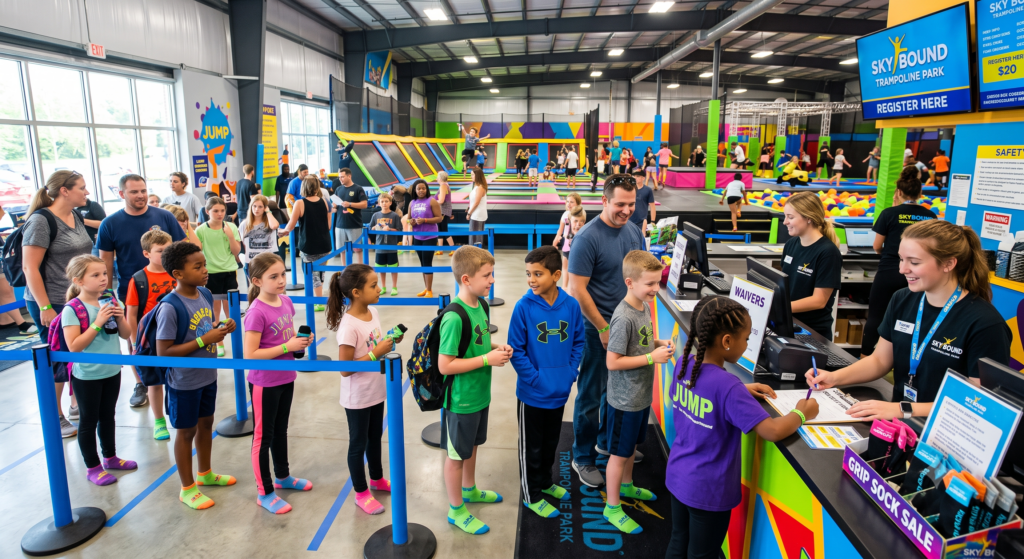
- Waivers signed at booking. Every jumper needs one, minors need guardians, and a clipboard at the desk is your longest line and weakest legal record. The waiver must attach to the booking and the guest profile automatically.
- A party engine, not a party form. Packages, deposits, headcount changes, F&B pre-orders that reach the kitchen — parties are your margin; the software should sell and run them end-to-end.
- One tab across the venue. Admission, grip socks, pizza, arcade — separate systems mean lost revenue and blind reporting. POS and F&B belong inside the platform.
- Memberships and CRM. The parks that win turn birthday guests into monthly members — that requires guest data the software captures by itself.
- Reporting you’ll actually use. Session utilization, revenue per jumper, party conversion — the numbers that tell you what to fix.
POS, Management, or Booking Software: One System or Three?
Operators search for trampoline park POS software, management software and booking software as if they were three purchases — and a decade ago, they were. In 2026 they’re one decision. A standalone POS can ring up admissions but doesn’t know the 3 PM session is full. A booking tool can sell sessions but can’t put pizza on the same tab. Neither builds the guest profile your marketing needs. Every serious platform on this list is all-in-one precisely because stitching three vendors together is where park operations (and data) fall apart. Choose the platform first; the POS comes with it.
See BMI Leisure Run Your Park’s Saturday
Timed sessions, waivers at booking, wristbands, parties and F&B on one guest tab — built by people who’ve powered session-based venues for 25+ years. Judge us by the demo.
Book Your DemoFrequently Asked Questions
What software do trampoline parks use?
All-in-one venue management platforms combining online booking with timed sessions, digital waivers signed before arrival, POS for admissions and F&B, wristband or RFID session tracking, real-time capacity, party booking, and CRM. Leading options include BMI Leisure, ROLLER, Parafait (Semnox), Venue Sumo and LilYPad POS.
Is owning a trampoline park profitable?
Well-run parks are profitable through a diversified mix: timed jump admissions, birthday parties (typically the highest-margin stream), memberships, and F&B. Profitability tracks session utilization, party calendar fill and repeat visits — which is why the software running bookings, capacity and CRM directly affects margins. More on venue economics in our guide to profitable entertainment business ideas.
What is the biggest trampoline park company?
Sky Zone and Urban Air operate the largest trampoline park networks, each with hundreds of locations, alongside brands like Altitude and Launch. Most of the industry, though, consists of independent parks and small regional groups — the operators industry software platforms primarily serve.
How much does trampoline park software cost?
Most vendors quote custom pricing based on venue size and modules — typically a monthly SaaS subscription plus payment processing and optional hardware (POS terminals, wristband printers, kiosks). Some, like ROLLER, publish tiered plans; most others, including BMI Leisure, scope pricing per venue. Budget for setup and training in year one.
Sources
- ROLLER — Trampoline Park Software industry page (features, 700+ parks claim, named customers, tiered plans). roller.software — verified July 21, 2026.
- Parafait (Semnox) — Trampoline Park Management Software page (RFID wristbands, 1,800+ venues claim, implementation timeline). parafait.com — verified July 21, 2026.
- Venue Sumo — Trampoline Parks industry page (feature set, party workflows, QR ordering). venuesumo.com — verified July 21, 2026.
- LilYPad POS — Trampoline Parks industry page (party booking, ticket sales, waiver and wristband features, online modules, Mountain Air reference). lilypadpos.com — verified July 21, 2026.
- Aluvii — excluded from this comparison: website unavailable during the July 2026 verification window.
Competitor information reflects each vendor’s own published pages as of July 21, 2026 and may change — verify details during your evaluation. BMI Leisure is the publisher of this comparison; we’ve disclosed that above and encourage you to demo multiple platforms. Last updated: July 21, 2026.