Search for how to start an arcade business and most of the answers come from forum threads, some of them years old, or from companies selling arcade machines. Both have useful things to say, and most of what we reviewed focuses on which games to buy. We think the first decision is a different one: how your guests will pay to play.
That choice shapes your floor, your staff, your revenue and the data you get back. This guide starts there, then covers real game prices, buying versus sharing revenue with an operator, the business plan, licenses and the technology. Every figure is sourced or marked as our own arithmetic. We make venue management software for entertainment venues that connects to arcade card systems, so we have a view on the payment step, and we flag where our product comes in. We don’t sell games.
How to Start an Arcade Business in 7 Steps
To start an arcade business, choose how guests will pay, size your floor, budget the games, decide whether to buy them or share revenue with an operator, write a business plan, get your licenses, and set up the payment and management system before you open:
- Choose your arcade model: pay-per-play, cashless with redemption, flat-rate or barcade.
- Check the market and size the floor: plan about 50 sq ft per game.
- Budget the games: eight new Raw Thrills games at one distributor list (pre-order) from about $6,500 to $21,000.
- Buy or share revenue: one industry source lists splits such as 50/50, 60/40, 65/35 and 80/20; the real split depends on the operator.
- Write the business plan: lenders and investors commonly ask for one.
- Get licenses and zoning: some cities require an amusement license.
- Set up payments and software: card system, kiosks and POS.
Step 1: Choose Your Arcade Model
We group arcades into four models. It’s our framework, not an industry standard, and the models differ less in the games than in how guests pay and where the money comes from:
| Model | How Guests Pay | Where Revenue Comes From | Main Thing to Get Right |
|---|---|---|---|
| Pay-per-play | Coins or tokens at each game | Plays per game per day | Cash handling and change machines; you see little data on who plays what |
| Cashless with redemption | A game card or wristband loaded with credits | Credit sales, often with bonus packages, plus prizes that bring guests back | Prize costs and the card system |
| Flat-rate (free play) | One admission or time-based pass for unlimited play | Admissions and time spent, often with food and drink | Pricing the pass so busy days pay for the games and staff |
| Barcade / eatertainment | Any of the above, alongside a bar or kitchen | Food and drink plus play | Liquor licensing, kitchen operations and age rules |
Large chains combine them. Dave & Buster’s, for example, sells game credits at automated kiosks, through its mobile app and through team members, and still earns 37.1% of its revenue from food and beverage. A small arcade can start with one model and add another later.
Step 2: Check the Market and Size the Floor
Start with who’s nearby: families, teens, college students or adults after work. Then map what they already have: family entertainment centers, bars with games, trampoline parks and bowling alleys all compete for the same evenings and birthday parties. The gap you find decides your model. A town with no place for kids’ parties needs a different arcade than a downtown full of bars.
For the floor, arcade manufacturer Neofuns suggests planning about 50 square feet per game and leaving at least two to four feet open in front of each machine. By that guideline, 30 games need roughly 1,500 sq ft of game floor (our arithmetic). Neofuns doesn’t say whether that includes aisles, so plan the prize counter, card kiosks, seating, restrooms and any kitchen on top and confirm with your layout. Before you sign, ask an electrician what a full floor of games will draw.
Step 3: Budget the Games, and Everything Around Them
New games are a large line, so price them first. Here are the listed prices for eight new Raw Thrills games at one Florida distributor, checked on October 1, 2026. All eight were listed as pre-order, so the price at delivery may differ, and freight and taxes may be extra:
| Game | Listed Price |
|---|---|
| Big Buck HD Reloaded Panorama | $6,495 |
| Big Buck HD Reloaded Mini 42″ | $7,995 |
| Cruis’n Blast · Nitro Trucks · Super Bikes 3 | $10,995 each |
| World’s Largest Pac-Man | $12,695 |
| Halo: Fireteam Raven, 2-player | $16,495 |
| Halo: Fireteam Raven, 4-player tethered | $20,995 |
For scale, the arcade industry blog Arcade Heroes put the average cost of a new video arcade game at about $7,500 back in 2014, not including freight or taxes, and noted then that prices were rising. It also warned that older games, the usual way to save money, need more maintenance. As an illustration only, 30 new games at about $11,000 each would come to about $330,000 for the games alone, before freight and taxes. That’s our arithmetic, not a quote. Your mix will differ, and fewer machines, used games or an operator revenue share would lower it; get several quotes.
Around the games, budget for:
- Build-out: electrical work, flooring, lighting, restrooms and any kitchen.
- The payment system: card readers on every game, card or wristband stock and kiosks. Vendors quote these by venue size; our guide to arcade card systems explains what drives the price.
- Prizes and the redemption counter, if you run ticket games.
- Point of sale for credits, food, drinks and parties.
- Maintenance: spare parts and a technician, in house or on call.
- Working capital to cover the months before attendance settles.
A simple way to model revenue: monthly game revenue = number of games × average plays per game per day × price per play × days open. Subtract the operator’s share if you have one, then prizes, payment fees, maintenance, rent, payroll and utilities. We found no verified benchmark for plays per game per day, so use your own location tests or an operator’s data rather than a number from a forum.
Step 4: Buy Your Games or Share Revenue With an Operator
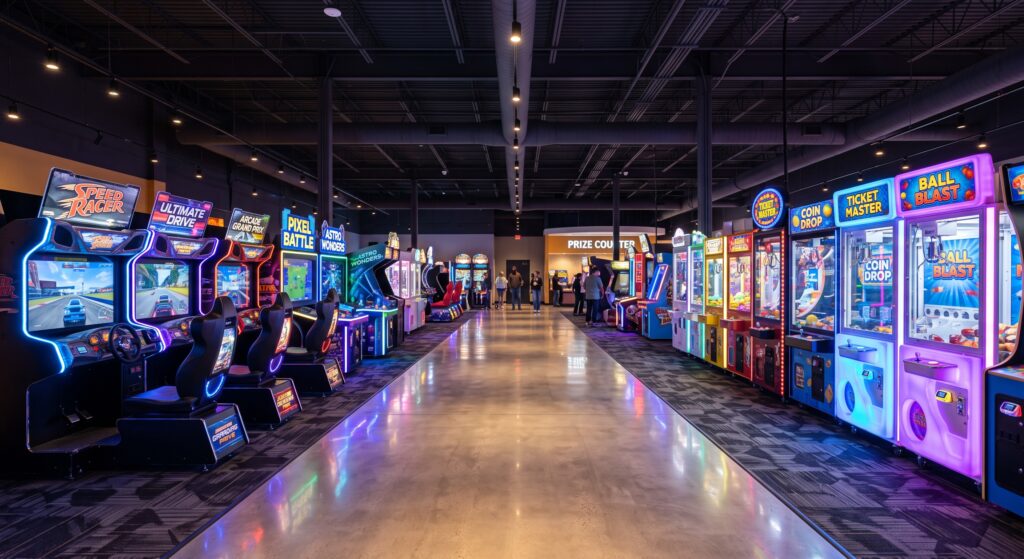
You don’t have to own every machine. A route operator can place and maintain its own games in your venue in exchange for a share of what they earn. Arcade Heroes (2014) lists splits owners will generally run into as 50/50, 60/40, 65/35 or 80/20, notes that they tend to favor the operator, who buys and maintains the games, and stresses that the real number depends on the operator you work with.
| Factor | Buying Your Games | Revenue Sharing With an Operator |
|---|---|---|
| Upfront cost | High: you pay for every machine | Low: the operator supplies the games |
| Revenue | All of it is yours | Split with the operator |
| Maintenance | Your responsibility | Usually the operator’s; check how fast they respond |
| Which games you run | Your choice | Negotiated with the operator |
Read any operator agreement closely: who pays for repairs, how fast they come out, how revenue is counted and how you can exit. You can also run a mix: owned games for the core floor and operator games to test new titles without buying them.
Step 5: Write Your Arcade Business Plan
An arcade business plan follows the traditional format described by the U.S. Small Business Administration, which lenders and investors commonly request; our family entertainment center guide walks through all eight sections. For an arcade, three of them carry most of the weight:
- Service or product line: your model from Step 1, the game mix, credit and pass pricing, prizes, parties and food.
- Funding request: the game list with prices, the build-out, the payment system and working capital, line by line. If part of the floor is on revenue share, say so; it lowers what you need to borrow.
- Financial projections: plays or credit sales per game per day, weekdays separate from weekends, and maintenance and prize costs as their own lines.
Dave & Buster’s offers a rare public benchmark. In its most recent annual report, entertainment was 62.9% of revenue, and the cost of entertainment was 8.1% of entertainment revenue, against 24.8% for food and beverage. These are cost-of-sales ratios from a large chain, not profit margins and not a forecast for a small arcade. They suggest that, once the games are bought, play revenue carries a lower cost of sales than food and drink.
Step 6: Get Your Licenses, Permits and Zoning
Requirements depend on your city and state, so confirm the list with your local licensing office and an attorney. Items to check:
- A business structure and, if yours requires one, an EIN. The IRS issues Employer Identification Numbers online for free and says you never have to pay a fee for one.
- A local business license and, where your city requires it, an occupancy certificate or placard.
- Zoning approval. The SBA warns that zoning ordinances can restrict or entirely ban specific kinds of businesses in an area, so confirm your use before you sign a lease.
- Food and liquor licenses if you serve them.
- An amusement license, in cities that have one.
Chicago shows how involved the last one can be. The city requires a Public Place of Amusement license for arcades.
The process includes a fingerprint-based background check for every controlling person, inspections by the city’s licensing, buildings and fire departments, written notice to the local alderman and to registered voters within 250 feet, who have 35 days to object, and a license fee of $770 to $13,200 based on occupancy, plus a $40 processing fee per person fingerprinted. The license runs for two years, and amusement businesses may also owe the Chicago Amusement Tax. Locations within 125 feet of certain residential districts aren’t allowed unless a distance reduction is granted. Other cities differ, but the lesson holds: ask about amusement licensing before you choose the site.
Step 7: Set Up How Guests Pay (Card System, POS and Software)
If you choose a card or wristband model, the payment system is the backbone of the arcade. Guests load credits at a kiosk or counter, play with a tap, and every play is recorded. Card-system vendor AmusementConnect says that upgrading an arcade to a game card system can give a 20% boost in sales. That’s the vendor’s own figure, and we couldn’t verify it independently. What a card system changes day to day is easier to see: no coins to count, bonus packages you can offer on larger loads, and usage data on which games get played.
The card system then has to connect to everything else: the point of sale, food and drinks, party bookings and your customer list. That’s where an arcade either runs one connected system or reconciles several. Our guides to arcade POS systems and arcade management software compare the options.
Disclosure: BMI Leisure makes venue management software that connects to card systems including Sacoa, Intercard and AmusementConnect. Guests buy and reload credits through online booking, the POS or self-service kiosks, and the same credits can pay for food and drinks. At Elev8 Fun, a family entertainment center operator that runs BMI alongside Intercard’s cashless system, self-serve kiosks that handle guest registration and waivers brought the ratio of employees to kiosks to 1 to 4, according to our case study.
Opening an Arcade?
Tell us about your concept and your card system. We’ll show you how credits, kiosks, POS, parties and food can run as one system, and what your counter needs for a busy Saturday.
Talk to Our TeamFrequently Asked Questions
How much does it cost to start an arcade?
The games are a major line. One Florida distributor lists eight new Raw Thrills games, all on pre-order, from $6,495 to $20,995, with three racing titles at $10,995. As an illustration, 30 new games at about $11,000 each would be about $330,000 before freight, taxes, the building work, the card system, prizes, furniture and working capital. Fewer machines, used games or a revenue-sharing deal with an operator can lower the upfront cost.
Are arcades profitable?
Some are, but there is no verified profit figure for small arcades. The one public benchmark is Dave & Buster’s, where the cost of entertainment was 8.1% of entertainment revenue, against 24.8% for food and beverage; that is a cost-of-sales ratio for a large chain, not a profit margin. Rent, staff, maintenance, prizes and the cost of the games themselves decide whether yours makes money.
What license do you need to open an arcade?
It depends on your city and state. Common items to check are business registration, an EIN (free from the IRS, if your structure requires one), a local business license, zoning approval, an occupancy certificate and, if you serve them, food and liquor licenses. Some cities add an amusement license: Chicago, for example, requires a Public Place of Amusement license for arcades, with background checks, inspections and a license fee of $770 to $13,200 based on occupancy.
How much space do you need per arcade game?
Arcade manufacturer Neofuns suggests planning about 50 square feet per game and leaving at least two to four feet open in front of each machine for players. It doesn’t say whether that includes aisles, so plan the prize counter, card kiosks, seating and any food service separately.
Should I buy arcade games or use a revenue-sharing operator?
Buying costs more upfront but keeps all of the game revenue and every decision about which games you run. A route operator places and maintains its own games in exchange for a share of the revenue; the industry blog Arcade Heroes (2014) lists splits such as 50/50, 60/40, 65/35 or 80/20, but the real split depends on the operator, so ask which side gets which share and get it in writing. A mix is also possible: owned games for the core floor and operator games to test new titles.
Sources
- Little Shop of Games — Raw Thrills arcade games, listed prices (Big Buck HD Reloaded Panorama $6,495 to Halo: Fireteam Raven 4-player tethered $20,995; several titles listed as pre-order). littleshopofgames.com — verified October 1, 2026.
- Arcade Heroes — So You Want To Open Up An Arcade: What About “Profit-Sharing”?, December 9, 2014 (average new video game about $7,500, excluding freight and taxes; older games need more maintenance; splits of 50/50, 60/40, 65/35 or 80/20). arcadeheroes.com — verified October 1, 2026.
- Neofuns — How to Start an Arcade Business (about 50 square feet per game; a minimum of two to four feet open in front). neofuns.com — verified October 1, 2026.
- U.S. Small Business Administration — Write your business plan (traditional plan sections) and Apply for licenses and permits (local zoning ordinances). sba.gov and sba.gov — verified October 1, 2026.
- Internal Revenue Service — Get an employer identification number (“You never have to pay a fee for an EIN”). irs.gov — verified October 1, 2026.
- City of Chicago — Public Place of Amusement license (arcades included; background checks; inspections; neighbor notice; $770–$13,200 based on occupancy). chicago.gov — verified October 1, 2026.
- Dave & Buster’s Entertainment, Inc. — Form 10-K for the fiscal year ended February 3, 2026 (revenue mix; cost of entertainment and of food and beverage; game credit sales channels). sec.gov — verified September 23, 2026.
- AmusementConnect — Why a Cashless Card System (vendor claim: “a 20% boost in sales”). amusementconnect.com — verified October 1, 2026.
- BMI Leisure — Arcade integrations feature highlight and Elev8 Fun case study (Sacoa, Intercard and AmusementConnect support; at Elev8 Fun, an FEC operator, an employee-to-kiosk ratio of 1:4 with kiosks handling registration and waivers). bmileisure.com — verified October 1, 2026.
Game prices are one distributor’s listed pre-order prices on the date checked and change often; get quotes from several distributors. Revenue-share splits depend on the operator. Licensing rules vary by city and state; Chicago is shown as an example only. Dave & Buster’s figures describe a large public chain and are a reference point, not a forecast. This guide is general information, not financial or legal advice. BMI Leisure is the publisher and sells venue management software to arcades, disclosed above. Last updated: October 1, 2026.